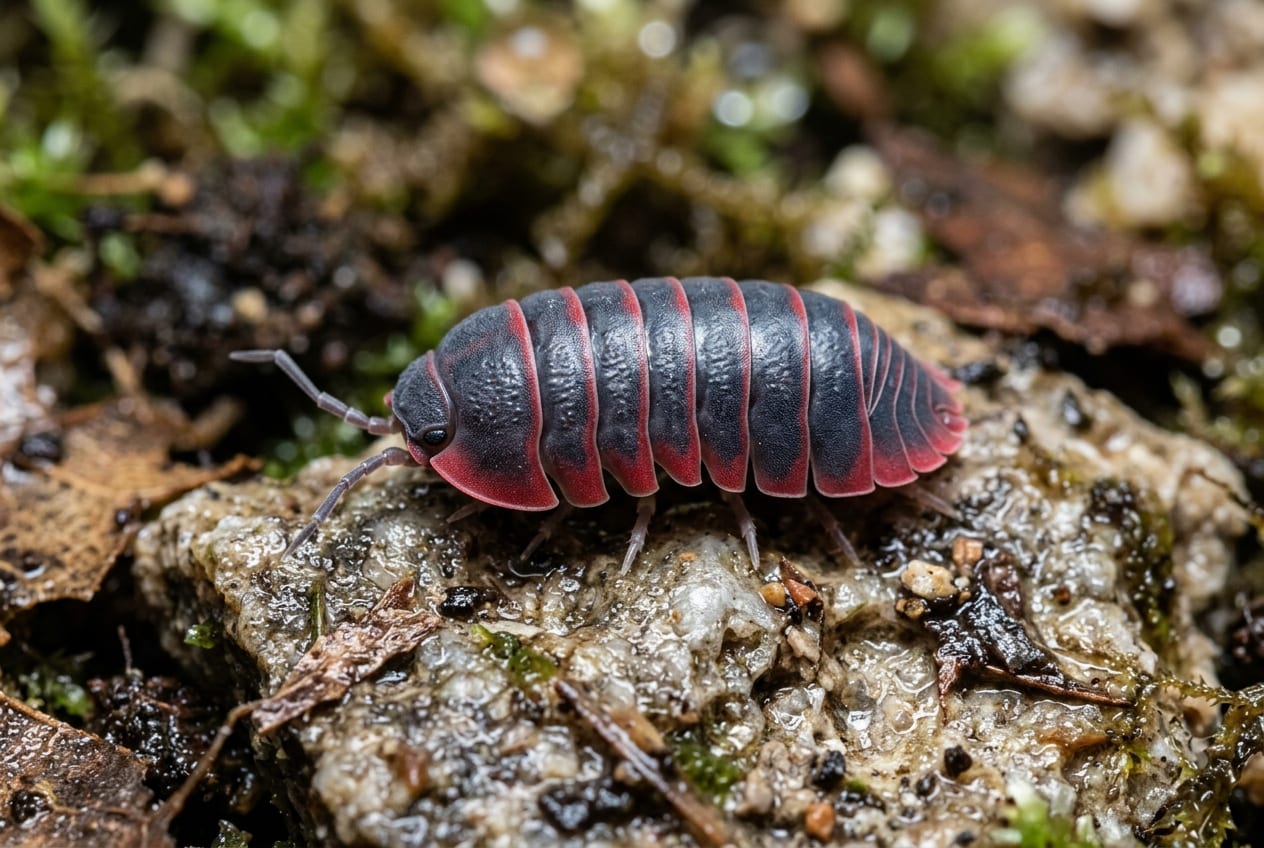
Red Edge Isopod
The Red Edge Isopod is an undescribed Cubaris species from limestone caves in Thailand, prized for its striking contrast: a body of dark blue-gray to near-black segments outlined from head to tail in vivid red. Among cave-dwelling Cubaris, it stands out as one of the more colorful options. Calm and unobtrusive, it spends its time breaking down leaf litter and decaying wood, quietly doing cleanup duty in a bioactive setup, and colonies tend to grow steadily once established. Care is considered intermediate-level, since replicating its cave-like humidity and temperature takes a bit of experience, but that effort pays off in a genuinely eye-catching species.
View Red Edge Isopod encyclopedia →Breeder Wanted!
List on BreederDirect and sell directly to customers nationwide!
BreederDirect's 5 Transparency Commitments
When listing Exotic Invertebrates, Breeders disclose the following. We guarantee transparency on growth stage and breeding unit.
- Real Photos
- Breeding Unit
- Generation Info
- Body Length (mm)
- Country of Origin
Browse all 286 breeds
Verified breeders wanted for Exotic Invertebrates
Breeders are signing up now ahead of launch. Subscribe to be notified when new listings go live.
Getting alerts is free with a member account. When new listings match your saved search, we'll notify you by email and in-app.
Browse other categories
Verified breeders (preview)
Are you raising exotic invertebrates?
Register as a breeder and connect with buyers directly.
Apply as a breederRed Edge Isopod key facts
- Care level
- Intermediate
- Lifespan
- 2-3 years
- Temperature
- 22〜26℃
- Humidity
- 75〜85%
- Diet
- Leaf litter and rotten wood as the base, with small amounts of vegetable and protein, plus permanent crushed limestone or cuttlebone
- Temperature & Humidity
- 22-26C and 75-85% humidity. Build a gradient with one damp end and one drier end, misting lightly two or three times a week.
- Enclosure
- Deep substrate of flake soil blended with rotted wood and topsoil; do not base it on coco coir. Add cork bark and limestone pieces for cover.
- Diet & Feeding
- Leaf litter and rotten wood are the staples. Add small amounts of vegetable and protein, and keep crushed limestone or cuttlebone permanently available.
- Temperament & Venom
- Harmless to people and conglobates when startled. Kept in groups, picking its way slowly across the leaf litter.
- Notes
- Breeding is slow, so leave the colony undisturbed rather than digging after it. A springtail culture keeps mould in check.
About Red Edge Isopod
An undescribed Cubaris isopod from Thai limestone caves, with near-black segments trimmed in vivid red from head to tail. Care is considered intermediate-level.
7 things to know before welcoming a Red Edge Isopod
1Origin & Habitat
Native to limestone caves in Thailand, this isopod is adapted to dark, consistently humid surroundings. Set up an enclosure that can hold steady high humidity to match its natural habitat.
2Coloration
Its defining feature is the vivid red edging that runs from head to tail across a body of dark blue-gray to near-black segments. The intensity of that red trim varies somewhat from individual to individual.
3Temperature & Humidity
Coming from caves, it prefers a cool, stable environment rather than heat. Dryness is its biggest enemy, so balance ventilation with measures that keep humidity from dropping too low.
4Diet & Cleanup Role
As a detritivore, it feeds on dead leaves, rotting wood, and fungal matter, doubling as a cleanup crew member in a planted enclosure. It poses little risk to living plants.
5Calcium Supplementation
Calcium plays an important role in molting and maintaining body color. Offer sources like crushed eggshell or cuttlebone so it can supplement its diet as needed.
6Colony Keeping
This species is generally kept as a group or colony rather than alone. In a calm, well-maintained setup, the population tends to grow naturally over time.
7Molting & Hiding Spots
Like other isopods, it molts in two halves rather than all at once. Right after molting its body is soft and vulnerable, so provide plenty of hiding spots for safety.
Frequently asked questions about Red Edge Isopod
- Q.Is this species suitable for beginners?
- A.Care for this species is generally considered intermediate rather than beginner-level. Because it comes from a cave habitat, some prior experience managing humidity and temperature is helpful.
- Q.Does the red edging vary between individuals?
- A.Yes, the depth and vividness of the red coloring can vary from one individual to another. Diet, especially calcium intake, and enclosure conditions can also affect how the color appears.
- Q.Can it be kept together with other isopod species?
- A.It's generally best managed as a single-species colony. Mixing different species can lead to competition or hybridization risks, so keeping species separate is recommended.
- Q.Is it okay to handle or hold them?
- A.This is a species best enjoyed through observation rather than handling. To avoid stressing them or risking an escape, it's best to let them go about their business inside the enclosure.
- Q.Are there any legal restrictions on keeping this species?
- A.It is not subject to CITES.
Learn more about Red Edge Isopod in the encyclopedia
View Red Edge Isopod encyclopedia entry →
Care difficulty, lifespan, size and diet — all basics covered.
More in this category
Can't find the one you're looking for?
Post your wishes for free and breeders with matching animals will contact you with introductions.