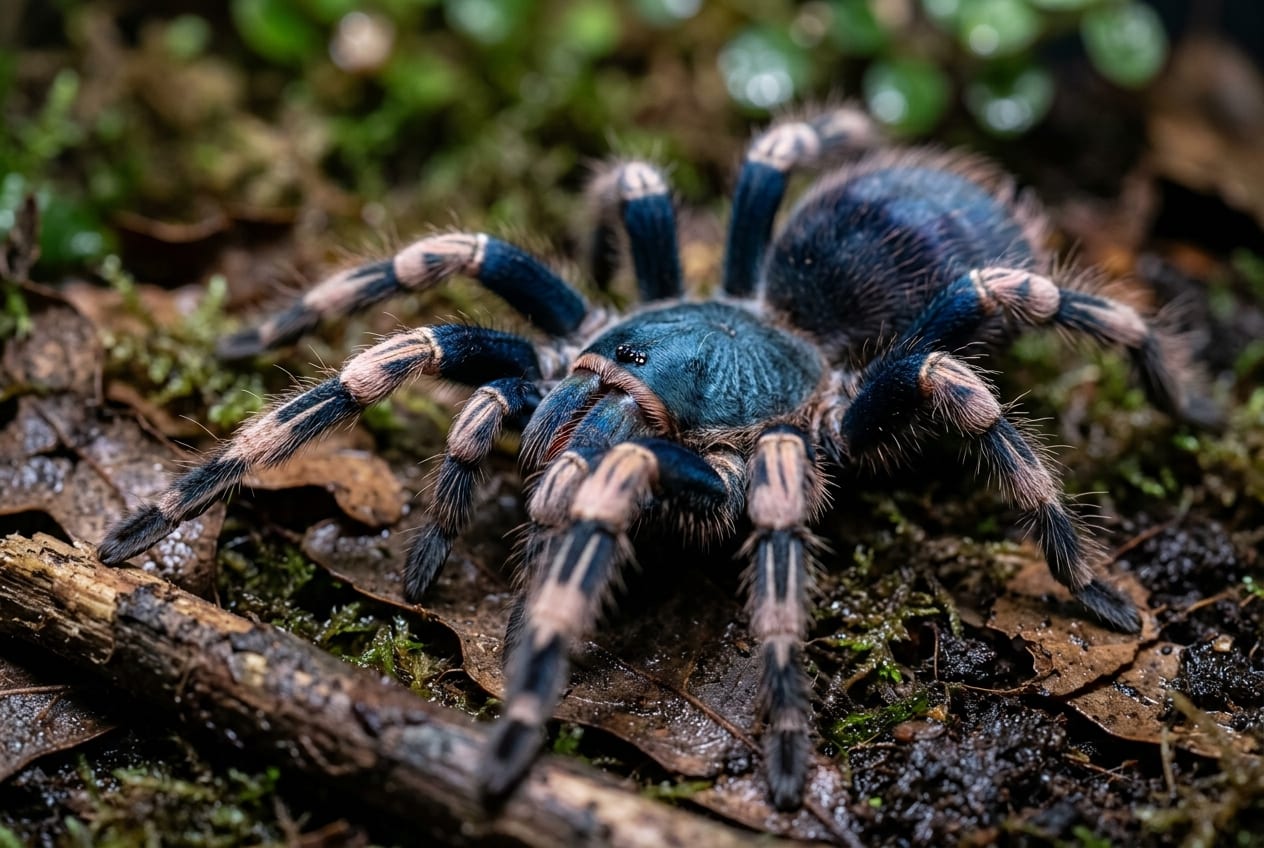
Homoeomma sp. Blue
Homoeomma sp. Blue is an undescribed species from Peru that has become a favorite among exotic invertebrate keepers for its striking color transformation. Depending on how many days have passed since its last molt, its coloration shifts from vivid blue to deep navy, while its legs carry bands of cream to pink that make the contrast even more dramatic. This is a large tarantula, with a leg span reaching up to about 20 cm, giving it real presence in any collection. Care is best suited to keepers with some prior experience, but the reward is watching this remarkable color shift unfold day by day.
View Homoeomma sp. Blue encyclopedia →0% commission on your first sales!Register by September 30, 2026 and your first 2 sales are commission-free!
Breeder Wanted!
List on BreederDirect and sell directly to customers nationwide!
5 Transparency Standards You Can Trust
When listing Exotic Invertebrates, Breeders disclose the following. We guarantee transparency on growth stage and breeding unit.
- Real Photos
- Breeding Unit
- Generation Info
- Body Length (mm)
- Country of Origin
Browse all 249 breeds
Verified breeders wanted for Exotic Invertebrates
Breeders are signing up now ahead of launch. Subscribe to be notified when new listings go live.
Getting alerts is free with a member account. When new listings match your saved search, we'll notify you by email and in-app.
Browse other categories
Verified breeders (preview)
Are you raising exotic invertebrates?
Register as a breeder and connect with buyers directly.
Apply as a breederAbout Homoeomma sp. Blue
Homoeomma sp. Blue is an undescribed Peruvian tarantula whose coloration shifts from vivid blue to deep navy after molting, with cream-to-pink banded legs. This large species reaches a leg span of about 20 cm and suits intermediate keepers.
7 things to know before welcoming a Homoeomma sp. Blue
1Color Changes Over Time
The coloration of Homoeomma sp. Blue shifts from vivid blue to deep navy depending on how long it has been since its last molt. Because the same individual can look quite different at different points in its molt cycle, daily observation becomes part of the enjoyment of keeping this species.
2Distinctive Leg Banding
The legs are marked with bands ranging from cream to pink, adding another layer of visual interest alongside the shifting body color. This distinctive look is one of the reasons the species has become so popular among enthusiasts.
3Plan for a Large Enclosure
This is a large tarantula, with a leg span reaching up to about 20 cm at maturity. Prepare a spacious enclosure with adequate floor area in advance, anticipating its eventual size.
4Best Suited to Intermediate Keepers
This species is considered suitable for intermediate-level keepers rather than complete beginners. It's a good idea to build up basic tarantula-keeping knowledge — temperature and humidity management, safe handling practices — before bringing one home.
5Limited Information as an Undescribed Species
Homoeomma sp. Blue is an undescribed species from Peru and does not yet have a formal scientific name. As a result, less husbandry and natural history information is available compared to well-established species, so keepers need to rely more on their own observation and experience.
6Set Up the Enclosure Before Arrival
Prepare the enclosure — temperature, humidity, and a hiding spot — before the tarantula arrives, rather than after. Setting things up in advance helps avoid unnecessary stress on the animal during its first days in a new home.
7Provide Deep, Burrow-Friendly Substrate
Many species in the Homoeomma genus are burrowers, and this species is thought to favor a similar substrate style. Give it a reasonably deep layer of substrate in the enclosure so it can dig and feel secure.
Frequently asked questions about Homoeomma sp. Blue
- Q.How big does Homoeomma sp. Blue get?
- A.It's a large tarantula, with a leg span reaching up to about 20 cm at full size. Beyond its size, the way its coloration shifts with each molt cycle adds another dimension to watching it grow.
- Q.Why does its color keep changing?
- A.Homoeomma sp. Blue naturally shifts in color, from vivid blue to deep navy, depending on how long it has been since its last molt. This is a normal characteristic of the species, not a sign of a problem.
- Q.Is this a good choice for a first-time tarantula keeper?
- A.This species is rated as suitable for intermediate keepers rather than complete beginners. It's best to gain some basic tarantula-keeping experience before taking one on.
- Q.Do all individuals have the banded leg pattern?
- A.Cream-to-pink banding on the legs is a characteristic feature of Homoeomma sp. Blue. Combined with its shifting body color, this banding is one of the key traits used to identify the species.
- Q.Are there any legal restrictions to be aware of?
- A.Homoeomma sp. Blue is not subject to CITES.
Learn more about Homoeomma sp. Blue in the encyclopedia
View Homoeomma sp. Blue encyclopedia entry →
Care difficulty, lifespan, size and diet — all basics covered.
More in this category
Can't find the one you're looking for?
Post your wishes for free and breeders with matching animals will contact you with introductions.