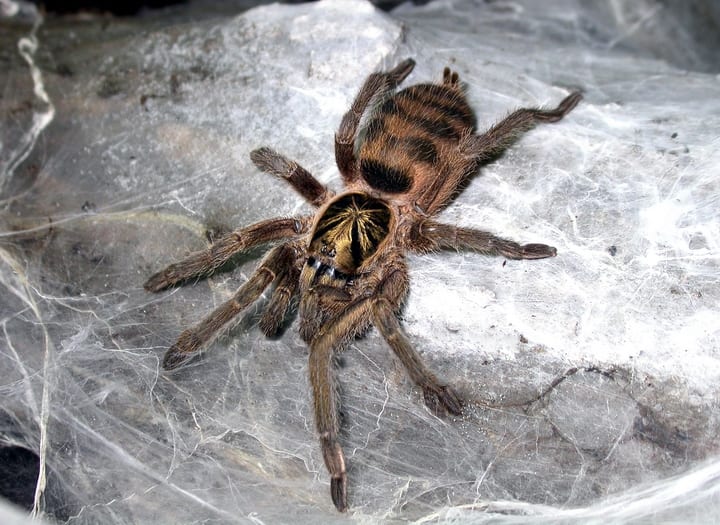
 © Www.universoaracnido.com / CC BY-SA 2.5
Trinidad Olive
The Trinidad Olive is a small tarantula native to Trinidad, prized for the striking contrast between its golden carapace and banded abdomen. With a legspan of about 5 to 8 cm, it stays compact and spends much of its time burrowed underground behind a thick web. Its calm temperament and easy care requirements make it a popular choice for beginners. Unusually for a tarantula, this species can sometimes be kept communally, with multiple individuals sharing the same enclosure. Lifespan varies by sex — females can live up to about 7 years, while males typically live around 2 — so those wanting a long-term companion should choose a female.
View Trinidad Olive encyclopedia →0% commission on your first sales!Register by September 30, 2026 and your first 2 sales are commission-free!
Breeder Wanted!
List on BreederDirect and sell directly to customers nationwide!
5 Transparency Standards You Can Trust
When listing Exotic Invertebrates, Breeders disclose the following. We guarantee transparency on growth stage and breeding unit.
- Real Photos
- Breeding Unit
- Generation Info
- Body Length (mm)
- Country of Origin
Browse all 249 breeds
Verified breeders wanted for Exotic Invertebrates
Breeders are signing up now ahead of launch. Subscribe to be notified when new listings go live.
Getting alerts is free with a member account. When new listings match your saved search, we'll notify you by email and in-app.
Browse other categories
Verified breeders (preview)
Are you raising exotic invertebrates?
Register as a breeder and connect with buyers directly.
Apply as a breederTrinidad Olive key facts
- Care level
- Beginner-friendly
- Lifespan
- Females up to about 7 years, males about 2 years
- Size
- 5-8cm leg span
- Temperature
- 22〜26℃
- Humidity
- 70〜80%
- Diet
- Live insects such as small crickets and roaches
- Temperature & Humidity
- Keep around 22-26 C and roughly 70-80% humidity, with a permanent water dish and one damp corner of substrate. Ventilate well to prevent mould.
- Enclosure
- Fossorial and a heavy webber: give ample substrate and add cork bark as web anchors, and leave the webbing it builds undisturbed.
- Diet & Feeding
- Offer small crickets and roaches. In a communal setup, feed enough to reach every animal: avoiding hunger is the key to preventing cannibalism.
- Temperament & Venom
- Not defensive but very fast. It has no urticating hairs, and its venom is regarded as mild although no research confirms this.
- Notes
- It is one of the few species that tolerates communal housing, but the risk of cannibalism remains. Never let feeding lapse, especially when an animal has just moulted.
About Trinidad Olive
A guide to the Trinidad Olive dwarf tarantula from Trinidad — its appearance, temperament, and lifespan (up to 7 years for females, about 2 for males) — written for beginners.
7 things to know before welcoming a Trinidad Olive
1Deep Substrate for Burrowing
This species burrows into the ground, so provide an enclosure with deep substrate. A thick substrate layer helps it feel secure enough to dig a proper burrow.
2Heavy Webbing Habits
It spins dense, heavy webbing around its burrow entrance as a retreat. Keep layout changes and cleaning to a minimum so you don't disturb this webwork.
3Communal Housing Is Possible
Unlike most tarantulas, the Trinidad Olive is known for tolerating multiple individuals in the same enclosure. That said, keeping a single specimen works just as well, and communal housing is not required.
4Calm but Shy Temperament
This species spends much of its time hidden in its burrow or web, so it isn't often seen out in the open. When startled, it can move quickly to retreat back into hiding.
5Beginner-Friendly Care
The Trinidad Olive tolerates a reasonably wide range of temperature and humidity, making it manageable for first-time tarantula keepers. Sticking to a basic setup and a regular feeding routine should keep husbandry straightforward.
6Lifespan Differs by Sex
Females can live up to about 7 years, while males typically live only around 2 — a significant difference in lifespan between the sexes. If you want a long-term companion, it's worth confirming the sex before bringing one home.
7Prepare Supplies in Advance
Set up a fossorial-style enclosure in advance, with deep substrate, a hide, and a water dish. The spider will likely stay hidden for a while after arrival, so give it time to settle into its new environment.
Frequently asked questions about Trinidad Olive
- Q.Is the Trinidad Olive suitable for beginners?
- A.Yes, it's generally considered a beginner-friendly species. Setting up a basic fossorial-style enclosure and keeping up with temperature, humidity, and regular feeding is enough to care for it well.
- Q.How big does it get?
- A.Adults have a legspan of about 5 to 8 cm. It's classified as a dwarf species among tarantulas.
- Q.Can multiple individuals be housed together?
- A.Unusually for a tarantula, this species is known for tolerating group housing in the same enclosure. That said, single housing works fine too, and communal setups are not required.
- Q.How long does it live?
- A.Females can live up to about 7 years, while males live around 2 years. Keep in mind that lifespan differs significantly between the sexes.
- Q.Is its temperament calm and easy to handle?
- A.It spends much of its time hidden away and isn't often visible. Since it can move quickly to flee when startled, it's best enjoyed through observation rather than handling.
Learn more about Trinidad Olive in the encyclopedia
View Trinidad Olive encyclopedia entry →
Care difficulty, lifespan, size and diet — all basics covered.
More in this category
Can't find the one you're looking for?
Post your wishes for free and breeders with matching animals will contact you with introductions.