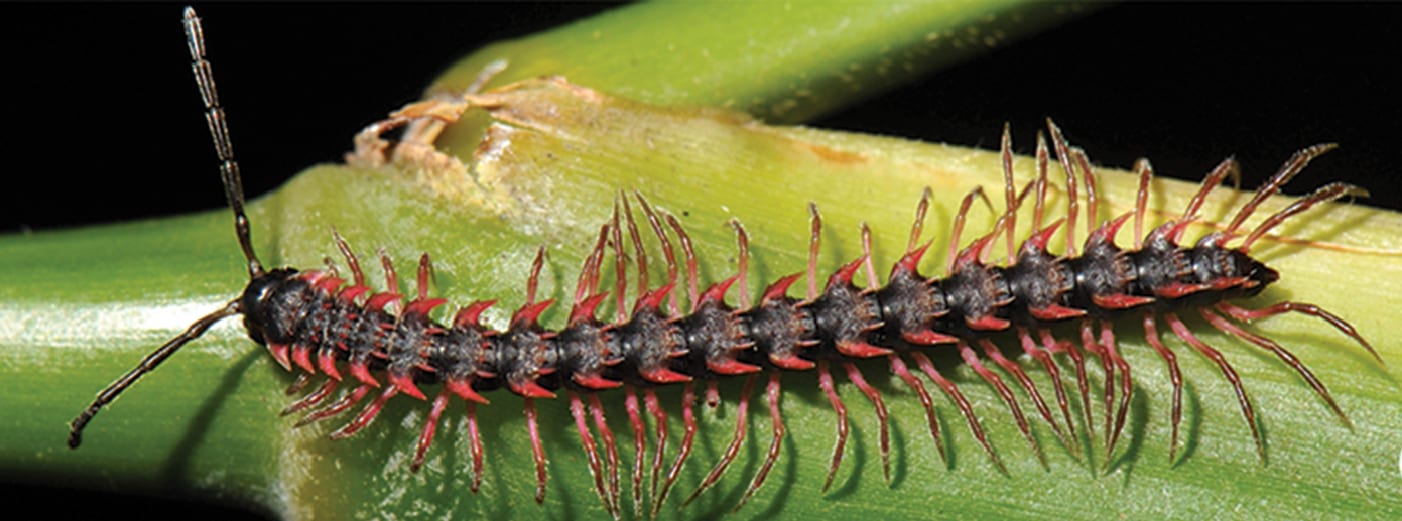
 © Ruttapon Srisonchai, Henrik Enghoff, Natdanai Likhitrakarn, Somsak Panha / CC BY 4.0
Pink Dragon Millipede
The Pink Dragon Millipede is a small millipede species known for the horn-like lateral projections extending from each body segment. These projections and legs take on pink-to-red hues, giving the animal a striking, dragon-like silhouette that has made it popular among keepers of unusual invertebrates. Its temperament is generally calm and slow-moving, spending most of its time in soil or decaying wood. Like other members of the Polydesmida order, it secretes hydrogen cyanide as a defense mechanism, so it should never be handled with bare hands. Coloration can vary by locality, with some populations showing darker tones, adding another point of interest for keepers. This species is considered suitable for experienced keepers rather than beginners.
View Pink Dragon Millipede encyclopedia →0% commission on your first sales!Register by September 30, 2026 and your first 2 sales are commission-free!
Breeder Wanted!
List on BreederDirect and sell directly to customers nationwide!
5 Transparency Standards You Can Trust
When listing Exotic Invertebrates, Breeders disclose the following. We guarantee transparency on growth stage and breeding unit.
- Real Photos
- Breeding Unit
- Generation Info
- Body Length (mm)
- Country of Origin
Browse all 249 breeds
Verified breeders wanted for Exotic Invertebrates
Breeders are signing up now ahead of launch. Subscribe to be notified when new listings go live.
Getting alerts is free with a member account. When new listings match your saved search, we'll notify you by email and in-app.
Browse other categories
Verified breeders (preview)
Are you raising exotic invertebrates?
Register as a breeder and connect with buyers directly.
Apply as a breederPink Dragon Millipede key facts
- Care level
- Advanced
- Lifespan
- 1-2 years
- Size
- 3-4cm
- Temperature
- 24〜26℃
- Humidity
- 75〜85%
- Diet
- Decaying hardwood and leaf litter as the staple, consumed fast, with vegetables, fish flake or dried herbs as extras; cuttlebone stays in permanently
- Temperature & Humidity
- 24-26C and 75-85% humidity. Heat from the side rather than underneath, since ordinary room temperature is usually too low. Keep the substrate evenly damp throughout.
- Enclosure
- 8-10cm of substrate, loaded with white-rotted hardwood and topped with a thick layer of hardwood leaf litter. Ventilate so the air does not go stagnant.
- Diet & Feeding
- It works through decaying hardwood fast, so top it up before it runs out. With leaf litter this is the diet. Keep cuttlebone in permanently.
- Temperament & Venom
- As a polydesmid it releases hydrogen cyanide, but in tiny amounts; the usual sign is a faint almond smell when a group is disturbed. Handle as little as possible and never seal them in an unventilated container.
- Notes
- Short-lived and fast-growing, so start with a group and plan to breed them. Do not house them with predators. They are small and quick, so unpack them in a closed room. The vivid shocking pink dragon millipede that made headlines in 2008 as one of the year's top new species is a different animal, Desmoxytes purpurosea, not this one; buying from that image will get you the wrong species.
About Pink Dragon Millipede
The Pink Dragon Millipede is a small species whose horn-like projections turn pink to red, creating a dragon-like appearance. Calm but defensive, it secretes hydrogen cyanide, making it a species best suited to experienced keepers.
7 things to know before welcoming a Pink Dragon Millipede
1Color Deepens With Growth
Juveniles start with pale projections that gradually turn pinker and redder with each molt. Watching the color intensify as it matures is part of the appeal of keeping this species.
2Handle With Care: Hydrogen Cyanide
Like other members of its order, it secretes hydrogen cyanide as a defense. Always wash your hands after contact and avoid touching your eyes or mouth.
3Needs Humid Substrate
This species comes from humid tropical forest floors and does not tolerate dry conditions well. Keep a thick layer of moistened leaf litter or coconut fiber substrate and maintain consistent humidity.
4Nocturnal and Shy
It burrows into substrate or hides under wood during the day and becomes active at night. Providing driftwood or leaf litter for cover helps it feel secure.
5Calm but Defensive
It is not aggressive and typically curls into a coil when disturbed rather than attacking. Because of its defensive secretion, it is best enjoyed as a species to observe rather than handle.
6Best Suited to Experienced Keepers
This species is rated for advanced keepers, requiring consistent humidity and temperature management. It can be challenging for someone keeping invertebrates for the first time.
7Lifespan of 1-2 Years
Adults typically live around 1 to 2 years and reach a body length of 3 to 4 cm. Its modest adult size means it does not require a large enclosure.
Frequently asked questions about Pink Dragon Millipede
- Q.Can beginners keep a Pink Dragon Millipede?
- A.This species is rated for advanced keepers due to the humidity management it requires. It is best approached after gaining some experience with invertebrate care.
- Q.Is it safe to handle with bare hands?
- A.Like other Polydesmida millipedes, it secretes hydrogen cyanide, so direct bare-hand contact should be avoided. Always wash your hands afterward and avoid touching your eyes or mouth.
- Q.How big does it get and how long does it live?
- A.It is a small species with an adult size of about 3 to 4 cm and a lifespan of roughly 1 to 2 years. This means it does not need a particularly large enclosure.
- Q.Does coloration vary between individuals?
- A.Yes, coloration can differ by locality — some populations show vivid pink or red projections, while others have darker tones.
- Q.Is the Pink Dragon Millipede listed under CITES?
- A.No, it is not subject to CITES.
Learn more about Pink Dragon Millipede in the encyclopedia
View Pink Dragon Millipede encyclopedia entry →
Care difficulty, lifespan, size and diet — all basics covered.
More in this category
Can't find the one you're looking for?
Post your wishes for free and breeders with matching animals will contact you with introductions.