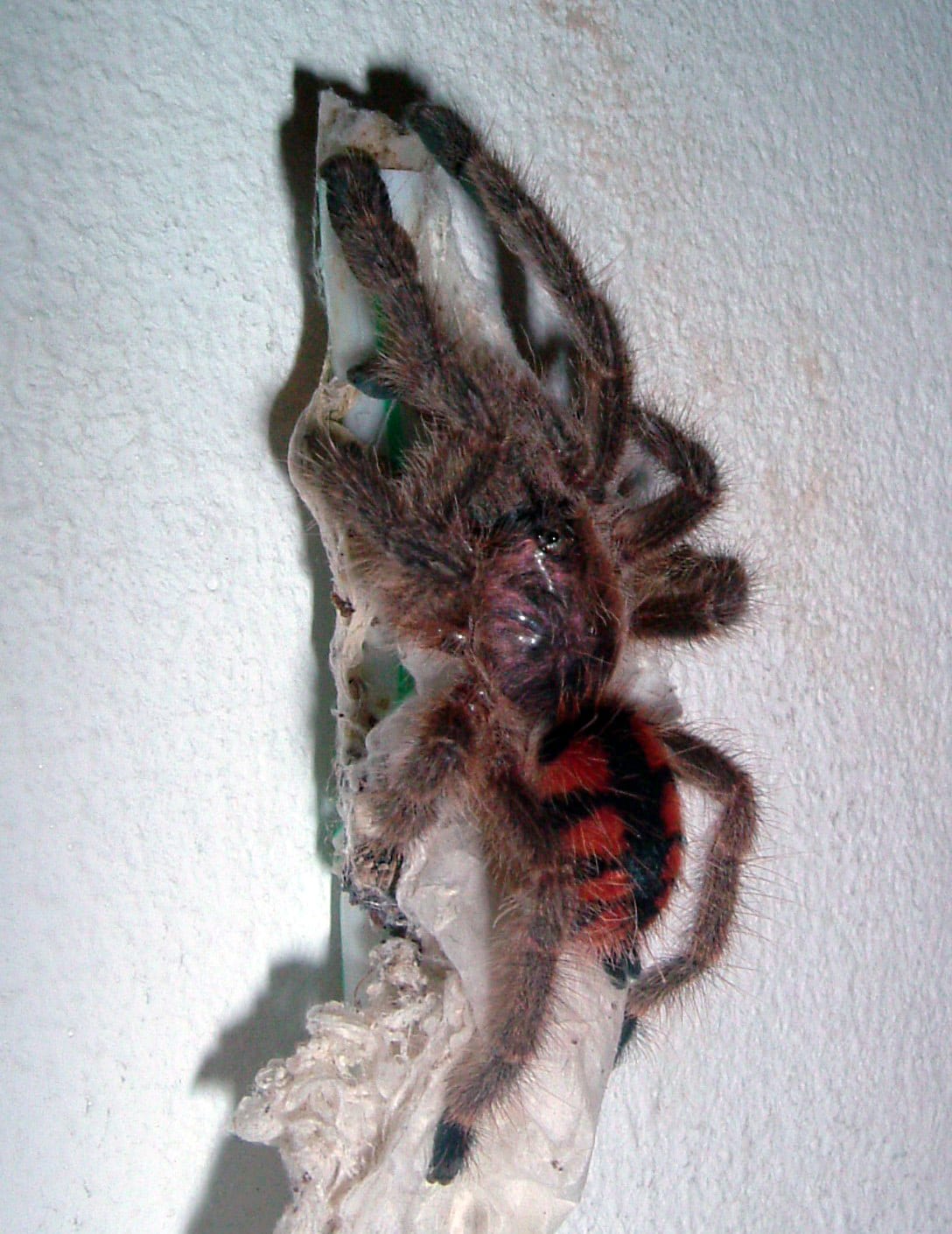
 © Viki (original), Micha L. Rieser (derivative work) / CC BY-SA 3.0
Venezuelan Red Stripe Pinktoe
The Venezuelan Red Stripe Pinktoe is the smallest arboreal tarantula in the genus Avicularia. Its reddish-brown carapace and legs are marked with pale banding at each joint, while the black abdomen displays a row of orange-red spots, giving it a striking, high-contrast appearance. This species is notably reclusive, spending much of its time tucked inside its silk retreat rather than out in the open. It can also move quickly when startled, so a calm, low-stress setup helps keep it settled. Considered suitable for intermediate keepers, it rewards those already comfortable managing humidity and vertical enclosure space for arboreal species.
View Venezuelan Red Stripe Pinktoe encyclopedia →0% commission on your first sales!Register by September 30, 2026 and your first 2 sales are commission-free!
Breeder Wanted!
List on BreederDirect and sell directly to customers nationwide!
5 Transparency Standards You Can Trust
When listing Exotic Invertebrates, Breeders disclose the following. We guarantee transparency on growth stage and breeding unit.
- Real Photos
- Breeding Unit
- Generation Info
- Body Length (mm)
- Country of Origin
Browse all 249 breeds
Verified breeders wanted for Exotic Invertebrates
Breeders are signing up now ahead of launch. Subscribe to be notified when new listings go live.
Getting alerts is free with a member account. When new listings match your saved search, we'll notify you by email and in-app.
Browse other categories
Verified breeders (preview)
Are you raising exotic invertebrates?
Register as a breeder and connect with buyers directly.
Apply as a breederVenezuelan Red Stripe Pinktoe key facts
- Care level
- Intermediate
- Lifespan
- Females 10-12 years, males 2-3 years
- Size
- Up to about 7.5cm leg span
- Temperature
- 20〜24℃
- Humidity
- 65〜75%
- Diet
- Small live insects such as crickets
- Temperature & Humidity
- 20-24 C and 65-75% humidity. Raise humidity with a large water dish rather than relying on misting, and avoid stagnant air, which quickly harms this species.
- Enclosure
- A dwarf arboreal species. Use a tall enclosure with cork bark for anchoring its web, ventilate through both the top and the sides, and keep the substrate layer shallow.
- Diet & Feeding
- Feed small live insects such as crickets. Even adults are small, so keep prey items small and remove uneaten food the next day.
- Temperament & Venom
- Docile but exceptionally skittish and fast. It flees rather than threatens, bolting into its web tunnels. It has urticating hairs but seldom uses them.
- Notes
- It tolerates company to a degree but is not communal, so keep it singly. Spiderlings are delicate and sensitive to dryness, and egg sacs produce few young.
About Venezuelan Red Stripe Pinktoe
The smallest arboreal tarantula in the Avicularia genus, with reddish-brown coloring, pale leg banding, and orange-red abdominal spots. Reclusive and best suited to intermediate keepers; females can live 10-12 years.
7 things to know before welcoming a Venezuelan Red Stripe Pinktoe
1Arboreal Cage Setup
As an arboreal species rather than a ground-dweller, this tarantula needs a taller enclosure rather than one with a large floor footprint. Provide climbing branches or cork bark so it has vertical hiding spots.
2Highly Reclusive Nature
This species is highly wary and prefers to stay hidden, often spending daytime hours tucked inside its silk retreat. Rarely seeing it out in the open is completely normal for this species.
3Quick, Skittish Movement
When startled, it can move very quickly to escape. Handle enclosure openings and maintenance calmly and deliberately to avoid creating an opportunity for it to bolt.
4Humidity Matters
Coming from tropical regions, it needs consistently adequate humidity in its enclosure. Excessive dryness can contribute to problems like incomplete molting, so balance misting with proper ventilation.
5Lifespan Differs by Sex
Females typically live around 10 to 12 years, while males tend to reach the end of their lifespan just 2 to 3 years after maturing. Keepers hoping for a long-term companion often choose females.
6Intermediate Difficulty
This species suits keepers already comfortable with arboreal or reclusive tarantulas more than first-time tarantula owners. It calls for careful enclosure setup and a willingness to work at the animal's own pace.
7Prep the Enclosure First
Set up climbing branches or cork bark hides in the enclosure before bringing your tarantula home. Having a ready hiding spot from day one helps it settle into its new environment more smoothly.
Frequently asked questions about Venezuelan Red Stripe Pinktoe
- Q.How big does this species get?
- A.Its leg span reaches roughly 7.5 cm at maximum, making it one of the smallest tarantulas in the Avicularia genus.
- Q.How long do these tarantulas live?
- A.Females typically live around 10 to 12 years, while males live only about 2 to 3 years. If you want a long-term companion, a female is the better choice.
- Q.Is it normal to rarely see it out in the open?
- A.Yes, this species is highly reclusive and tends to stay hidden inside its retreat. Not seeing it often is typical behavior, not a sign of a problem.
- Q.Can it be handled by hand?
- A.Handling isn't recommended, since it tends to move quickly and try to escape when startled. It's best kept and enjoyed as a display animal, with care given quietly to avoid startling it.
- Q.Is this species subject to CITES regulations?
- A.No, this species is not subject to CITES.
Learn more about Venezuelan Red Stripe Pinktoe in the encyclopedia
View Venezuelan Red Stripe Pinktoe encyclopedia entry →
Care difficulty, lifespan, size and diet — all basics covered.
More in this category
Can't find the one you're looking for?
Post your wishes for free and breeders with matching animals will contact you with introductions.