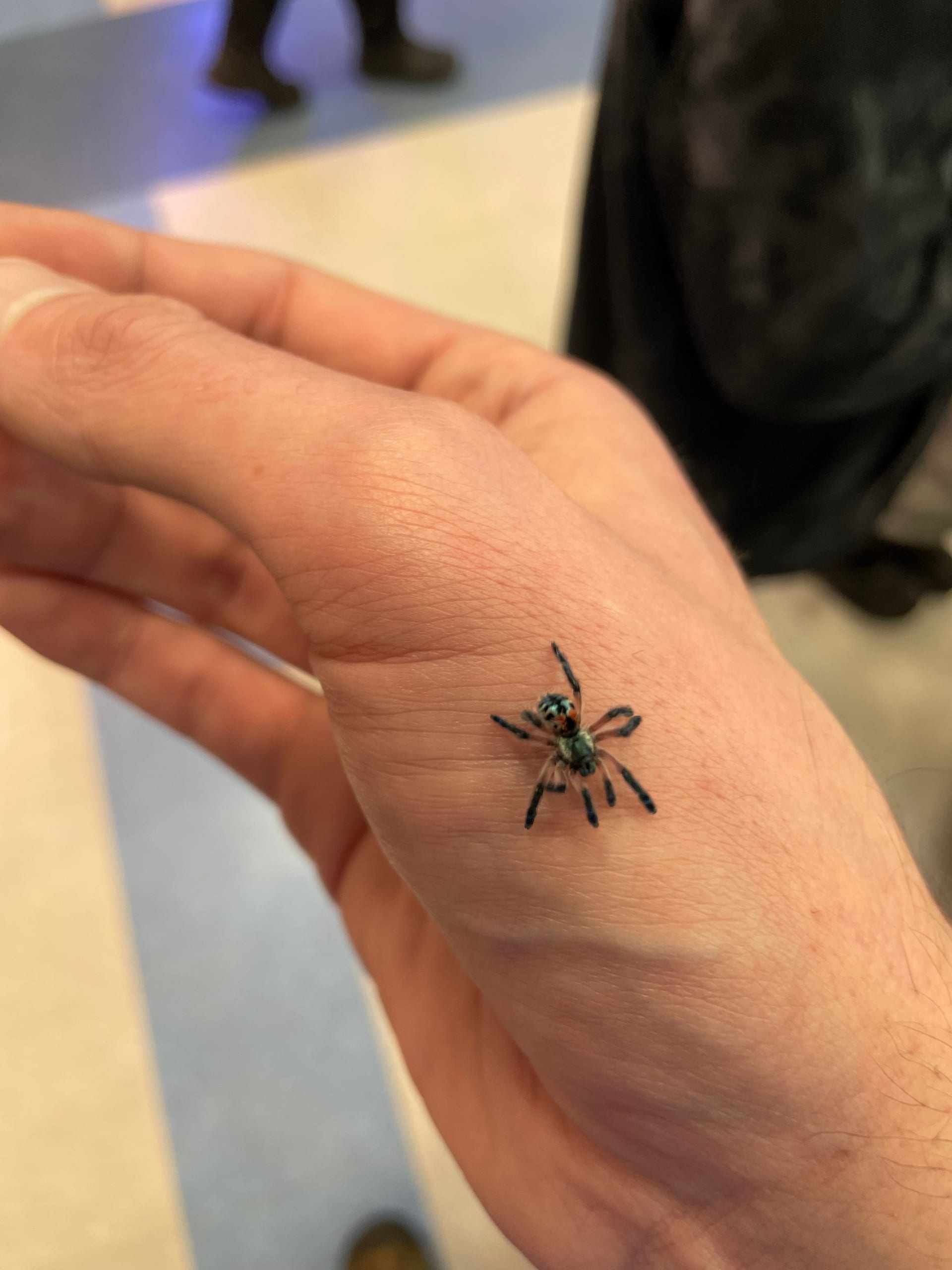
 © Fungus Guy / CC BY-SA 4.0
Brazilian Jewel Tarantula
The Brazilian Jewel tarantula (genus Typhochlaena) is a small arboreal tarantula found only in the Atlantic coastal forests of northeastern Brazil. Its name comes from a striking color combination — a greenish carapace paired with a jet-black abdomen marked by rows of yellow and red spots. Its most distinctive trait is an unusual habit of spinning a silk "door" over a crevice in tree bark and retreating behind it to hide. Adults stay small, with males reaching about 9.5-12.5mm and females up to around 21mm in body length, and many individuals are fast-moving and easily startled. Because of its delicate size and the careful humidity balance it needs, this species is generally recommended for experienced keepers.
View Brazilian Jewel Tarantula encyclopedia →Breeder Wanted!
List on BreederDirect and sell directly to customers nationwide!
BreederDirect's 5 Transparency Commitments
When listing Exotic Invertebrates, Breeders disclose the following. We guarantee transparency on growth stage and breeding unit.
- Real Photos
- Breeding Unit
- Generation Info
- Body Length (mm)
- Country of Origin
Browse all 286 breeds
Verified breeders wanted for Exotic Invertebrates
Breeders are signing up now ahead of launch. Subscribe to be notified when new listings go live.
Getting alerts is free with a member account. When new listings match your saved search, we'll notify you by email and in-app.
Browse other categories
Verified breeders (preview)
Are you raising exotic invertebrates?
Register as a breeder and connect with buyers directly.
Apply as a breederBrazilian Jewel Tarantula key facts
- Care level
- Advanced
- Lifespan
- Females 15-18 years / males 3-5 years
- Size
- Body length: males 9.5-12.5mm, females up to 21mm
- Humidity
- High
- Diet
- Small flying insects, cockroaches and crickets
- Temperature & Humidity
- Its habitat is humid forest in northeastern Brazil, so the enclosure should not be allowed to dry out.
- Enclosure
- Arboreal, building a trapdoor retreat in bark crevices. Use a tall enclosure with cork bark and a thin layer of lightly moist substrate, and never break open the retreat once built.
- Diet & Feeding
- It ambushes small insects passing the entrance. Feed spiderlings twice a week on flightless fruit flies or small roach nymphs, juveniles every 7-10 days, and adults every 2-3 weeks.
- Temperament & Venom
- A small, timid New World species with type II urticating hairs. It is not aggressive and hides behind its trapdoor when threatened.
- Notes
- Small and delicate, with limited availability. Brazil's 1999 Environmental Crimes Law prohibits keeping, trading or exporting wildlife without authorisation, so the provenance of traded animals matters. Pterinopelma sazimai is also traded as the Brazilian jewel but is a different species; this one is the small arboreal spider, so check for the name Typhochlaena seladonia.
About Brazilian Jewel Tarantula
The Brazilian Jewel tarantula is a small arboreal species native to Brazil, known for spinning a silk trapdoor over bark crevices and its striking green-and-black coloring with yellow and red spots. An advanced-keeper species.
7 things to know before welcoming a Brazilian Jewel Tarantula
1An advanced-keeper species
Brazilian Jewel tarantulas are small and sensitive to dehydration and sudden environmental changes, which is why they're considered an advanced-keeper species. It helps to have solid tarantula-keeping fundamentals before bringing one home.
2Builds a trapdoor-like nest
In the wild, this species spins a silk "door" over a crevice in tree bark and lives concealed just inside it — an unusual trapdoor-like habit. Providing cork bark with a suitable gap in captivity helps replicate this natural behavior.
3Striking green-and-black coloring
The greenish carapace contrasts strikingly with the black abdomen marked by rows of yellow and red spots, making this a visually striking species to observe. The exact pattern of the spots varies from individual to individual.
4A compact body size
Adults stay small even at full size — males reach about 9.5-12.5mm and females up to around 21mm in body length — making this one of the more compact tarantula species. Because of their size, they can escape through surprisingly small gaps, so enclosure security matters.
5Fast and easily startled
Many individuals are fast-moving and easily startled by noise or vibration, so handling isn't recommended. It's best enjoyed as a species to observe rather than handle.
6Balancing humidity and airflow
As a small arboreal species, too little humidity risks dehydration, while too much can lead to mold or poor air circulation. Finding the right balance of misting and ventilation is an ongoing part of keeping this species.
7Extra care for juveniles
Juveniles are even more vulnerable to environmental swings and dehydration than adults, especially around molting. Extra care and attention are warranted when keeping young specimens.
Frequently asked questions about Brazilian Jewel Tarantula
- Q.Is this species suitable for beginners?
- A.Because of its small size and sensitivity to environmental changes, the Brazilian Jewel tarantula is considered an advanced-keeper species. It's best to gain some tarantula-keeping experience before bringing one home.
- Q.Can it be handled?
- A.Many individuals are fast and easily startled, so handling is not recommended. It's better enjoyed as a species to observe, both to avoid stress to the spider and the risk of a fall.
- Q.Why does it build a trapdoor-like nest?
- A.In the wild, it spins a silk door over a crevice in tree bark, which is thought to help it hide from predators and ambush prey. In captivity, providing cork bark with a similar gap lets you observe this behavior.
- Q.How big does it get?
- A.Adults are small — males reach about 9.5-12.5mm and females up to around 21mm in body length — making this one of the more compact tarantula species. The enclosure can be compact too, though care is needed to prevent escapes through small gaps.
- Q.Is this species regulated under CITES?
- A.The Brazilian Jewel tarantula is not subject to CITES. It's still worth checking the listing details when considering a purchase.
Learn more about Brazilian Jewel Tarantula in the encyclopedia
View Brazilian Jewel Tarantula encyclopedia entry →
Care difficulty, lifespan, size and diet — all basics covered.
More in this category
Can't find the one you're looking for?
Post your wishes for free and breeders with matching animals will contact you with introductions.