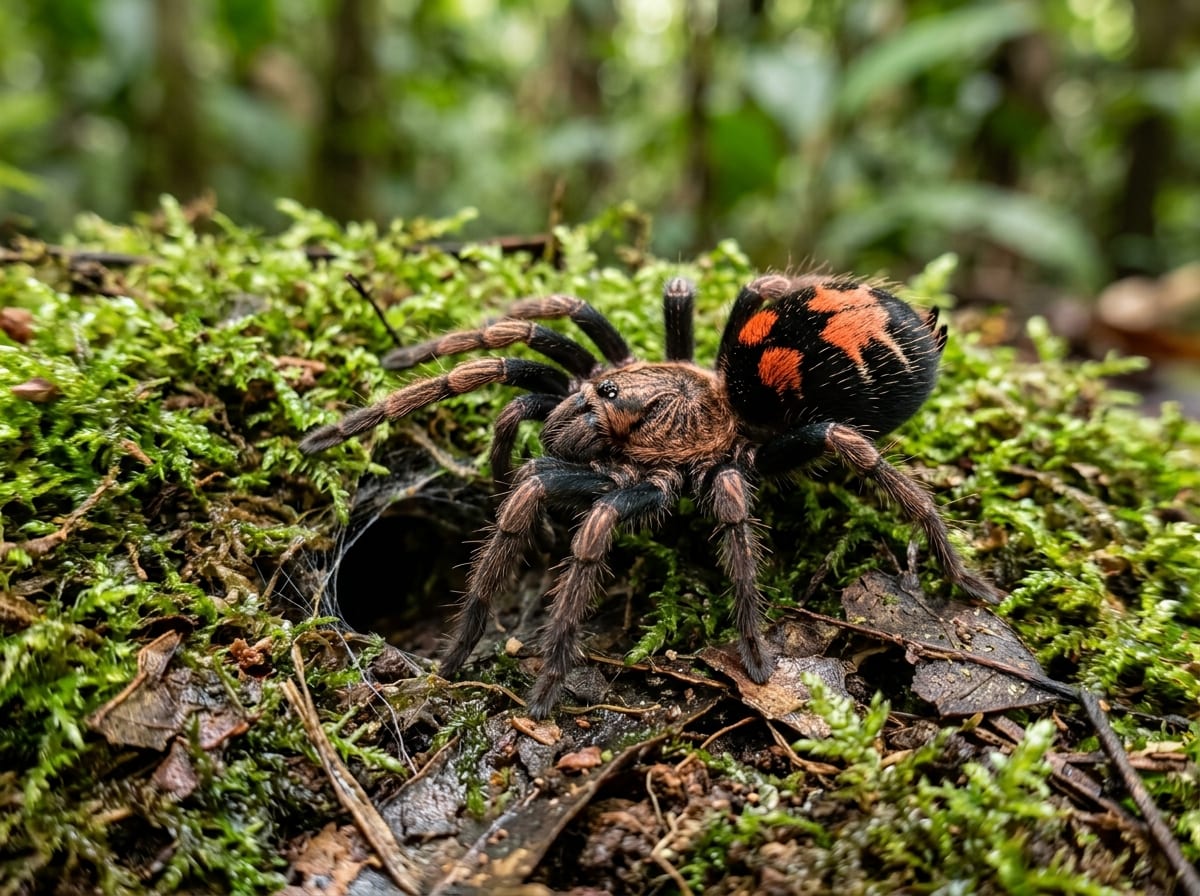
Peruvian dwarf beauty
The Peruvian dwarf beauty is a small tarantula from the genus Cyriocosmus, native to South America. The genus as a whole ranges from small to medium in size, so an enclosure does not need to take up much room. Despite the name, scientific records come only from Brazil and Bolivia, not Peru. It defends itself with Type III urticating hairs, so handle enclosure maintenance with care. It is rated as suited to intermediate keepers, and little is published about adult size and lifespan, so it is worth asking the breeder about the individual before you commit.
View Peruvian dwarf beauty encyclopedia →0% commission on your first sales!Register by September 30, 2026 and your first 2 sales are commission-free!
Breeder Wanted!
List on BreederDirect and sell directly to customers nationwide!
BreederDirect's 5 Transparency Commitments
When listing Exotic Invertebrates, Breeders disclose the following. We guarantee transparency on growth stage and breeding unit.
- Real Photos
- Breeding Unit
- Generation Info
- Body Length (mm)
- Country of Origin
Browse all 286 breeds
Verified breeders wanted for Exotic Invertebrates
Breeders are signing up now ahead of launch. Subscribe to be notified when new listings go live.
Getting alerts is free with a member account. When new listings match your saved search, we'll notify you by email and in-app.
Browse other categories
Verified breeders (preview)
Are you raising exotic invertebrates?
Register as a breeder and connect with buyers directly.
Apply as a breederPeruvian dwarf beauty key facts
- Care level
- Intermediate
- Lifespan
- Little data (congener C. elegans: females up to 7 years, males about 2)
- Size
- Little data (a small-bodied genus)
- Diet
- Carnivorous (live insects such as crickets and roaches)
- Enclosure
- A small terrestrial burrower. Use a small enclosure with ample room relative to its leg span, with deep substrate, a hide and a small water dish.
- Temperature & Humidity
- Species data are scarce. Care information for C. elegans gives 20-24 C, with moist lower substrate and a drier surface.
- Diet & Feeding
- Being small, it needs small crickets or roach nymphs. Remove uneaten prey and wait a few days after a moult.
- Temperament & Venom
- All Cyriocosmus carry type III urticating setae; C. elegans relies more on speed than setae for defence. Keep setae away from eyes and skin.
- Notes
- The trade name does not match the recorded range and other Cyriocosmus may be sold under it; confirm the scientific name and origin. Small and fast, it escapes easily — never release captive animals.
About Peruvian dwarf beauty
Peruvian dwarf beauty: a small Cyriocosmus tarantula recorded only from Brazil and Bolivia despite its name. Intermediate level; what to know first.
7 things to know before welcoming a Peruvian dwarf beauty
1Name vs. origin
Although sold under a Peruvian name, its scientific records are limited to Brazil and Bolivia. Because the name is a poor guide to origin, it is worth asking the breeder about the individual's background before you decide.
2Intermediate difficulty
Its difficulty is rated for intermediate keepers, so it suits people already comfortable with basic tarantula care. Small species can be quick depending on the individual, and escapes during maintenance do happen. Open the lid slowly and work in a calm, uncluttered space.
3A small-bodied genus
The genus as a whole is small to medium, and its members tend to be manageable in compact enclosures. Data on this species' adult size is scarce, though, so avoid assuming a figure and ask the breeder about the individual's size and growth stage.
4Lifespan and sex
Lifespan data for this species itself is scarce. In the related C. elegans, females live up to 7 years and males about 2 years, so the sexes may differ here too. Sexing juveniles can be difficult, so ask the breeder what is known about the individual.
5Urticating hairs
This genus carries Type III urticating hairs for defense. Contact with the skin or eyes can cause itching or irritation, so use tweezers or similar tools during cleaning and feeding, and wash your hands afterward.
6Setting up the enclosure
Members of this genus are often ground dwellers, and a shelter plus a substrate they can dig into helps them settle. Keep the enclosure neither too dry nor too damp, and choose a container with a tightly fitting lid.
7Feeding and molting
Feed appropriately sized prey such as small crickets. Appetite often drops before a molt, and leftover prey can harm a molting spider, so remove uneaten food promptly. Asking the breeder about the last molt date and current diet also makes the move to a new enclosure smoother.
Frequently asked questions about Peruvian dwarf beauty
- Q.Can a beginner keep one?
- A.It is rated as suited to intermediate keepers. It is safer to gain some basic tarantula experience first. If this would be your first, talk to the breeder about the setup and feeding.
- Q.How long does it live?
- A.Lifespan data for this species itself is scarce. In the related C. elegans, females live up to 7 years and males about 2 years. The sexes may differ, so knowing the individual's sex is a useful guide.
- Q.Is it not from Peru?
- A.Although the trade name mentions Peru, scientific records are limited to Brazil and Bolivia. Do not rely on the name alone for origin, and ask the breeder about the individual's background.
- Q.How large does it grow?
- A.The genus is small to medium overall, but data on this species' adult size is scarce, so no specific figure can be given. It tends to fit in compact enclosures, but ask the breeder about the individual's size and growth stage.
- Q.Do I need to watch for urticating hairs?
- A.It has Type III urticating hairs, and contact can cause itching or irritation. During routine care, avoid touching it unnecessarily, use tweezers or similar tools, and wash your hands afterward. If symptoms concern you, consult a medical professional.
Learn more about Peruvian dwarf beauty in the encyclopedia
View Peruvian dwarf beauty encyclopedia entry →
Care difficulty, lifespan, size and diet — all basics covered.
More in this category
Can't find the one you're looking for?
Post your wishes for free and breeders with matching animals will contact you with introductions.