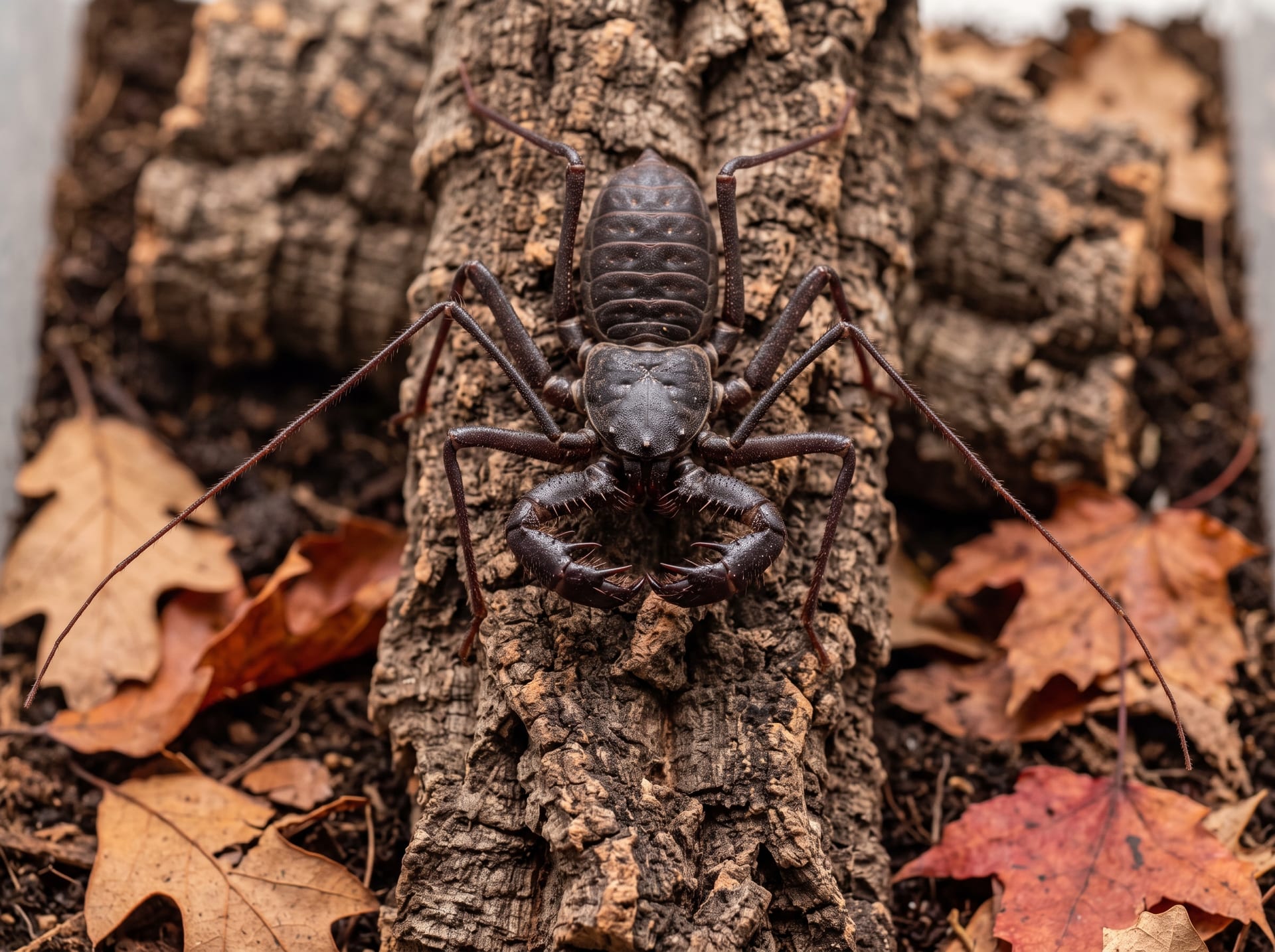
Tailless Whip Scorpion (Whip Spider)
Tailless whip scorpions (whip spiders) are striking arachnids known for their flattened bodies and remarkably long, whip-like front legs, which they use like antennae to sense their surroundings. Despite their alien appearance, they have no venom, no stinger, and produce no silk, making them essentially harmless to humans. By day they press themselves flat against bark or rock crevices, nearly invisible, then emerge at night to explore with slow, deliberate steps punctuated by quick strikes when hunting. They're naturally shy, retreating to cover at the first sign of disturbance rather than confronting anything larger than themselves. With a lifespan of five to ten years, they make a long-term companion for keepers willing to learn their quiet rhythms.
View Tailless Whip Scorpion (Whip Spider) encyclopedia →0% commission on your first sales!Register by September 30, 2026 and your first 2 sales are commission-free!
Breeder Wanted!
List on BreederDirect and sell directly to customers nationwide!
5 Transparency Standards You Can Trust
When listing Exotic Invertebrates, Breeders disclose the following. We guarantee transparency on growth stage and breeding unit.
- Real Photos
- Breeding Unit
- Generation Info
- Body Length (mm)
- Country of Origin
Browse all 249 breeds
Verified breeders wanted for Exotic Invertebrates
Breeders are signing up now ahead of launch. Subscribe to be notified when new listings go live.
Getting alerts is free with a member account. When new listings match your saved search, we'll notify you by email and in-app.
Browse other categories
Verified breeders (preview)
Are you raising exotic invertebrates?
Register as a breeder and connect with buyers directly.
Apply as a breederTailless Whip Scorpion (Whip Spider) key facts
- Care level
- Intermediate
- Lifespan
- 5-10 years (females longer)
- Size
- Body 4-6 cm; legspan 20-25 cm
- Temperature
- 24〜28℃
- Humidity
- 70〜85%
- Diet
- Live insects such as crickets and roaches, offered 2-3 times weekly.
- Habitat
- A tall enclosure with cork bark or vertical surfaces to climb and cling to.
- Temp & Humidity
- Keep 24-28℃ and 70-85% humidity with regular misting.
- Feeding
- Live insects 2-3 times weekly, snatched with the raptorial pedipalps.
- Caution
- Harmless to people, but the long antenniform legs and molts are very fragile — avoid handling and don't disturb during molting.
About Tailless Whip Scorpion (Whip Spider)
Meet the tailless whip scorpion: a flat-bodied arachnid with long, whip-like legs. Venom-free, stingerless, and harmless to humans, it lives 5–10 years. Learn what to know before bringing one home.
7 things to know before welcoming a Tailless Whip Scorpion (Whip Spider)
1Related to spiders, but no silk
Whip spiders are arachnids, but they belong to a separate order (Amblypygi) distinct from true spiders. They lack silk-producing organs, so you'll never find webbing in their enclosure.
2No venom, no stinger
Despite their intimidating appearance, they have no venom glands or stinger, and their bite force is minimal, posing essentially no real risk to people. The spines on their pedipalps are for gripping prey, not defense — their first instinct is always to flee.
3Balance humidity with airflow
In the wild they live on tree bark and in rock crevices in tropical rainforests, so captive setups need both high humidity and good ventilation. Dry conditions can lead to failed molts, which is one reason they're considered a species for intermediate keepers.
4Vertical hiding spots matter
Cork bark or driftwood that they can cling to vertically lets you see their natural posture and behavior. They stay motionless flattened against surfaces during the day, then extend their long front legs to explore once night falls.
5Shy despite the quick movements
Their sudden bursts of speed are a startle response, not aggression — they rarely go on the offensive. Handling causes significant stress and can trigger leg autotomy (self-amputation), so it's best enjoyed as a species to observe rather than hold.
6Molting is a delicate time
As they grow, whip spiders molt periodically, and during this process their body is extremely soft and vulnerable. They often retreat and stay still before and after a molt, so it's important to avoid disturbing them during this window.
7A 5-10 year commitment, longer for females
With proper care they can live five to ten years, with females typically outliving males. Before bringing one home, it's worth considering whether you can maintain a stable enclosure for the long term.
Frequently asked questions about Tailless Whip Scorpion (Whip Spider)
- Q.Do whip spiders bite? Are they dangerous?
- A.They have no venom or stinger and rarely act aggressively toward people. While a startled individual could pinch with its pedipalps, this almost never causes any real harm.
- Q.Can I handle mine?
- A.Handling isn't recommended, since their bodies are delicate and their legs can detach easily under stress. They're best enjoyed by watching their behavior through the enclosure glass, especially at night.
- Q.Can they live with other animals in the same enclosure?
- A.Whip spiders should be housed alone. Territorial behavior and predation risk make cohabitation with other whip spiders or other species inadvisable.
- Q.Are they suitable for beginners?
- A.They're generally considered suitable for intermediate keepers. Getting the humidity and ventilation balance right takes some know-how, so prior experience with reptiles or other exotic invertebrates helps.
- Q.How big do they get?
- A.Adults reach a body length of about 4 to 6 cm, but their long, whip-like legs can span 20 to 25 cm when extended. Despite the dramatic leg span, the body itself is flat and compact.
Learn more about Tailless Whip Scorpion (Whip Spider) in the encyclopedia
View Tailless Whip Scorpion (Whip Spider) encyclopedia entry →
Care difficulty, lifespan, size and diet — all basics covered.
More in this category
Can't find the one you're looking for?
Post your wishes for free and breeders with matching animals will contact you with introductions.