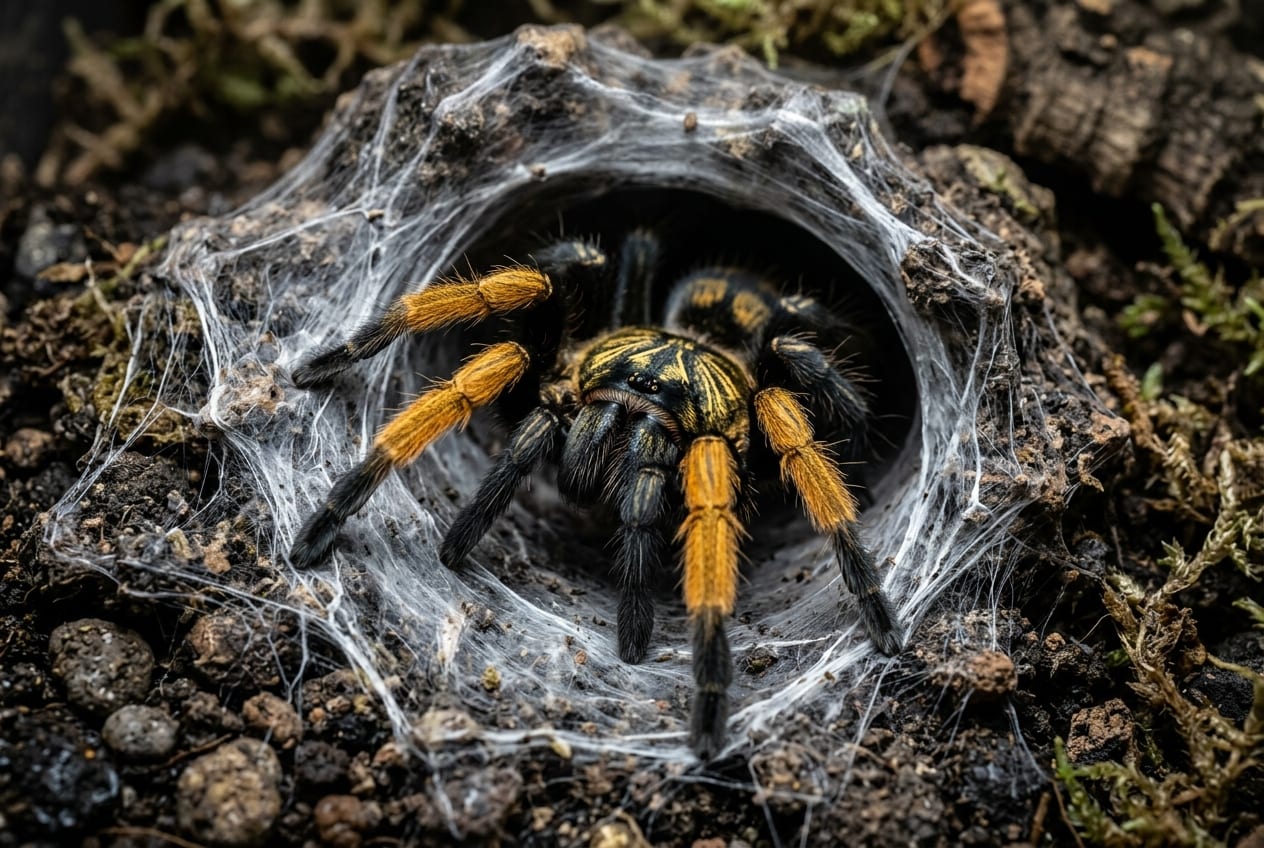
Mozambique Golden Baboon
The Mozambique Golden Baboon is a tarantula endemic to Mozambique, known for the striking gold radiating pattern across its black carapace and the golden sheen along the base of its legs. It is a dedicated burrower, and in enclosures without enough room to dig, it compensates by weaving heavy sheets of webbing to build a surface retreat instead. Because it tends to stay hidden and can move quickly when disturbed, handling calls for some prior experience, making it better suited to intermediate keepers. Adult females measure around 3.4cm in body length with a leg span of 12 to 14cm, a compact size that makes it easy to appreciate the contrast between its dark body and gold highlights up close.
View Mozambique Golden Baboon encyclopedia →0% commission on your first sales!Register by September 30, 2026 and your first 2 sales are commission-free!
Breeder Wanted!
List on BreederDirect and sell directly to customers nationwide!
5 Transparency Standards You Can Trust
When listing Exotic Invertebrates, Breeders disclose the following. We guarantee transparency on growth stage and breeding unit.
- Real Photos
- Breeding Unit
- Generation Info
- Body Length (mm)
- Country of Origin
Browse all 249 breeds
Verified breeders wanted for Exotic Invertebrates
Breeders are signing up now ahead of launch. Subscribe to be notified when new listings go live.
Getting alerts is free with a member account. When new listings match your saved search, we'll notify you by email and in-app.
Browse other categories
Verified breeders (preview)
Are you raising exotic invertebrates?
Register as a breeder and connect with buyers directly.
Apply as a breederMozambique Golden Baboon key facts
- Care level
- Intermediate
- Lifespan
- Females 12-15 years / males 3-4 years
- Size
- Body about 3.4cm (female specimen), leg span 12-14cm
- Temperature
- 26〜28℃
- Humidity
- 55〜65%
- Diet
- Live insects such as crickets and roaches
- Temperature & Humidity
- Aim for 26-28C and 55-65% humidity. It comes from tropical savanna, so prioritise ventilation over moisture.
- Enclosure
- As an obligate burrower it needs deep substrate. Without somewhere to dig it webs heavily at the surface, so provide plenty of depth.
- Diet & Feeding
- Offer live crickets and roaches. It ambushes from the burrow entrance, so prey dropped nearby gets a good response.
- Temperament & Venom
- It is defensive and has no urticating hairs. When cornered it threatens and then bites, so it is not handled.
- Notes
- It is sometimes sold as Ceratogyrus ezendami, so check the scientific name when buying.
About Mozambique Golden Baboon
Learn about the Mozambique Golden Baboon, a tarantula endemic to Mozambique with striking gold markings. Adult females reach about 3.4cm in body length with a 12-14cm leg span, and it's best suited to intermediate keepers.
7 things to know before welcoming a Mozambique Golden Baboon
1A Dedicated Burrower
This species naturally lives in burrows dug into the substrate. Without deep enough substrate to dig into, it may compensate by weaving heavy webbing to build a retreat on the surface instead.
2Deep Substrate Is Essential
Without room to burrow, it can become stressed or display unnatural behavior, so provide substrate deeper than its body height. Choose a substrate type that's easy for it to dig through.
3Striking Gold Markings
Its black carapace is marked with a radiating gold pattern, and the base of its legs also gleams gold. The coloring shifts subtly as the spider grows, which adds to the enjoyment of keeping it.
4A Secretive Nature
It tends to stay tucked away in its shelter and is rarely seen out in the open. Rather than trying to coax it out, the best approach is to simply observe quietly and let it be.
5Quick Movements, Handle With Care
When startled, it can move very quickly, so care is needed when opening the enclosure or using tools during maintenance. This is one reason it's recommended for intermediate keepers rather than beginners.
6Managing Temperature and Humidity
Avoid extremes of dryness or excess moisture, keeping the substrate at a moderate humidity level for its health. Choose a well-ventilated enclosure to help prevent mold and stagnant air.
7Preparing Before You Bring One Home
Set up deep, diggable substrate, a shelter to hide in, and a well-ventilated enclosure in advance for a smooth transition. Having a pair of feeding tongs ready is also a good idea.
Frequently asked questions about Mozambique Golden Baboon
- Q.Is this species suitable for beginners?
- A.It's generally considered a species for intermediate keepers rather than complete beginners. Familiarity with its secretive habits and quick movements is recommended before bringing one home.
- Q.How big does it get?
- A.Adult females reach about 3.4cm in body length, with a leg span of roughly 12 to 14cm. That makes it a relatively compact tarantula overall.
- Q.How deep should the substrate be?
- A.Since this species is a dedicated burrower, it needs substrate deep enough to dig into comfortably. Without room to burrow, it may instead build a web retreat on the surface.
- Q.Will it be visible often in its enclosure?
- A.It spends much of its time hidden in its shelter or burrow, so it isn't a species you'll see out in the open constantly. It's a spider that spends long stretches tucked away out of sight.
- Q.Is the Mozambique Golden Baboon listed under CITES?
- A.No, this species is not subject to CITES.
Learn more about Mozambique Golden Baboon in the encyclopedia
View Mozambique Golden Baboon encyclopedia entry →
Care difficulty, lifespan, size and diet — all basics covered.
More in this category
Can't find the one you're looking for?
Post your wishes for free and breeders with matching animals will contact you with introductions.