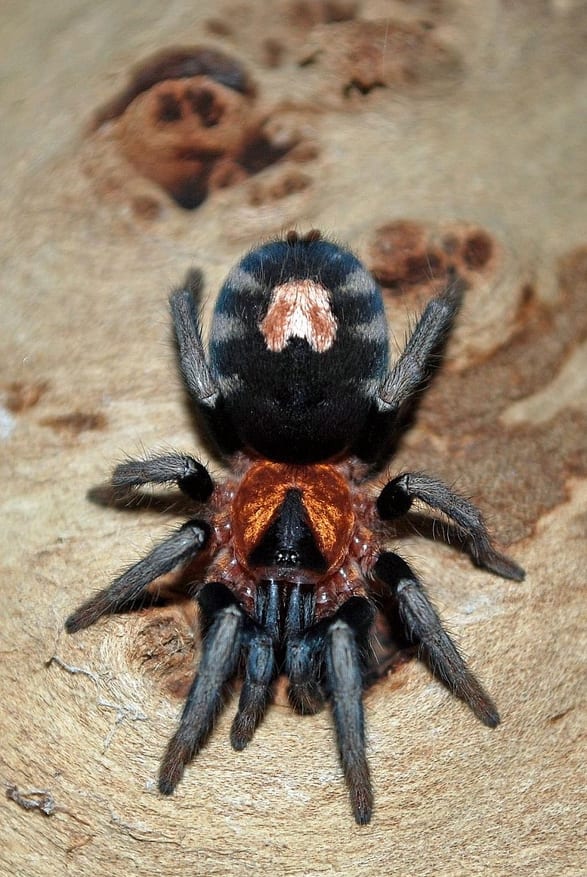
 © B a y L e e ' s 8 Legged Art / CC BY-SA 2.0
Trinidad Dwarf Tiger
The Trinidad Dwarf Tiger is a small tarantula with a legspan of about 5 cm. Its metallic-sheened carapace paired with striped and heart-shaped markings on the abdomen give it a striking appearance, and it tends to burrow readily into substrate. It grows quickly and typically reaches maturity within about a year, so keepers can enjoy its adult coloring sooner than with many other species. Rated beginner-friendly in care difficulty, it's an approachable choice for those new to tarantula keeping. Lifespan differs notably by sex — females can live up to around 7 years, while males live about 2 years — so it's worth understanding this difference before bringing one home. Compact yet visually striking, it makes a great entry point into the world of exotic invertebrates.
View Trinidad Dwarf Tiger encyclopedia →0% commission on your first sales!Register by September 30, 2026 and your first 2 sales are commission-free!
Breeder Wanted!
List on BreederDirect and sell directly to customers nationwide!
5 Transparency Standards You Can Trust
When listing Exotic Invertebrates, Breeders disclose the following. We guarantee transparency on growth stage and breeding unit.
- Real Photos
- Breeding Unit
- Generation Info
- Body Length (mm)
- Country of Origin
Browse all 249 breeds
Verified breeders wanted for Exotic Invertebrates
Breeders are signing up now ahead of launch. Subscribe to be notified when new listings go live.
Getting alerts is free with a member account. When new listings match your saved search, we'll notify you by email and in-app.
Browse other categories
Verified breeders (preview)
Are you raising exotic invertebrates?
Register as a breeder and connect with buyers directly.
Apply as a breederTrinidad Dwarf Tiger key facts
- Care level
- Beginner-friendly
- Lifespan
- Females up to about 7 years, males about 2 years
- Size
- 5-6cm leg span (body about 2cm)
- Temperature
- 20〜24℃
- Humidity
- 70〜80%
- Diet
- Live insects such as small crickets and fruit flies
- Temperature & Humidity
- Keep around 20-24 C. Aim for roughly 70-80% humidity with a gradient: damp lower substrate and a drier surface. Poor ventilation encourages mould.
- Enclosure
- Even for such a small species give 5-6 cm or more of substrate for burrowing. Cork bark hides and branches serve as web anchors. Keep the enclosure low to limit fall distance.
- Diet & Feeding
- Feed small crickets and fruit flies. It is an eager feeder and grows fast; pre-killed prey works well for spiderlings.
- Temperament & Venom
- Nervous but not defensive, retreating into its burrow when startled. It has urticating setae but rarely kicks them, and the venom is considered mild.
- Notes
- It is tiny and even a short fall can be fatal, so treat it as a display animal and do not handle it. It is fast, so guard against escapes when opening the enclosure.
About Trinidad Dwarf Tiger
A small tarantula with a metallic carapace and heart-shaped markings, known for fast growth, burrowing habits, and beginner-friendly care.
7 things to know before welcoming a Trinidad Dwarf Tiger
1Burrows Into Substrate
This species readily burrows into substrate. Provide a reasonably deep layer in the enclosure so it can dig and retreat as needed. It may spend much of its time hidden — this is normal behavior, not a sign of a problem.
2Beginner-Friendly Care
This species is rated as beginner-friendly. Even first-time tarantula keepers can manage it comfortably by maintaining basic temperature and humidity ranges along with a regular feeding routine.
3Fast Growth, Matures Within a Year
Growth is fast, with maturity typically reached in about a year. This means keepers can enjoy the adult coloring and pattern sooner than with many other tarantula species.
4Lifespan Varies Greatly by Sex
Females can live up to around 7 years, while males typically live only about 2 years. If you're hoping for a long-term companion, consider sex when choosing your individual.
5Small Body, Striking Patterns to Observe
Even as an adult, this species stays compact — legspan of about 5–6 cm and a body length of around 2 cm. Despite the small size, the metallic carapace and the striped, heart-shaped abdominal markings make it rewarding to observe closely.
6Keep Individually
Like most tarantulas, this species is solitary and can be cannibalistic, so individuals should be housed separately, each in its own enclosure. If you plan to keep more than one, prepare a dedicated setup for each.
7Prepare the Enclosure Before Arrival
Before bringing one home, set up an enclosure with substrate deep enough to burrow into, a hide, and the means to maintain appropriate temperature and humidity. Also have feeder insects and a water dish ready for ongoing care.
Frequently asked questions about Trinidad Dwarf Tiger
- Q.Can beginners keep this species?
- A.Yes, this species is rated as beginner-friendly. As long as you maintain basic temperature and humidity levels and a regular feeding schedule, it's manageable even for first-time tarantula keepers.
- Q.How big does it get?
- A.It's a small species, reaching a legspan of about 5–6 cm as an adult. Body length stays compact at around 2 cm.
- Q.What is its lifespan?
- A.Lifespan differs by sex — females can live up to about 7 years, while males live around 2 years. If you want a longer-term companion, a female may be the better choice.
- Q.It has burrowed into the substrate and I can't see it — is that okay?
- A.That's completely normal. This species readily burrows into substrate, so spending long periods out of sight is natural behavior. There's no need to dig it out — just let it be.
- Q.Is this species subject to any regulations?
- A.The Trinidad Dwarf Tiger is not subject to CITES.
Learn more about Trinidad Dwarf Tiger in the encyclopedia
View Trinidad Dwarf Tiger encyclopedia entry →
Care difficulty, lifespan, size and diet — all basics covered.
More in this category
Can't find the one you're looking for?
Post your wishes for free and breeders with matching animals will contact you with introductions.