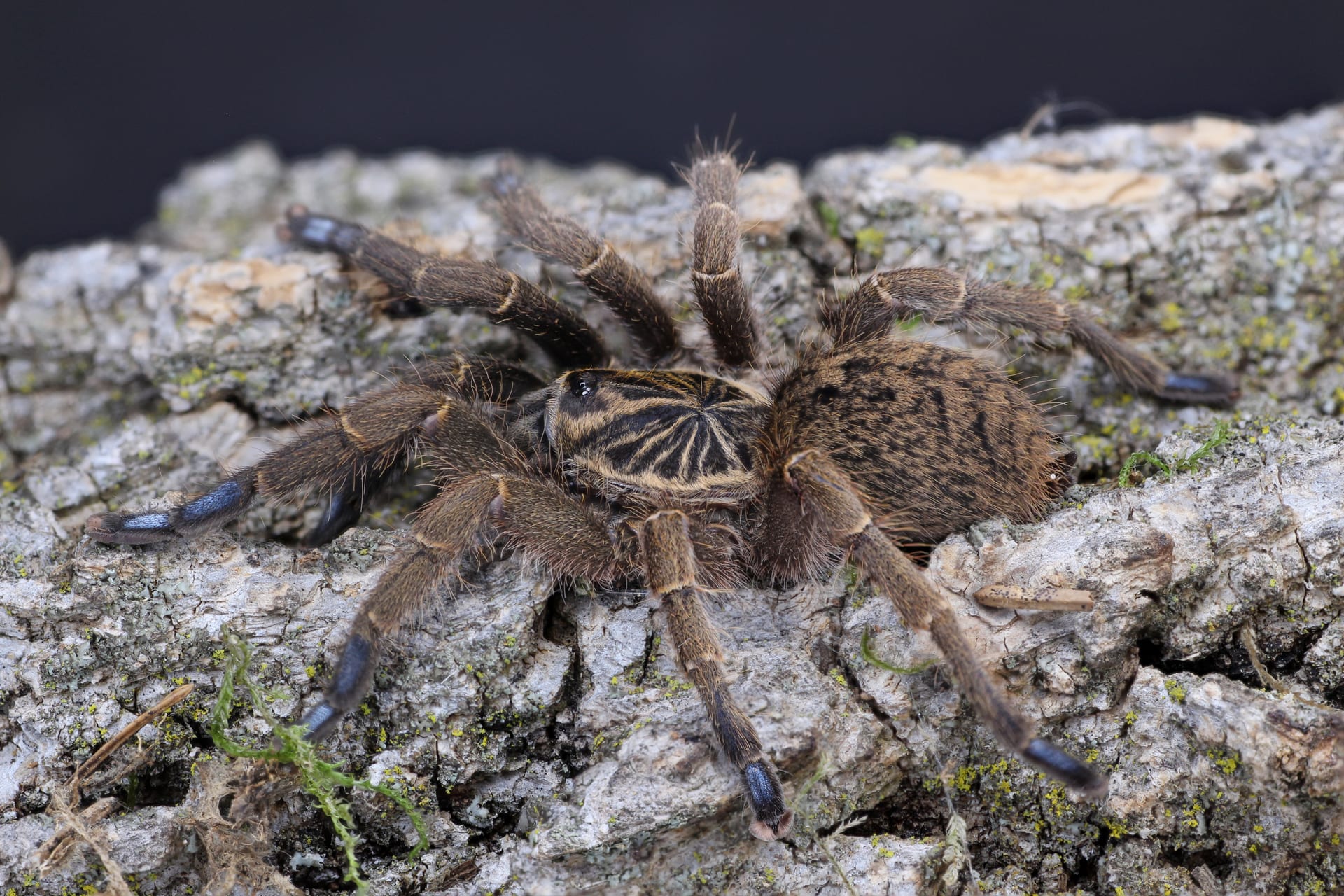
 © Quengsalinas / CC BY-SA 4.0
Blue Foot Baboon
The Blue Foot Baboon is a small South African tarantula named for the vivid sky-blue color that covers just the tips of its legs, standing out sharply against its dark brown body. It's known for an unusual trait among tarantulas: digging a burrow and sealing the entrance with a silk-lined trapdoor. Skittish and easily startled by vibration or noise, it tends to retreat into its burrow at the first sign of disturbance rather than stay out in the open. Adults stay compact, with a body length of about 3-4cm in females and a leg span of roughly 11cm, so they don't need much enclosure space. Because it's considered an intermediate-level species, it makes a good next tarantula for keepers who already have some hands-on experience.
View Blue Foot Baboon encyclopedia →0% commission on your first sales!Register by September 30, 2026 and your first 2 sales are commission-free!
Breeder Wanted!
List on BreederDirect and sell directly to customers nationwide!
5 Transparency Standards You Can Trust
When listing Exotic Invertebrates, Breeders disclose the following. We guarantee transparency on growth stage and breeding unit.
- Real Photos
- Breeding Unit
- Generation Info
- Body Length (mm)
- Country of Origin
Browse all 249 breeds
Verified breeders wanted for Exotic Invertebrates
Breeders are signing up now ahead of launch. Subscribe to be notified when new listings go live.
Getting alerts is free with a member account. When new listings match your saved search, we'll notify you by email and in-app.
Browse other categories
Verified breeders (preview)
Are you raising exotic invertebrates?
Register as a breeder and connect with buyers directly.
Apply as a breederBlue Foot Baboon key facts
- Care level
- Intermediate
- Lifespan
- Females 12-15 years / males 3-4 years
- Size
- Body 3-4cm (female), leg span about 11cm
- Temperature
- 22〜25℃
- Humidity
- 60〜70%
- Diet
- Live insects such as crickets and roaches
- Temperature & Humidity
- Aim for 22-25C and 60-70% humidity, avoiding extremes by dampening only part of the substrate.
- Enclosure
- Provide deep diggable substrate so it can build a trapdoor, with flat stones or bark as an anchor for the entrance.
- Diet & Feeding
- Offer live crickets and roaches. It ambushes from behind the door, so prey dropped near the entrance gets a response.
- Temperament & Venom
- An Old World species with no urticating hairs, shy and inclined to retreat into its burrow. It is still fast, so it is not handled.
- Notes
- It seldom leaves the burrow, so it is rarely seen. Opening the trapdoor to check on it causes stress.
About Blue Foot Baboon
A small South African tarantula whose leg tips turn a striking sky blue, known for building silk-sealed trapdoor burrows. An intermediate-level species, compact in size at about 3-4cm body length (female).
7 things to know before welcoming a Blue Foot Baboon
1Sky-Blue Leg Tips
The species' namesake feature is the bright sky-blue coloring on just the tips of its legs. Set against a dark brown body, the contrast makes it instantly recognizable among tarantulas.
2A Rare Trapdoor Habit
It digs a burrow and seals the entrance with a silk-woven trapdoor, a behavior that's unusual even among tarantulas. Watching the burrow and trapdoor take shape is one of the more distinctive parts of keeping this species.
3An Old World Species
As an Old World tarantula, it lacks the urticating hairs that New World species use for defense, relying instead on speed and defensive posturing when startled. It's best kept as a hands-off, observation-only pet rather than one you handle directly.
4Naturally Shy and Alert
It's highly sensitive to vibration and sound, and will retreat into its burrow at the first sign of disturbance. Don't expect it to be out and visible often — the appeal here is patient observation rather than constant viewing.
5Deep, Diggable Substrate
Since it naturally digs burrows, the enclosure needs a deep layer of substrate rather than a shallow one, giving it enough depth to dig and build properly. Letting it express this natural digging behavior is key to good husbandry.
6A Compact Size
Even as adults, they stay on the small side for a tarantula — around 3-4cm in body length for females, with a leg span of roughly 11cm. That compact size means the enclosure doesn't need to take up much room.
7Best for Experienced Keepers
Its quick movements and defensive nature make it a less forgiving choice for a first tarantula, which is why it's generally considered an intermediate-level species. It's best suited to keepers who already have experience with other species.
Frequently asked questions about Blue Foot Baboon
- Q.Is this a good species for beginners?
- A.It's generally classed as an intermediate-level species, so it suits keepers who already have some tarantula experience. It's better suited as a second or third species than as a first tarantula.
- Q.Is it likely to bite?
- A.As an Old World species it has no urticating hairs to fall back on, so when startled it may react with quick movement or defensive posturing instead. As with any tarantula, it's best to avoid direct handling and keep interaction to observation.
- Q.How big does it get?
- A.Adults stay fairly compact, reaching a body length of about 3-4cm in females with a leg span of roughly 11cm. That puts it on the smaller end for a tarantula.
- Q.How do I encourage it to build a burrow?
- A.Give it a deep layer of substrate so it has enough depth to dig into. With the right conditions, it will naturally build its burrow and seal the entrance with its characteristic silk trapdoor.
- Q.Will I be able to see it often?
- A.It's naturally shy and quick to retreat into its burrow at any disturbance, so it won't be out and visible very often. The appeal is more in observing its trapdoor and burrowing behavior than in frequent sightings.
Learn more about Blue Foot Baboon in the encyclopedia
View Blue Foot Baboon encyclopedia entry →
Care difficulty, lifespan, size and diet — all basics covered.
More in this category
Can't find the one you're looking for?
Post your wishes for free and breeders with matching animals will contact you with introductions.