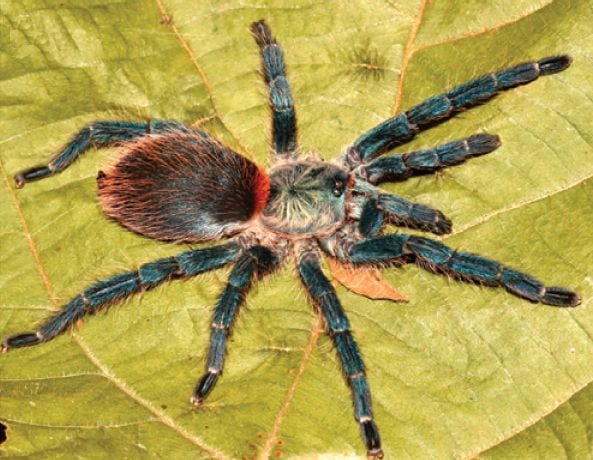
 © Rogerio Bertani / CC BY 3.0
Brazilian Blue Dwarf Beauty
The Brazilian Blue Dwarf Beauty is a dwarf tarantula species from Brazil known for its striking blue-green carapace, vivid blue legs, and reddish long hairs covering the abdomen. It builds thick, tunnel-like webbing and tends to stay out in the open rather than hiding, making it easy to observe. It also doesn't kick urticating hairs, adding to its appeal as a display species. Suited to keepers with some prior tarantula experience, this species has a notable lifespan gap between sexes: females can live 12 to 15 years, while males typically live only around 3 years.
View Brazilian Blue Dwarf Beauty encyclopedia →Breeder Wanted!
List on BreederDirect and sell directly to customers nationwide!
BreederDirect's 5 Transparency Commitments
When listing Exotic Invertebrates, Breeders disclose the following. We guarantee transparency on growth stage and breeding unit.
- Real Photos
- Breeding Unit
- Generation Info
- Body Length (mm)
- Country of Origin
Browse all 286 breeds
Verified breeders wanted for Exotic Invertebrates
Breeders are signing up now ahead of launch. Subscribe to be notified when new listings go live.
Getting alerts is free with a member account. When new listings match your saved search, we'll notify you by email and in-app.
Browse other categories
Verified breeders (preview)

Are you raising exotic invertebrates?
Register as a breeder and connect with buyers directly.
Apply as a breederBrazilian Blue Dwarf Beauty key facts
- Care level
- Intermediate
- Lifespan
- Females 12-15 years, males about 3 years
- Size
- 7.5-12cm leg span
- Temperature
- 22〜26℃
- Humidity
- 70〜80%
- Diet
- Live insects such as crickets and roaches
- Temperature & Humidity
- Keep around 22-26 C. Roughly 70-80% humidity is the target, though it tolerates drier conditions; keeping the water dish full matters more. Ventilate well.
- Enclosure
- It builds thick web tunnels, so add cork bark and branches as anchors alongside the substrate, and leave the webbing intact.
- Diet & Feeding
- Offer crickets and roaches. It grows fast and matures in about eighteen months, so review prey size after each moult.
- Temperament & Venom
- Skittish and fast, darting into its retreat when disturbed; threat postures are rare. It cannot kick urticating hairs, so maintenance carries no hair irritation. The venom is considered mild.
- Notes
- Spiderlings in particular are very quick, so guard against escapes when opening the enclosure. The species is under pressure from habitat change, so captive-bred animals are preferable.
About Brazilian Blue Dwarf Beauty
A Brazilian dwarf tarantula with a striking blue-green carapace and blue legs. Builds visible webbing and doesn't kick urticating hairs, making it easy to observe.
7 things to know before welcoming a Brazilian Blue Dwarf Beauty
1Builds Thick Web Tunnels
This species builds thick, tunnel-like webbing, so provide a hide or cork bark it can burrow into and use as a scaffold. Watching the web structure develop is part of the enjoyment of keeping it.
2Often Visible, Not Hidden
Unlike many tarantulas that stay hidden in their burrows, this species is often seen out in the open, making day-to-day observation easy. It's a good match for keepers who want to actually see their pet.
3Doesn't Kick Urticating Hairs
This species lacks the hair-kicking defense common to many New World tarantulas. That said, biting is still a possibility, so handle with care regardless.
4Intermediate Care Level
This species is rated as suitable for intermediate keepers. It's better suited to those already comfortable with basic humidity, temperature, and feeding management than to a first-ever tarantula.
5Big Lifespan Gap by Sex
Females can live 12 to 15 years, while males typically live only around 3 years. If you're hoping for a long-term companion, keep this in mind when choosing which sex to bring home.
6Adult Size of 7.5–12cm
Adults reach a leg span of about 7.5 to 12cm, staying compact as befits a dwarf species. Use this as a guide when choosing enclosure size and placement.
7Prepare the Enclosure First
Set up a three-dimensional layout that allows webbing, along with a hide and stable humidity and temperature, before the spider arrives so it can settle in smoothly.
Frequently asked questions about Brazilian Blue Dwarf Beauty
- Q.Can beginners keep this species?
- A.This species is rated as suitable for intermediate keepers rather than beginners. It may be a bit more challenging as a first tarantula, so some prior experience is recommended.
- Q.Does it kick urticating hairs as a defense?
- A.This species doesn't kick urticating hairs, which makes it easier to observe compared to many other tarantulas. However, it can still bite if provoked, so handle it with care.
- Q.How big does it get as an adult?
- A.Adults reach a leg span of roughly 7.5 to 12cm. As a dwarf species, it stays relatively compact compared to many other tarantulas.
- Q.How different is the lifespan between males and females?
- A.Females typically live 12 to 15 years, while males live only around 3 years — a substantial difference. If you want a long-term companion, a female may be the better choice.
- Q.What kind of enclosure setup does it need?
- A.Since it builds thick webbing, a three-dimensional setup with a hide and climbing material is recommended. Maintaining appropriate humidity and temperature is also important on an ongoing basis.
Learn more about Brazilian Blue Dwarf Beauty in the encyclopedia
View Brazilian Blue Dwarf Beauty encyclopedia entry →
Care difficulty, lifespan, size and diet — all basics covered.
More in this category
Can't find the one you're looking for?
Post your wishes for free and breeders with matching animals will contact you with introductions.