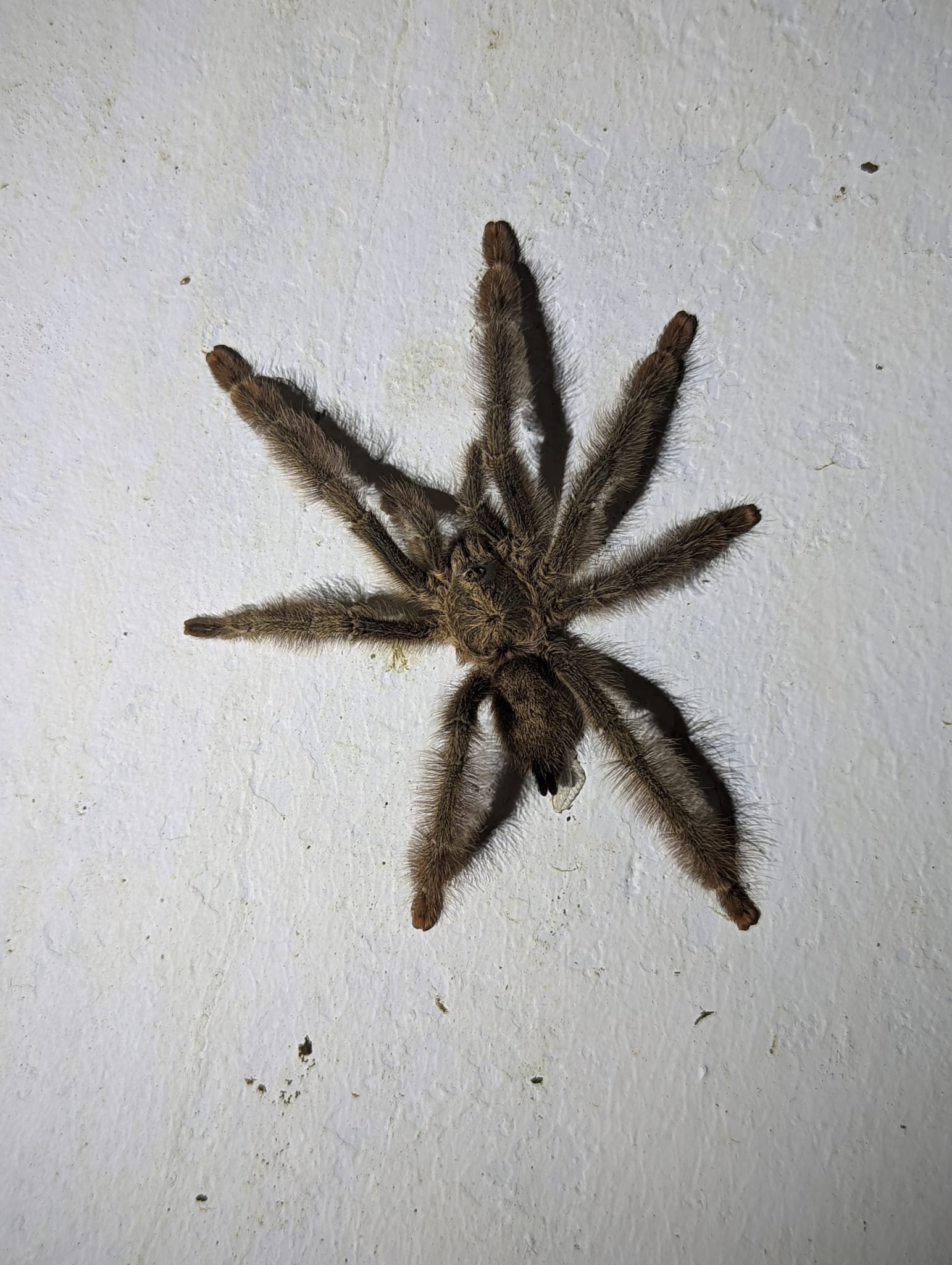
 © Andrew Quitmeyer / CC0
Panama Blonde
The Panama Blonde is an arboreal tarantula native to the forests of Panama and Colombia. Its grayish to pale beige body is accented with a soft pink blush along the legs, while a dark stripe runs down the center of the abdomen. Look closely and you'll catch an iridescent blue-green sheen on the underside of the legs as the light shifts. Unlike many New World tarantulas, this species lacks urticating hairs, giving it a distinct set of traits compared to its relatives. It's generally considered suitable for intermediate keepers who already have experience setting up arboreal enclosures and managing temperature and humidity. Its subtle, elegant coloring makes it a rewarding species to observe over time.
View Panama Blonde encyclopedia →0% commission on your first sales!Register by September 30, 2026 and your first 2 sales are commission-free!
Breeder Wanted!
List on BreederDirect and sell directly to customers nationwide!
5 Transparency Standards You Can Trust
When listing Exotic Invertebrates, Breeders disclose the following. We guarantee transparency on growth stage and breeding unit.
- Real Photos
- Breeding Unit
- Generation Info
- Body Length (mm)
- Country of Origin
Browse all 249 breeds
Verified breeders wanted for Exotic Invertebrates
Breeders are signing up now ahead of launch. Subscribe to be notified when new listings go live.
Getting alerts is free with a member account. When new listings match your saved search, we'll notify you by email and in-app.
Browse other categories
Verified breeders (preview)
Are you raising exotic invertebrates?
Register as a breeder and connect with buyers directly.
Apply as a breederAbout Panama Blonde
The Panama Blonde is an arboreal tarantula from Panama and Colombia, with a pale beige body, pink-tinged legs, and iridescent blue-green leg undersides. It lacks urticating hairs and suits intermediate keepers; females reach up to a 15cm legspan.
7 things to know before welcoming a Panama Blonde
1Arboreal Enclosure Setup
As an arboreal species, the Panama Blonde needs a tall enclosure rather than one with a large floor footprint, furnished with cork bark or driftwood to climb. A secure hide where it can spin a retreat helps it settle in comfortably.
2Best Suited to Intermediate Keepers
This species calls for some prior experience with temperature and humidity management, as well as the enclosure setup arboreal tarantulas need. It's a good fit for keepers who already have some tarantula-keeping experience.
3No Urticating Hairs
Unlike many New World tarantulas, the Panama Blonde doesn't have urticating hairs. That said, individuals can be fast and skittish, so situations involving handling should always be approached calmly and carefully.
4Leg Undersides Shift in Light
The body is typically a muted gray to pale beige, but the underside of the legs takes on an iridescent blue-green sheen depending on the angle of light. The dark stripe down the center of the abdomen is another distinguishing feature between individuals.
5Watch for Molting Signs
Before a molt, appetite often drops and coloring can look duller than usual. During this period, hold off on feeding and avoid disturbing the spider — just let it be.
6Quick and Alert by Nature
True to its arboreal roots, this species moves quickly and may bolt when startled. Take care when opening the enclosure to avoid an escape, and work calmly and deliberately.
7Supplies to Prepare in Advance
Have a tall enclosure, climbing branches, a cork bark hide, and a thermo-hygrometer ready before bringing one home. Feeding frequency and prey size should be adjusted to match the individual's size.
Frequently asked questions about Panama Blonde
- Q.Is the Panama Blonde suitable for beginners?
- A.It's generally considered a species for intermediate keepers, so some prior tarantula-keeping experience is recommended. If you're completely new to the hobby, it may be worth starting with an easier species first.
- Q.What does it mean that it has no urticating hairs?
- A.Many New World tarantulas defend themselves by flicking urticating hairs when threatened, but the Panama Blonde doesn't have this defense. It can still be fast and skittish, so care should be taken in any handling situation.
- Q.Do males and females differ in size?
- A.Yes — females reach a legspan of up to about 15cm, while males max out around 12.5cm, with females typically running slightly larger.
- Q.How big of an enclosure does it need?
- A.Since this is an arboreal species, height matters more than floor space. Choose an enclosure tall enough to fit climbing branches and a proper hide.
- Q.Is the Panama Blonde subject to CITES?
- A.The Panama Blonde is not subject to CITES.
Learn more about Panama Blonde in the encyclopedia
View Panama Blonde encyclopedia entry →
Care difficulty, lifespan, size and diet — all basics covered.
More in this category
Can't find the one you're looking for?
Post your wishes for free and breeders with matching animals will contact you with introductions.