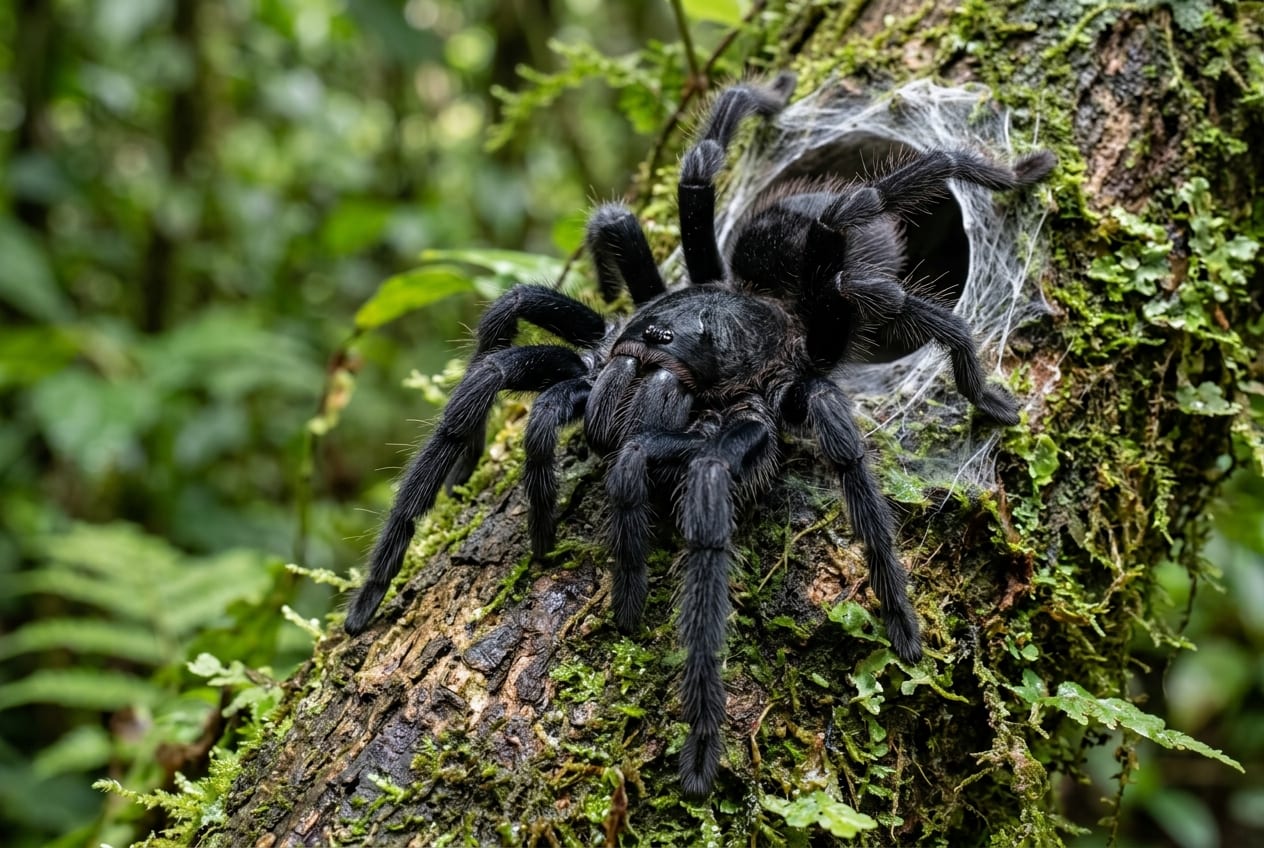
Sangihe Black Tarantula
The Sangihe Black Tarantula is an arboreal species found only on Sangihe Island, Indonesia. Mature females develop an all-black, velvety body that gives them a striking, understated elegance, while males transform into a greenish-yellow hue after their maturity molt, giving the sexes a dramatically different look. Quick-moving and lacking urticating hairs, this species calls for careful handling and prior experience, making it a pick for advanced keepers. It's a great choice for hobbyists who want to observe its brisk arboreal behavior and dramatic color shift firsthand.
View Sangihe Black Tarantula encyclopedia →0% commission on your first sales!Register by September 30, 2026 and your first 2 sales are commission-free!
Breeder Wanted!
List on BreederDirect and sell directly to customers nationwide!
5 Transparency Standards You Can Trust
When listing Exotic Invertebrates, Breeders disclose the following. We guarantee transparency on growth stage and breeding unit.
- Real Photos
- Breeding Unit
- Generation Info
- Body Length (mm)
- Country of Origin
Browse all 249 breeds
Verified breeders wanted for Exotic Invertebrates
Breeders are signing up now ahead of launch. Subscribe to be notified when new listings go live.
Getting alerts is free with a member account. When new listings match your saved search, we'll notify you by email and in-app.
Browse other categories
Verified breeders (preview)
Are you raising exotic invertebrates?
Register as a breeder and connect with buyers directly.
Apply as a breederSangihe Black Tarantula key facts
- Care level
- Advanced
- Lifespan
- Females 13-16 years / males 2-4 years
- Size
- Body 6.5-7cm (female), leg span 17-18cm
- Temperature
- 27〜29℃
- Humidity
- 80〜85%
- Diet
- Live insects such as crickets and locusts
- Temperature & Humidity
- Keep 27-29C by day and 24-25C at night, with humidity held high at 80-85%. In the wild it selects humid sites.
- Enclosure
- Use a tall enclosure of about 20x20x40cm with a cork tube or similar retreat. Although arboreal it often builds from the floor up, so provide a deep substrate layer.
- Diet & Feeding
- Spiderlings readily take fly larvae, mealworms and small crickets. Adults prefer crickets and locusts and are less keen on roaches.
- Temperament & Venom
- As an Old World species it has no urticating hairs and is very fast. Do not handle it, and guard against escapes during maintenance.
- Notes
- Communal rearing works until about the fourth moult and speeds growth, but cannibalism follows, so separate them after that. It is uncommon in the trade and easily confused with its congeners.
About Sangihe Black Tarantula
Sangihe Black Tarantula: an arboreal species endemic to Indonesia's Sangihe Island. Females turn solid black, males greenish-yellow after maturity. Fast-moving, with no urticating hairs, this is an advanced-keeper species.
7 things to know before welcoming a Sangihe Black Tarantula
1Arboreal Housing Needs
The Sangihe Black is an arboreal tarantula native to Sangihe Island, Indonesia, so it prefers height over floor space. Set up a tall enclosure with cork bark or driftwood hides that let it climb and perch off the ground. Building the habitat around this upward-dwelling instinct is the foundation of good care.
2Fast Movement, Advanced Level
This species moves very quickly and can dart out the moment the enclosure is opened. It's classified as an advanced-level species, best suited to keepers who already have tarantula-handling experience. It isn't a good match for a first tarantula.
3No Urticating Hairs
Many tarantulas flick urticating hairs to ward off threats, but the Sangihe Black doesn't have them. Instead, it may rely on other defenses like biting when it feels threatened, so handle husbandry tasks with tools rather than bare hands.
4Color Change at Maturity
Mature females become a uniform, velvety black, while males turn greenish-yellow after their maturity molt. The same species can look strikingly different depending on sex, which is part of its appeal. Keep in mind that coloring will also look different depending on the individual's growth stage.
5Plan for Adult Size
Adult females reach a body length of about 6.5-7 cm, with a leg span of 17-18 cm. Even though juveniles start out small, it's worth planning ahead for a larger enclosure sized for their eventual adult dimensions.
6Keep Solitary
Tarantulas are territorial and can cannibalize one another, so they should be kept one per enclosure. Avoid housing multiple individuals together, and give each one its own separate space.
7Best Observed, Not Handled
Given its speed and lack of urticating hairs, handling this tarantula bare-handed carries real risk. It's best appreciated as a species to watch through the enclosure glass rather than a hands-on pet. Understanding this before bringing one home will help set the right expectations.
Frequently asked questions about Sangihe Black Tarantula
- Q.Is this a good tarantula for beginners?
- A.The Sangihe Black is considered an advanced-level species because it moves quickly and lacks urticating hairs. It isn't recommended as a first tarantula for someone without prior handling experience.
- Q.Is it true this species has no urticating hairs?
- A.Yes, that's correct. Unlike many tarantulas, the Sangihe Black doesn't have urticating hairs. When startled, it may instead rely on other defenses such as biting, so handle care tasks with tools rather than bare hands.
- Q.Why do males and females look so different?
- A.It's because this species changes color as it reaches sexual maturity. Females develop a uniform, velvety black body, while males turn greenish-yellow after their maturity molt.
- Q.How big does it get as an adult?
- A.Adult females reach a body length of roughly 6.5-7 cm, with a leg span of about 17-18 cm. It's worth planning your enclosure upgrades around this eventual adult size.
- Q.Is the Sangihe Black Tarantula covered by CITES?
- A.The Sangihe Black Tarantula falls outside CITES. There's nothing further to note on this point.
Learn more about Sangihe Black Tarantula in the encyclopedia
View Sangihe Black Tarantula encyclopedia entry →
Care difficulty, lifespan, size and diet — all basics covered.
More in this category
Can't find the one you're looking for?
Post your wishes for free and breeders with matching animals will contact you with introductions.