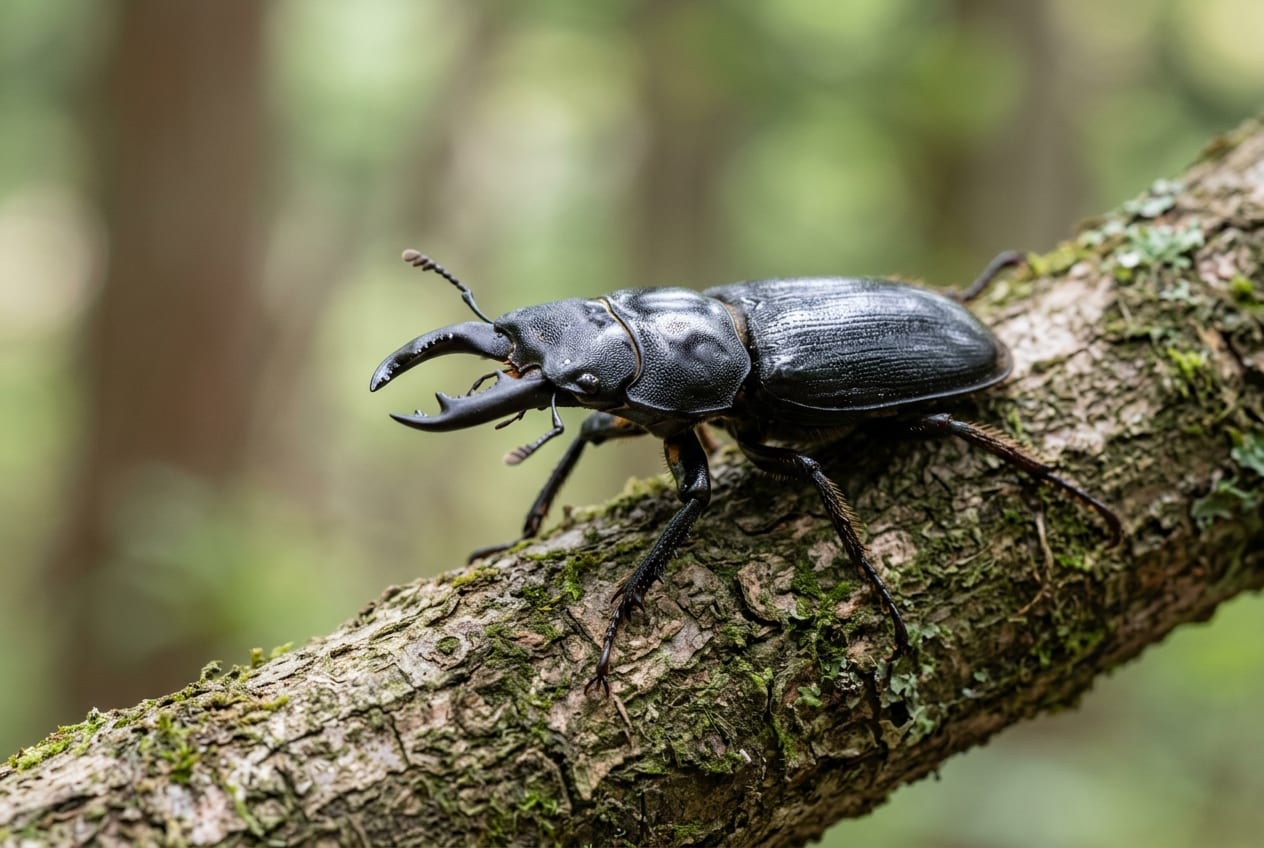
Amami Lesser Stag Beetle
The Amami Lesser Stag Beetle is a small-bodied nominate subspecies of Japan's lesser stag beetles, found only on Amami-Oshima and Kakeromajima islands. Its mandibles are short but strongly curved, and its legs and tarsi are relatively long, well suited to a life spent climbing among trees. As with stag beetles in general, males fight one another, so adults should be kept individually, which suits keepers who enjoy careful observation. Because their range is so restricted, wild populations are not abundant, adding to their appeal as a regional specialty. With adults living anywhere from six months to two years, they reward keepers willing to spend time getting to know them.
View Amami Lesser Stag Beetle encyclopedia →Breeder Wanted!
List on BreederDirect and sell directly to customers nationwide!
BreederDirect's 6 Transparency Commitments
When listing Insects, Breeders disclose the following. We guarantee transparency on growth stage and breeding unit.
- Life Stage Clarity
- Generation Info
- Real Photos
- Breeding Unit
- Country of Origin
- Body Length (mm)
Browse all 336 breeds
No listings match your filters
Adjust your filters, or get notified when new listings arrive.
Getting alerts is free with a member account. When new listings match your saved search, we'll notify you by email and in-app.
Browse other categories
Verified breeders (preview)
Amami Lesser Stag Beetle key facts
- Care level
- Intermediate
- Lifespan
- 6 months to 2 years as an adult
- Size
- Males 21.3-36.2mm, females 22-28mm
- Diet
- Adults take sap of broadleaf trees and beetle jelly; larvae feed on soft rotten wood
- Temperature & Humidity
- The larvae live in fairly damp, soft rotten wood, so neither the laying log nor the rearing medium should be allowed to dry out.
- Breeding & Egg-laying
- Females lay in rotten broadleaf wood along streams. The larvae hatch about a month after laying, feed on soft rotten wood and take about a year to develop. Final-instar larvae begin building a pupal chamber in the autumn of that year or the following spring, spend about a month becoming a pupa and eclose about a month after that.
- Cohabitation
- As with stag beetles generally, males fight, so keep adults singly. Beetles from anywhere other than Amami-Oshima and Kakeromajima belong to other subspecies and must not be housed or crossed with them.
- Lifespan & Rearing Period
- Adults live from six months to two years. Those that eclose in autumn overwinter and become active the following spring, while those that eclose in spring leave the pupal chamber after about a month.
- Health & Notes
- The 2025 edition of BE-KUWA lists a captive record of 40.8 mm (Kenichi Nakaya, 2009) and a wild record of 37.8 mm (Yusuke Takamochi). The beetle is not as numerous as the mainland lesser stag, so keep collecting to a minimum and do not release captive stock into the wild. Females are easily confused with those of Rhaetulus recticornis, so check the swellings on the head.
About Amami Lesser Stag Beetle
Meet the Amami Lesser Stag Beetle, a small subspecies found only on Amami-Oshima and Kakeromajima. Learn about its size, care basics, single-adult housing, and 6-month-to-2-year adult lifespan.
7 things to know before welcoming a Amami Lesser Stag Beetle
1Found Only on Two Islands
The Amami Lesser Stag Beetle is found only on Amami-Oshima and Kakeromajima, and wild populations are not abundant. It's worth checking the background of any individual you bring home, simply to understand where it came from.
2Small Body, Bold Jaws
Among Japan's lesser stag beetles, this is one of the smallest, yet its mandibles are short and strongly curved. Adults typically measure 21.3–36.2mm for males and 22–28mm for females, a size worth comparing against other lesser stag beetle species.
3Built for Life in Trees
Its legs and tarsi are relatively long, an adaptation well suited to climbing among trees. Adding branches or bark inside the enclosure lets it move and perch more naturally, making its behavior easier to observe.
4Keep Adults Individually
As with stag beetles in general, males fight one another, so adults should be kept individually. Individuals from localities other than Amami-Oshima and Kakeromajima belong to other subspecies, so never house or breed them together.
5Best Suited to Intermediate Keepers
This species is generally considered suitable for keepers with some prior insect-keeping experience rather than absolute beginners. Setting up an environment where you can easily notice small shifts in temperature and humidity will make day-to-day care much easier.
6Adults Live 6 Months to 2 Years
Adult lifespan ranges widely, from about six months to two years. Knowing roughly when an individual emerged as an adult can help you get a sense of how much time you may spend together.
7Prepare the Enclosure First
Before bringing one home, set up the basics — insect mat substrate, climbing branches, and a well-ventilated case. Arranging the enclosure with its tree-dwelling habits in mind helps a new beetle settle in more quickly.
Frequently asked questions about Amami Lesser Stag Beetle
- Q.Is the Amami Lesser Stag Beetle suitable for beginners?
- A.This species is generally considered better suited to keepers with some prior insect-keeping experience rather than complete beginners. Learn the basics first, including temperature and humidity management, and care for it attentively.
- Q.How large do they grow?
- A.Adults typically measure 21.3–36.2mm for males and 22–28mm for females. That makes them one of the smaller members of Japan's lesser stag beetle group.
- Q.How long do adults live?
- A.Adult lifespan ranges from roughly six months to two years, varying by individual. Differences in care and condition can affect how long a beetle lives.
- Q.Can I keep several together?
- A.As with stag beetles in general, males fight one another, so adults should be kept individually. Individuals from localities other than Amami-Oshima and Kakeromajima are different subspecies, so do not house or breed them together.
- Q.What kind of enclosure setup do they need?
- A.Because their body is adapted for climbing, adding branches or bark gives them natural perches to display their tree-dwelling behavior. A well-ventilated case with insect mat substrate, plus attention to temperature and humidity, rounds out the basic setup.
Useful tools for Amami Lesser Stag Beetle care
Learn more about Amami Lesser Stag Beetle in the encyclopedia
View Amami Lesser Stag Beetle encyclopedia entry →
Care difficulty, lifespan, size and diet — all basics covered.
More in this category
Can't find the one you're looking for?
Post your wishes for free and breeders with matching animals will contact you with introductions.