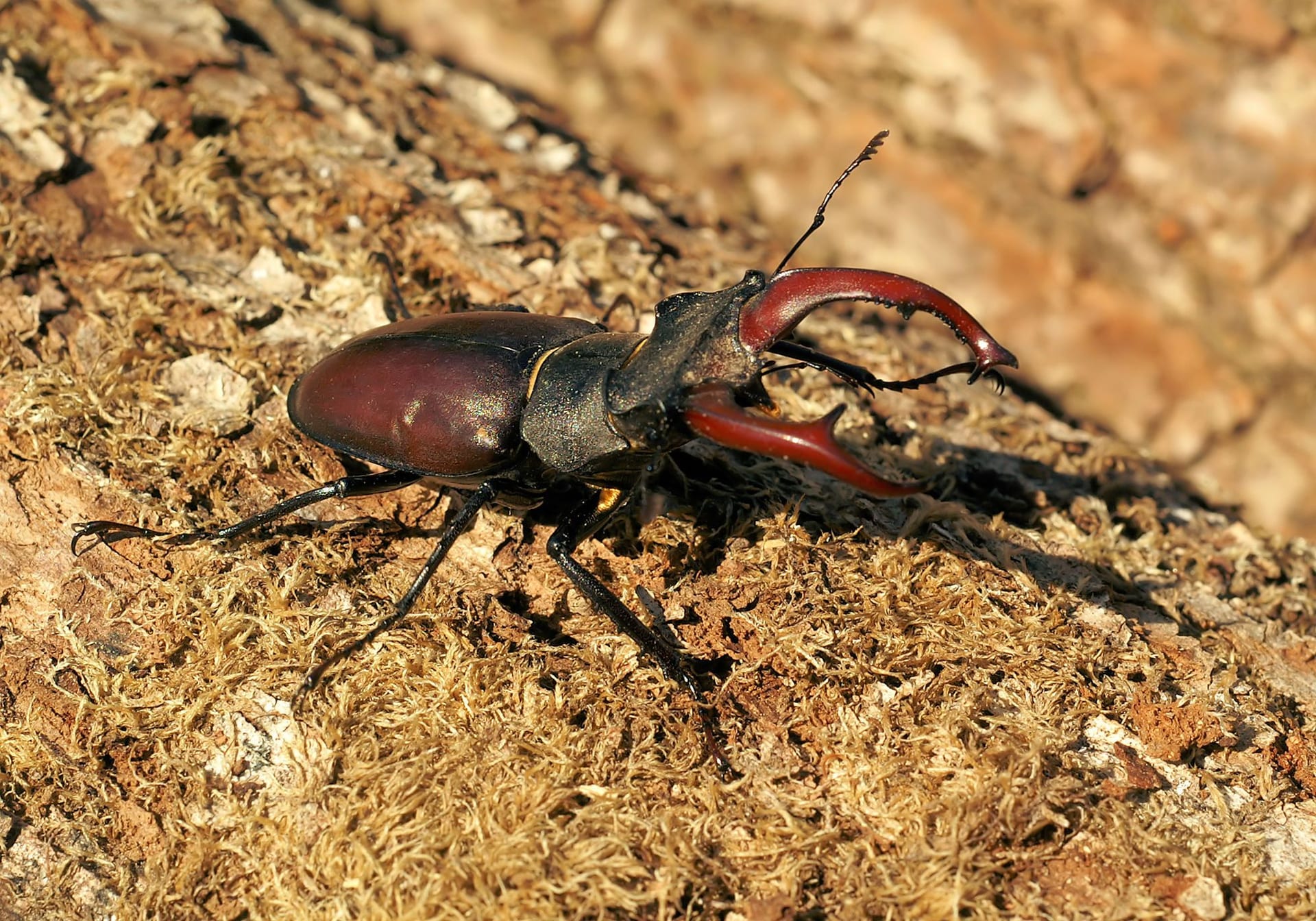
 © Orchi / CC BY-SA 3.0
European Stag Beetle
The European Stag Beetle is the largest beetle native to Europe and the type species of the genus Lucanus. Its reddish-black body and the male's dramatically oversized, antler-like mandibles give it a striking, powerful presence. Compared with Japan's native stag beetles, it has a broader build and a noticeably larger head, adding to its imposing look. Keeping this species well calls for some experience with temperature control and substrate selection, making it better suited to intermediate keepers. Adults remain active for only about two to three months, so that relatively short window makes every close observation of this striking beetle feel worthwhile.
View European Stag Beetle encyclopedia →0% commission on your first sales!Register by September 30, 2026 and your first 2 sales are commission-free!
Breeder Wanted!
List on BreederDirect and sell directly to customers nationwide!
6 Transparency Standards You Can Trust
When listing Insects, Breeders disclose the following. We guarantee transparency on growth stage and breeding unit.
- Life Stage Clarity
- Generation Info
- Real Photos
- Breeding Unit
- Country of Origin
- Body Length (mm)
Browse all 296 breeds
Verified breeders wanted for Insects
Breeders are signing up now ahead of launch. Subscribe to be notified when new listings go live.
Getting alerts is free with a member account. When new listings match your saved search, we'll notify you by email and in-app.
Browse other categories
Verified breeders (preview)
European Stag Beetle key facts
- Care level
- Intermediate
- Lifespan
- Adults active for two to three months
- Size
- Males to about 75mm, females 30-50mm (a record beetle of 90.0mm is known from the wild)
- Temperature
- 25℃
- Diet
- Adults take tree sap, fruit juices and beetle jelly; larvae eat well-rotted broadleaf wood
- Temperature & Humidity
- It occurs on lowlands that get hot in summer and tolerates warmth to a degree, but both adults and larvae are best held at or below 25C. High temperatures at pupation and eclosion often kill the beetle, so that is precisely when the temperature must come down. Keep the substrate at a moisture that forms a ball when squeezed.
- Breeding & Egg-laying
- Egg-laying is called easier and more productive than in the Japanese species. Figures for the larval period vary, from up to 24 months to three to seven years before pupation. The BE-KUWA 2025 edition records 93.6mm for the nominate subspecies (Hiroaki Tanokura, registered 2012; wild record 90.0mm, expected maximum 98mm), with 105.0mm for akbesianus and 104.8mm for judaicus.
- Cohabitation
- Adults are kept singly and put together only for pairing. Males fight by lifting an opponent with their mandibles and throwing him off, so they must always be separated. There are many subspecies and localities, so do not mix lines.
- Lifespan & Rearing Period
- Adults are active for two to three months, and their lifespan is sometimes given as only a few weeks; the beetle spends most of its life as a larva. Short-lived as an adult and vulnerable to the abrupt changes of shipping, it reaches the market far less often than the foreign Dorcus and Prosopocoilus species.
- Health & Notes
- The IUCN Red List treats it as Near Threatened, and it is listed in Annex II of the EU Habitats Directive, Appendix III of the Berne Convention and Schedule 5 of the UK Wildlife and Countryside Act 1981. It is protected in its native countries and numbers are reported to be falling. It is not on the CITES appendices, but choose captive-bred stock rather than beetles taken in the wild.
About European Stag Beetle
A guide to the European Stag Beetle, Europe's largest beetle, known for its reddish-black body and antler-like mandibles. Suited to intermediate keepers, with adults active for about two to three months.
7 things to know before welcoming a European Stag Beetle
1Best Suited to Intermediate Keepers
Keeping the European Stag Beetle is considered an intermediate-level challenge, requiring some knowledge of temperature and humidity control as well as substrate selection. Keepers with prior experience raising native stag beetles will likely find the transition smooth.
2Handle the Male's Mandibles with Care
Males carry large, antler-like mandibles that are the species' signature feature. They're used for display and contests with rival males, but their grip is strong, so take care to avoid getting a finger pinched when handling one.
3Adults Are Only Active for a Few Months
Adults remain active for roughly two to three months, a relatively short window. Because that time is limited, it helps to check on your beetle daily so you notice any changes early.
4A Clear Size Difference Between Sexes
Males can grow to roughly 75mm at their largest, and wild record specimens have reached as much as 90.0mm. Females are smaller, typically measuring 30 to 50mm, with noticeably smaller mandibles.
5How It Differs from Japan's Stag Beetle
Its reddish-black body is broader and more heavy-headed than that of Japan's native stag beetle. As the type species of the genus Lucanus, it offers an interesting point of comparison within the same genus.
6Setting Up a Suitable Enclosure
Line the enclosure with substrate of an appropriate depth and keep temperature and humidity from swinging suddenly. As a general rule, avoid direct sunlight and excessive heat or humidity, and keep the enclosure somewhere with good airflow.
7What to Prepare Before Bringing One Home
Before your beetle arrives, it's a good idea to have an enclosure, substrate, a food dish, and insect jelly ready to go. Since adults are only active for a limited time, setting everything up in advance lets your beetle settle into a proper environment from day one.
Frequently asked questions about European Stag Beetle
- Q.Can beginners keep a European Stag Beetle?
- A.This species is generally considered suited to intermediate keepers, and some prior experience with temperature and humidity control is helpful. Anyone who has already kept native stag beetles will likely find the transition fairly easy.
- Q.How long do adults live?
- A.Adults are typically active for about two to three months. It's a good idea to plan your care routine around this window.
- Q.Is the European Stag Beetle listed under CITES?
- A.No, the European Stag Beetle is not listed under CITES.
- Q.How is it different from Japan's native stag beetle?
- A.Its body is reddish-black, and it's broader with a larger head than Japan's native stag beetle. The male's mandibles are also dramatically enlarged, antler-like structures that give it a strikingly powerful look.
- Q.How much size difference is there between males and females?
- A.Males have large, developed mandibles and can grow to roughly 75mm at maximum, with wild record specimens reaching 90.0mm. Females have smaller mandibles and typically measure 30 to 50mm, making them noticeably smaller than males.
Useful tools for European Stag Beetle care
Learn more about European Stag Beetle in the encyclopedia
View European Stag Beetle encyclopedia entry →
Care difficulty, lifespan, size and diet — all basics covered.
More in this category
Can't find the one you're looking for?
Post your wishes for free and breeders with matching animals will contact you with introductions.