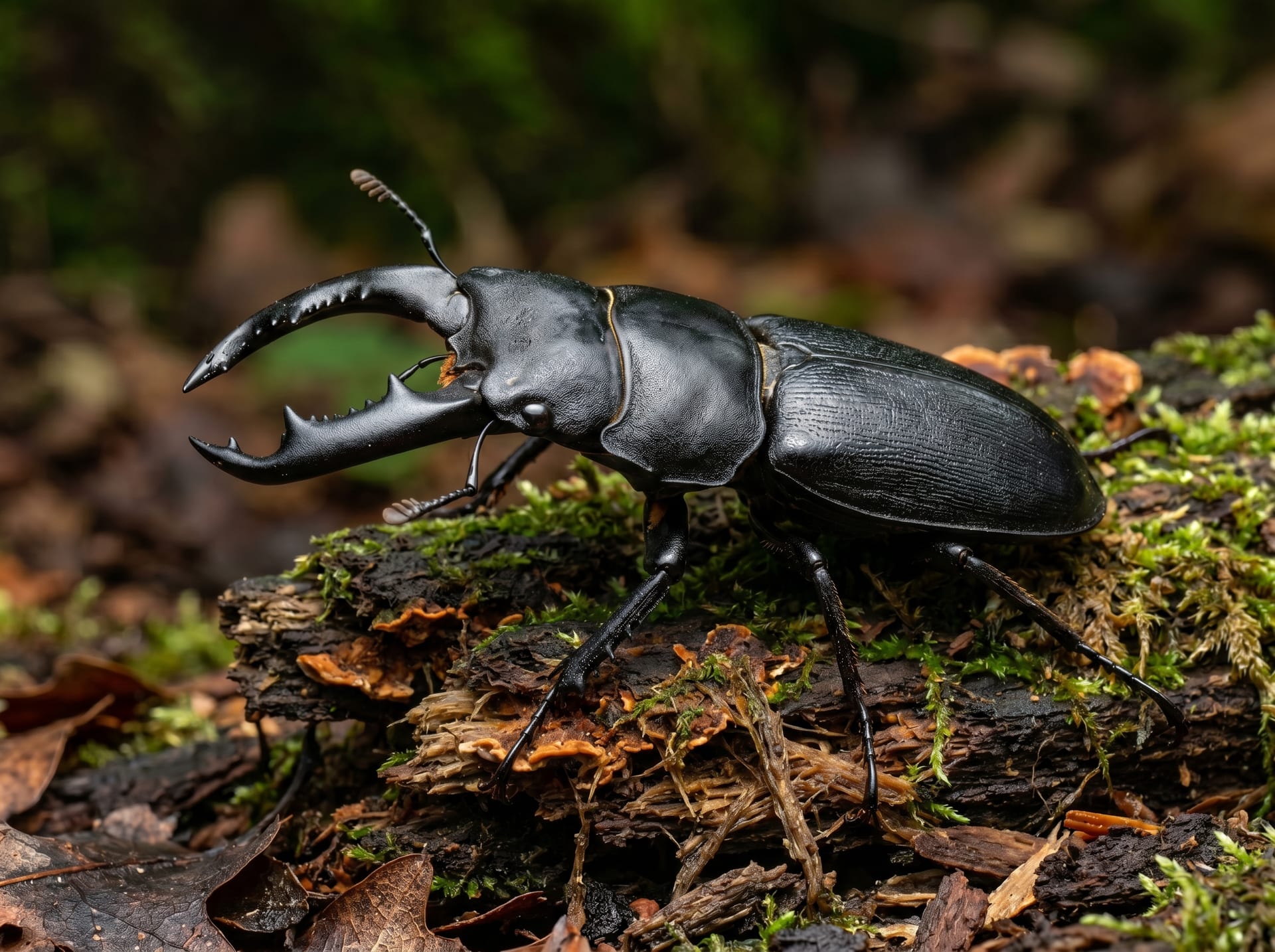
Taiwanese Giant Stag Beetle
The Taiwanese Giant Stag Beetle is endemic to Taiwan and considered a Taiwan subspecies of the Grandis Stag Beetle. Its glossy black body and powerful mandibles give it real presence, with males reaching roughly 38 to 78mm in the wild — and occasionally topping 80mm when raised in captivity. Males have strong mandibles and fight fiercely with one another, so they are best kept one to a container, and pairs should be watched so the male does not injure the female. Care follows much the same approach as Japan's native giant stag beetles, using bottled mycelium or fermented mat substrate. Adults can live two to four years, making for a long-term relationship with your beetle. It takes a bit of know-how, but with the basics down, this striking beetle rewards intermediate keepers well.
View Taiwanese Giant Stag Beetle encyclopedia →0% commission on your first sales!Register by September 30, 2026 and your first 2 sales are commission-free!
Breeder Wanted!
List on BreederDirect and sell directly to customers nationwide!
6 Transparency Standards You Can Trust
When listing Insects, Breeders disclose the following. We guarantee transparency on growth stage and breeding unit.
- Life Stage Clarity
- Generation Info
- Real Photos
- Breeding Unit
- Country of Origin
- Body Length (mm)
Browse all 296 breeds
Verified breeders wanted for Insects
Breeders are signing up now ahead of launch. Subscribe to be notified when new listings go live.
Getting alerts is free with a member account. When new listings match your saved search, we'll notify you by email and in-app.
Browse other categories
Verified breeders (preview)
Taiwanese Giant Stag Beetle key facts
- Care level
- Intermediate
- Lifespan
- Adults 2–4 years
- Size
- Males 38–78 mm, females 35–48 mm
- Temperature
- 18〜28℃
- Diet
- Insect jelly
- Notes
- Rearing and breeding are almost the same as for the Japanese giant stag beetle. It is said to be relatively short-tempered for a giant stag beetle, so watch that the male does not injure the female during pairing.
- Temperature & Humidity
- Aim for 18–28°C. Keep it above 10°C in winter and below 30°C in summer. Egg-laying needs 20°C or more (ideally 23–25°C). Keep the substrate moist enough to hold together when squeezed but crumble when pressed.
- Diet & Feeding
- Feed adults beetle jelly; in the wild they feed on sap from trees of the beech family. Larvae grow well in fungus bottles, with 1.4 L bottles recommended for males. They can also be raised on fermented flake substrate.
- Breeding & Egg-laying
- Pair mature adults at least six months after emergence, then place the female in a laying setup with buried sawtooth oak or konara oak logs, or artificial kawara (Trametes) logs. She lays in the wood; remove her after about a month and break open the logs 2–4 weeks later.
- Health & Cautions
- Adults live a long 2–4 years and can be kept for several years. Because it can hybridize with the Japanese giant stag beetle, never release captive individuals outdoors. Keep it out of direct sunlight.
About Taiwanese Giant Stag Beetle
Learn about the Taiwanese Giant Stag Beetle, a Taiwan subspecies of the Grandis Stag Beetle. Adults live 2-4 years and males grow to 38-78mm, making this an intermediate-level species to keep.
7 things to know before welcoming a Taiwanese Giant Stag Beetle
1Best Suited for Intermediate Keepers
The Taiwanese Giant Stag Beetle is considered a species for intermediate keepers. It can be raised using much the same methods as Japan's native giant stag beetles, so having some basic beetle-keeping knowledge helps things go smoothly. First-time keepers are encouraged to learn the basics before bringing one home.
2Temperature Control Is Key
Stag beetles are sensitive to heat, and managing temperature during summer is especially important. Keep the enclosure out of direct sunlight in a cool, well-ventilated spot. A room with stable temperature, such as one with air conditioning, is ideal.
3Don't House Males Together
Males use their large mandibles to fight fiercely, and housing two males in the same enclosure can lead to serious injury. Keep each beetle in its own enclosure as a rule. Even when pairing a male and female, monitor them closely and keep time together brief.
4Handle the Mandibles with Care
Males have well-developed mandibles that can pinch hard enough to hurt if you're caught between them. Pick the beetle up by the thorax, between the head and body, and keep your fingers out of the mandibles' reach. If a child wants to handle one, an adult should supervise.
5Males and Females Differ in Size
In the wild, males grow to roughly 38-78mm while females reach about 35-48mm, with males showing more variation due to their mandible development. Individual size can vary even within the same species, so the beetle you bring home may differ in appearance from others. If keeping a pair, it helps to keep this size difference in mind when choosing individuals.
6Adults Live 2 to 4 Years
Adults typically live for two to four years, making them fairly long-lived as insects go. That long lifespan means ongoing care, steady temperature management and regular feeding, is essential throughout. Keeping them in an environment with minimal temperature swings helps them live out their full lifespan.
7Prepare Supplies Before Bringing One Home
Before your beetle arrives, prepare an enclosure, substrate or mycelium bottle, insect jelly, and a piece of wood or bark to prevent it from getting stuck on its back. A reasonably sized enclosure gives the beetle room to move comfortably. Having everything ready in advance makes for a smooth transition into its new home.
Frequently asked questions about Taiwanese Giant Stag Beetle
- Q.How big does the Taiwanese Giant Stag Beetle get?
- A.Males grow to roughly 38-78mm in the wild, while females reach about 35-48mm. In captivity, some males emerge at over 80mm. Since individual size varies quite a bit, the beetle you bring home may be larger or smaller than others.
- Q.How long do they live?
- A.Adults typically live for two to four years, which is fairly long for an insect. Day-to-day care, especially stable temperature management, affects how well they reach that lifespan. Their long lifespan is part of what makes them appealing to keep.
- Q.Is this species difficult to keep?
- A.The Taiwanese Giant Stag Beetle is considered suitable for intermediate keepers. It can be raised using much the same methods as Japan's native giant stag beetles, so basic beetle-keeping knowledge is enough to care for it without much trouble. First-time keepers may want to research the basics beforehand.
- Q.Can I keep a male and female together?
- A.Two males should never be housed together, as they will fight fiercely. Even a male and female pair is not always safe together, since the female can be attacked depending on timing and compatibility. It's safest to keep them separately and only pair them briefly, under supervision, when breeding.
- Q.What should I feed it?
- A.Store-bought insect jelly is the standard food for adults. Jelly dries out and degrades quickly, so replace it regularly. If you offer fruit, keep in mind it spoils fast, so don't leave it in the enclosure too long.
Useful tools for Taiwanese Giant Stag Beetle care
Learn more about Taiwanese Giant Stag Beetle in the encyclopedia
View Taiwanese Giant Stag Beetle encyclopedia entry →
Care difficulty, lifespan, size and diet — all basics covered.
More in this category
Can't find the one you're looking for?
Post your wishes for free and breeders with matching animals will contact you with introductions.