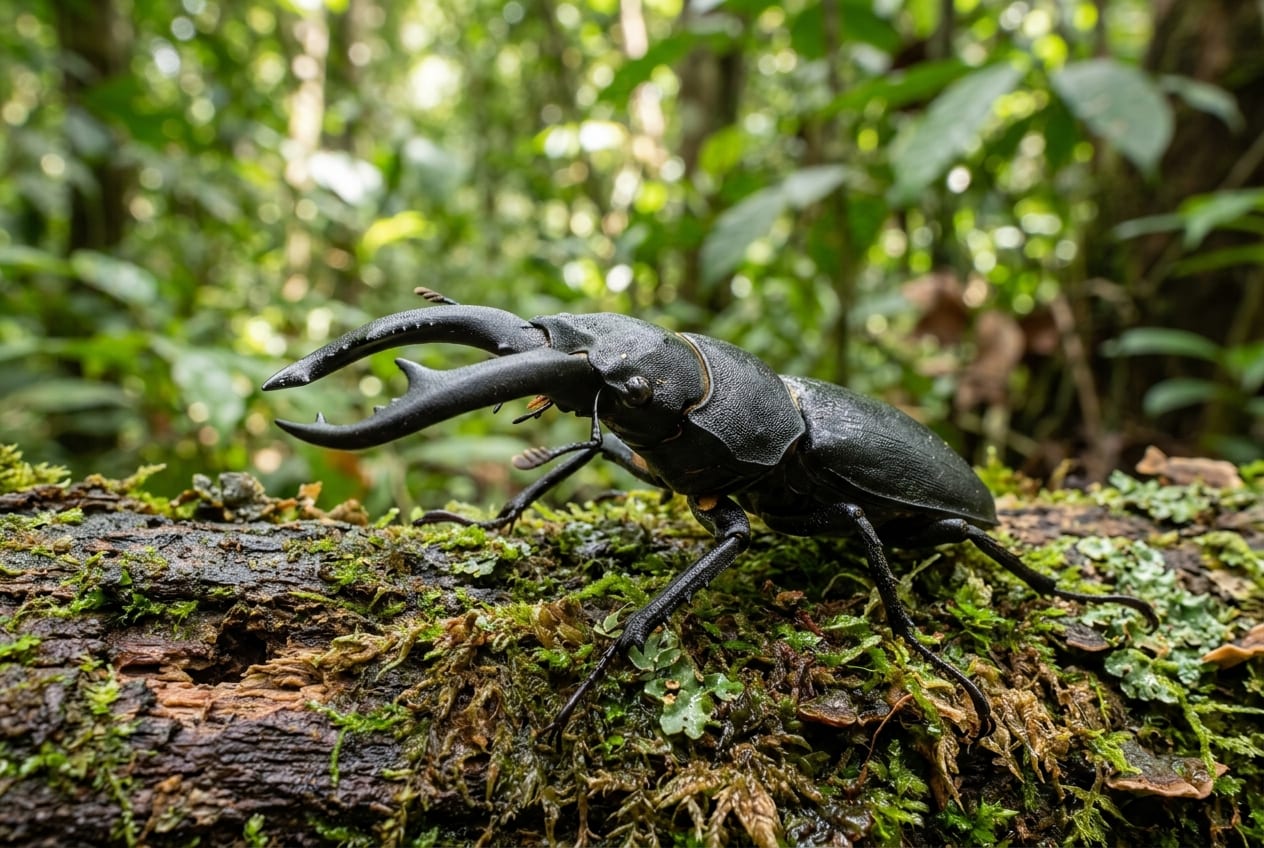
Nigritus Stag Beetle
The Nigritus Stag Beetle is a rare species known only from the mountains around Khao Yai in central Thailand. Its most striking feature is a uniformly glossy black body, giving it the look of a darkened cousin to the Parry's stag beetle. The mandible shape closely resembles that of the Bukit stag beetle from Java, though the two can be distinguished by differences in the shape of the pronotum's side margins. Because it reaches keepers in limited numbers, coming across one is something of an occasion. Like other Hexarthrius species, breeding relies on an egg-laying log, making this a beetle best suited to keepers with some prior stag beetle experience.
View Nigritus Stag Beetle encyclopedia →0% commission on your first sales!Register by September 30, 2026 and your first 2 sales are commission-free!
Breeder Wanted!
List on BreederDirect and sell directly to customers nationwide!
6 Transparency Standards You Can Trust
When listing Insects, Breeders disclose the following. We guarantee transparency on growth stage and breeding unit.
- Life Stage Clarity
- Generation Info
- Real Photos
- Breeding Unit
- Country of Origin
- Body Length (mm)
Browse all 296 breeds
Verified breeders wanted for Insects
Breeders are signing up now ahead of launch. Subscribe to be notified when new listings go live.
Getting alerts is free with a member account. When new listings match your saved search, we'll notify you by email and in-app.
Browse other categories
Verified breeders (preview)
Nigritus Stag Beetle key facts
- Care level
- Intermediate
- Lifespan
- Adults 6 months to 1 year
- Size
- Males up to 81mm (wild max), females up to 50.9mm (captive record)
- Temperature
- 23〜25℃
- Diet
- Beetle jelly (adults); fermented substrate or kinshi bottles (larvae)
- Temperature & Humidity
- No species-specific temperature is published. As a rule for the genus keep adults at 23-25C, larvae at 20-25C and the laying set slightly warm at 25-27C.
- Breeding & Egg-laying
- As for the genus, lay Quercus logs on the surface; eggs sit near the log surface. Not prolific; leave the set untouched for 1-2 months.
- Cohabitation
- Most Hexarthrius are aggressive and this species is housed singly. Tie the male's mandibles for cohabitation pairing.
- Lifespan & Rearing Period
- No species-specific adult lifespan is published. As for the genus, larvae emerge from fermented substrate or kinshi in 8-12 months (males) or 6-10 months (females).
- Health & Notes
- With little trade and few breeding reports, secure several pairs to maintain lines. Guard against confusion with the all-black Buquet's stag and manage stock by locality label.
About Nigritus Stag Beetle
A rare all-black stag beetle found only in Thailand's Khao Yai mountains, resembling a darkened Parry's stag beetle. Breeding relies on an egg-laying log, as with other Hexarthrius species.
7 things to know before welcoming a Nigritus Stag Beetle
1Native only to Khao Yai
This species is known only from a limited mountain range around Khao Yai in central Thailand. Because it isn't widely distributed among keepers, finding one available is a notable occasion.
2All-black body color
Unlike most other Hexarthrius stag beetles, its entire body is a uniform glossy black. The overall look is often described as a darkened version of the Parry's stag beetle.
3Telling it apart from lookalikes
The mandible shape is similar to that of the Bukit stag beetle from Java, but the two can be told apart by the shape of the pronotum's side margins. It's worth checking this detail when choosing an individual.
4Breeding relies on a log
As with other Hexarthrius species, breeding is based on using an egg-laying log suited to the female. The condition and quality of the log has a major effect on breeding success, so it helps to research the method beforehand.
5Best for intermediate keepers
Day-to-day care is similar to other stag beetles, but replicating suitable temperature, humidity, and egg-laying conditions takes some prior experience. First-time keepers may want to research care basics before bringing one home.
6Keep males separated
Males carry large mandibles and can injure each other if housed together. If keeping more than one, house each individual separately.
7Size varies by individual
Wild-caught males have been recorded up to about 81mm, while captive-bred females have reached up to about 50.9mm. Because larval rearing conditions affect adult size, it's worth confirming an individual's growth stage when acquiring one.
Frequently asked questions about Nigritus Stag Beetle
- Q.Where does this species live in the wild?
- A.It is known only from a mountain range around Khao Yai in central Thailand, which is why it's not widely available.
- Q.What is its most distinctive feature?
- A.Its most distinctive trait is a uniform glossy black body. It gives the impression of a darkened Parry's stag beetle.
- Q.How is it different from the Bukit stag beetle from Java?
- A.The mandible shapes are quite similar, but the two can be distinguished by the shape of the pronotum's side margins. Comparing them side by side makes the difference clearer.
- Q.Can beginners keep this species?
- A.It's considered suitable for intermediate keepers. Basic care is similar to other stag beetles, but breeding requires some experience handling an egg-laying log.
- Q.Is this species listed under CITES?
- A.No, this species is not covered under CITES.
Useful tools for Nigritus Stag Beetle care
Learn more about Nigritus Stag Beetle in the encyclopedia
View Nigritus Stag Beetle encyclopedia entry →
Care difficulty, lifespan, size and diet — all basics covered.
More in this category
Can't find the one you're looking for?
Post your wishes for free and breeders with matching animals will contact you with introductions.