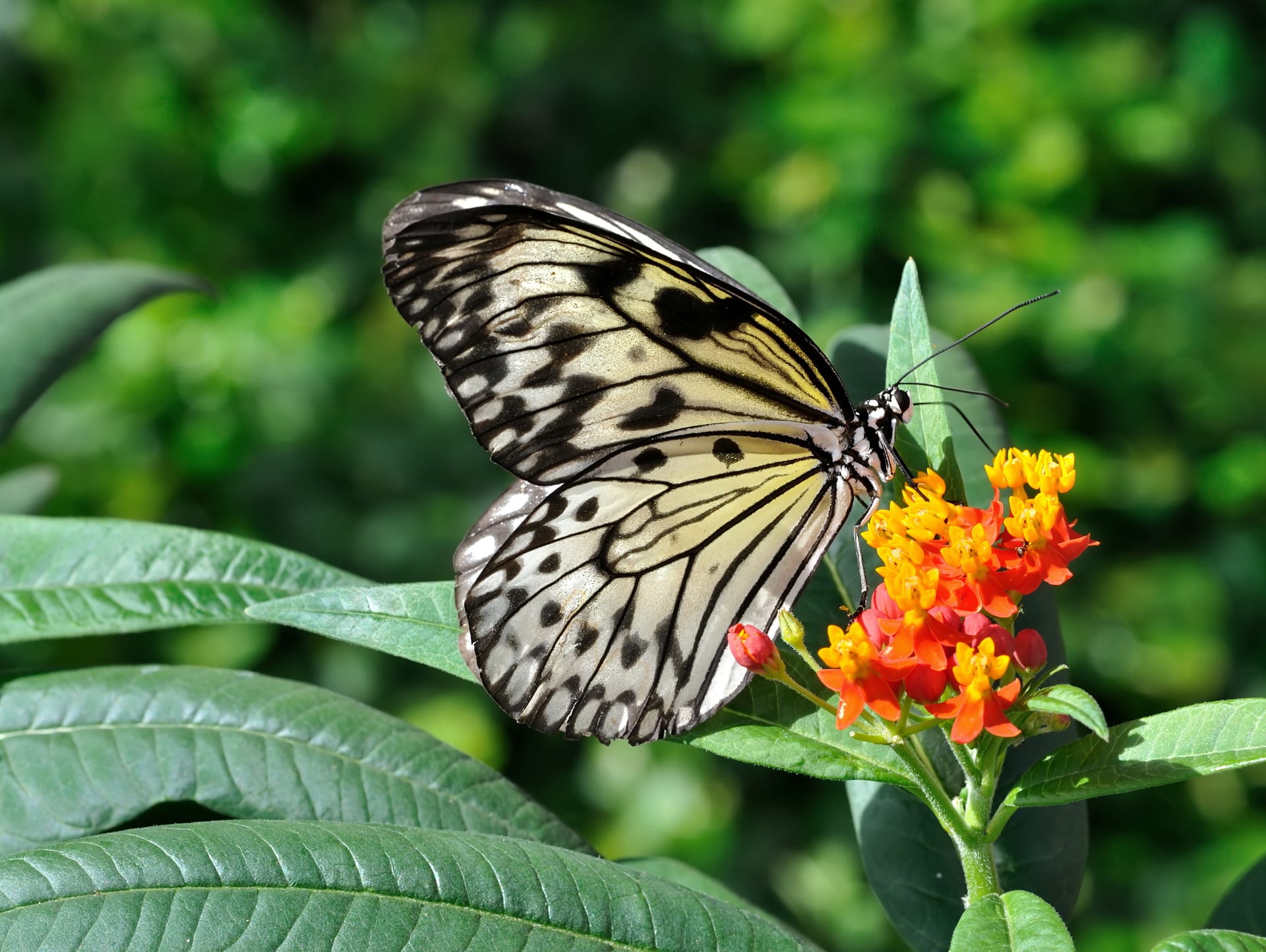
 © Quartl / CC BY-SA 3.0
Tree Nymph Butterfly
The Tree Nymph Butterfly (Idea leuconoe) is one of Japan's largest marked butterflies, its elegant wings patterned in white with bold black veins and spots. It flies with a slow, gliding motion rather than quick flutters, making it a beloved centerpiece in butterfly houses and insect museums. Caterpillars feed on a specific host vine known in Japanese as horai-kagami, and the species is famous for its brilliant, mirror-like golden chrysalis, a moment of emergence that draws plenty of admirers. Adults are notably unafraid of people, so it's easy to watch them feeding on nectar up close. As long as the host plant is available, the full life cycle can be completed indoors, which is why it's such a popular choice for insect museums and school programs.
View Tree Nymph Butterfly encyclopedia →0% commission on your first sales!Register by September 30, 2026 and your first 2 sales are commission-free!
Breeder Wanted!
List on BreederDirect and sell directly to customers nationwide!
6 Transparency Standards You Can Trust
When listing Insects, Breeders disclose the following. We guarantee transparency on growth stage and breeding unit.
- Life Stage Clarity
- Generation Info
- Real Photos
- Breeding Unit
- Country of Origin
- Body Length (mm)
Browse all 296 breeds
Verified breeders wanted for Insects
Breeders are signing up now ahead of launch. Subscribe to be notified when new listings go live.
Getting alerts is free with a member account. When new listings match your saved search, we'll notify you by email and in-app.
Browse other categories
Verified breeders (preview)
Tree Nymph Butterfly key facts
- Care level
- Intermediate
- Lifespan
- Adults 2-3 months (up to six months in good conditions); egg to adult about 40 days
- Size
- Wingspan 12-14cm (forewing about 7cm); final-instar larva about 7cm
- Temperature
- 26℃
- Diet
- Larvae eat Parsonsia alboflavescens and Tylophora leaves; adults take nectar
- Temperature & Humidity
- Insectariums rear at about 26C. As a subtropical species it needs heating in winter; pupae kept cooler emerge later.
- Breeding & Egg-laying
- Eggs are laid on the underside of the host plant; egg about 5 days, larva about 20 days, pupa 15-20 days. Adults mate and lay readily in a screened cage.
- Cohabitation
- Adults are gentle and are kept in groups in greenhouses. Larvae consume a lot of foliage, so limit numbers per host plant.
- Lifespan & Rearing Period
- Adults live 2-3 months, up to six months. Egg to adult takes about 40 days, allowing continuous year-round rearing.
- Health & Notes
- Larvae, pupae and adults are toxic from host-plant alkaloids. Colonies collapse if the host plant runs out, so secure plants before rearing.
About Tree Nymph Butterfly
The Tree Nymph Butterfly is one of Japan's largest marked species, prized for its bold black-and-white wings and a strikingly golden, mirror-like chrysalis.
7 things to know before welcoming a Tree Nymph Butterfly
1Host Plant Is a Must
Caterpillars eat only the leaves of a single host vine, horai-kagami. Before bringing one home, make sure you can reliably grow or source this plant, since a shortage will directly affect larval growth.
2A Shimmering Golden Chrysalis
The chrysalis develops a mirror-like, metallic gold sheen, one of the species' signature traits. As emergence approaches, it darkens and becomes translucent, letting the wing pattern show through.
3Adult Lifespan: 2-3 Months
Adults typically live about 2 to 3 months, though they can survive up to half a year under favorable conditions. The journey from egg to emergence takes roughly 40 days.
4Temperature Control Matters
Native to tropical and subtropical regions, this butterfly is sensitive to cold and needs stable indoor warmth during cooler months. Sudden temperature swings can stress both caterpillars and pupae.
5Impressive Wingspan
With a wingspan of 12 to 14 cm, it's one of the larger butterflies you can keep, gliding gracefully rather than fluttering quickly. The full-grown caterpillar also reaches an impressive 7 cm or so.
6Calm, People-Friendly Nature
Adults are notably unafraid of people and will often keep feeding on nectar even when observed up close. This makes them a rewarding species for photography and for first-time close encounters with butterflies.
7Best Suited to Intermediate Keepers
This species is generally recommended for intermediate keepers, since daily care involves managing host plant supply along with temperature and humidity. It's worth reviewing the basics of butterfly husbandry before getting started.
Frequently asked questions about Tree Nymph Butterfly
- Q.Is the Tree Nymph Butterfly suitable for beginners?
- A.It's generally considered an intermediate-level species, requiring some knowledge of host plant care and temperature and humidity management. With the basics in place, though, it's a rewarding species to try.
- Q.What if I can't find the host plant, horai-kagami?
- A.Caterpillars eat almost exclusively horai-kagami leaves, so it's important to secure a plant source or growing setup before bringing them home.
- Q.How long do adults typically live?
- A.Adult lifespan is usually around 2 to 3 months, though it varies with conditions. Under favorable conditions, they can live up to about half a year.
- Q.Why does the chrysalis turn gold?
- A.The golden sheen comes from the structure of the pupal shell and is one of the species' most distinctive traits. As emergence approaches, the color shifts and the wing pattern beneath becomes visible.
- Q.Can the full life cycle be completed indoors?
- A.Yes, if you can consistently supply the host plant, horai-kagami, the life cycle can be completed indoors. That's why the species is widely kept in insect museums and schools.
Useful tools for Tree Nymph Butterfly care
Learn more about Tree Nymph Butterfly in the encyclopedia
View Tree Nymph Butterfly encyclopedia entry →
Care difficulty, lifespan, size and diet — all basics covered.
More in this category
Can't find the one you're looking for?
Post your wishes for free and breeders with matching animals will contact you with introductions.