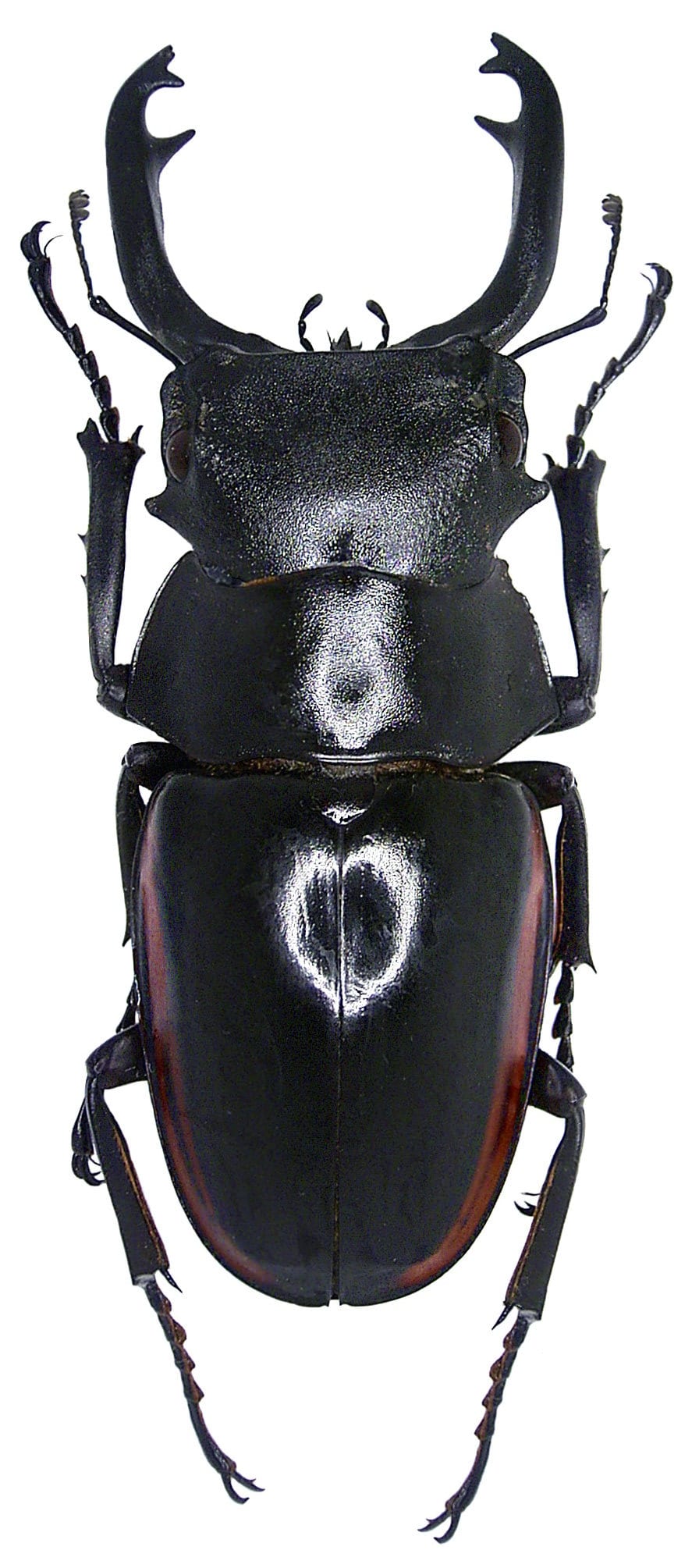
 © Udo Schmidt / CC BY-SA 2.0
Stevens' Shining Stag Beetle
Stevens' Shining Stag Beetle is found mainly on the Indonesian island of Sulawesi. Its most striking trait is the male's mandible: at the base it splits sideways before running straight out, without any inner teeth—a clean, distinctive silhouette. The yellow-tinged edge of the elytra adds a touch of color that catches the light beautifully. Several subspecies are recognized across its range, so appearance can vary noticeably by locality. This species suits keepers with some prior stag beetle experience, given its intermediate care requirements, and adults typically live only a few months—worth making the most of the time you have together.
View Stevens' Shining Stag Beetle encyclopedia →0% commission on your first sales!Register by September 30, 2026 and your first 2 sales are commission-free!
Breeder Wanted!
List on BreederDirect and sell directly to customers nationwide!
6 Transparency Standards You Can Trust
When listing Insects, Breeders disclose the following. We guarantee transparency on growth stage and breeding unit.
- Life Stage Clarity
- Generation Info
- Real Photos
- Breeding Unit
- Country of Origin
- Body Length (mm)
Browse all 296 breeds
Verified breeders wanted for Insects
Breeders are signing up now ahead of launch. Subscribe to be notified when new listings go live.
Getting alerts is free with a member account. When new listings match your saved search, we'll notify you by email and in-app.
Browse other categories
Verified breeders (preview)
Stevens' Shining Stag Beetle key facts
- Care level
- Intermediate
- Lifespan
- A few months as an adult
- Size
- Captive records 84.4mm for the nominate form and 86.0mm for Sangihe stock (wild records 93.0mm and 90.3mm)
- Diet
- Adults take fermented sap of broadleaf trees and beetle jelly; larvae eat humus close to soil
- Temperature & Humidity
- Odontolabis adults and larvae alike tolerate cold poorly and are said to be unable to survive a winter on mainland Japan or further north. Do not let the substrate dry out.
- Breeding & Egg-laying
- The larvae feed on humus formed where broadleaf wood has rotted down close to soil. For the genus, spent substrate mixed with the remains of mycelium or nitrogen-rich rhinoceros-beetle substrate is used for the larvae, with red-rotted flake for the species that are hard to breed. The captive records are 84.4 mm for the nominate form and 86.0 mm for Sangihe stock.
- Cohabitation
- Male Odontolabis are for the most part short-tempered and combative, and a male will sometimes kill a female he does not take to. Several are never kept together and each beetle is housed alone. The larvae too hold their chamber in the humus as territory, attacking and sometimes eating intruders, so they are reared separately.
- Lifespan & Rearing Period
- For the genus, one to two years pass between hatching and pupation and the adults live a few months. Beetles that have been active for about a month and a half are said to start losing tarsi and antennal segments to necrosis at an increasing rate.
- Health & Notes
- Subspecies are separated by locality even within Sulawesi, and Sangihe stock circulates as a distinct form, so beetles from different regions should not be mixed. Importing live Scarabaeoidea requires the species identification certificate. Odontolabis larvae compete strongly with other species, so the beetles must never be released or abandoned outdoors.
About Stevens' Shining Stag Beetle
A shining stag beetle native mainly to Sulawesi, Indonesia. Males have straight, toothless mandibles and yellow-edged elytra; several subspecies are recognized, and it's considered suited to intermediate keepers.
7 things to know before welcoming a Stevens' Shining Stag Beetle
1Native to Sulawesi
Stevens' Shining Stag Beetle is found mainly on the Indonesian island of Sulawesi, with populations also recorded on nearby islands. Appearance can vary somewhat by locality. Since its native range is tropical, keep that in mind when setting up housing conditions.
2Straight, toothless jaws
The male's mandibles split sideways at the base and then run straight out, without any inner teeth—a simpler shape than many other stag beetles. That clean structure gives it a distinctive look, and the exact length and angle vary from one individual to another.
3Yellow-edged elytra
The defining feature of this species is the yellow tint along the edge of the elytra (wing covers). How vivid the yellow and its sheen appear can shift depending on the light and the individual beetle, and coloring can also vary somewhat with maturity.
4Subspecies vary by locality
Multiple subspecies of Stevens' Shining Stag Beetle have been described, and mandible shape and body form differ somewhat by locality of origin. It's worth checking which locality a beetle comes from beforehand, since the impression can differ quite a bit.
5Adults live only months
Adult lifespan is typically just a few months, shorter than many long-lived stag beetle species. Set up its enclosure soon after arrival so you can make the most of the limited time you'll have together.
6Intermediate-level care
This species is generally considered suited to keepers with some prior experience, since it calls for reasonably careful temperature and humidity management. First-time keepers may want to research care basics before deciding to bring one home.
7Prepare before bringing home
Before your beetle arrives, prepare basic supplies such as insect mat, a climbing branch, and insect jelly, along with a spot where temperature and humidity can be kept stable. Having a settled environment ready as soon as it arrives supports healthy care afterward.
Frequently asked questions about Stevens' Shining Stag Beetle
- Q.How difficult is it to keep?
- A.It's generally considered a species for intermediate-level keepers. It calls for someone reasonably comfortable managing temperature and humidity, so newcomers may want to learn the basics of stag beetle care before bringing one home.
- Q.How long do the adults live?
- A.Adult lifespan is typically just a few months, shorter than many long-lived stag beetle species. Set up a stable environment soon after arrival so you can make the most of that time.
- Q.Is it normal for the mandibles to have no inner teeth?
- A.Yes, that's a defining trait of this species. The male's mandibles split sideways at the base and then run straight out with no inner teeth, giving it a simpler silhouette than many other stag beetles.
- Q.How big does it get?
- A.Captive-bred records include 84.4mm for the nominotypical subspecies and 86.0mm for the Sangihe Islands population. Wild-caught records reach 93.0mm and 90.3mm, so size varies considerably between individuals.
- Q.Is this species covered by CITES?
- A.No, Stevens' Shining Stag Beetle is not subject to CITES.
Useful tools for Stevens' Shining Stag Beetle care
Learn more about Stevens' Shining Stag Beetle in the encyclopedia
View Stevens' Shining Stag Beetle encyclopedia entry →
Care difficulty, lifespan, size and diet — all basics covered.
More in this category
Can't find the one you're looking for?
Post your wishes for free and breeders with matching animals will contact you with introductions.