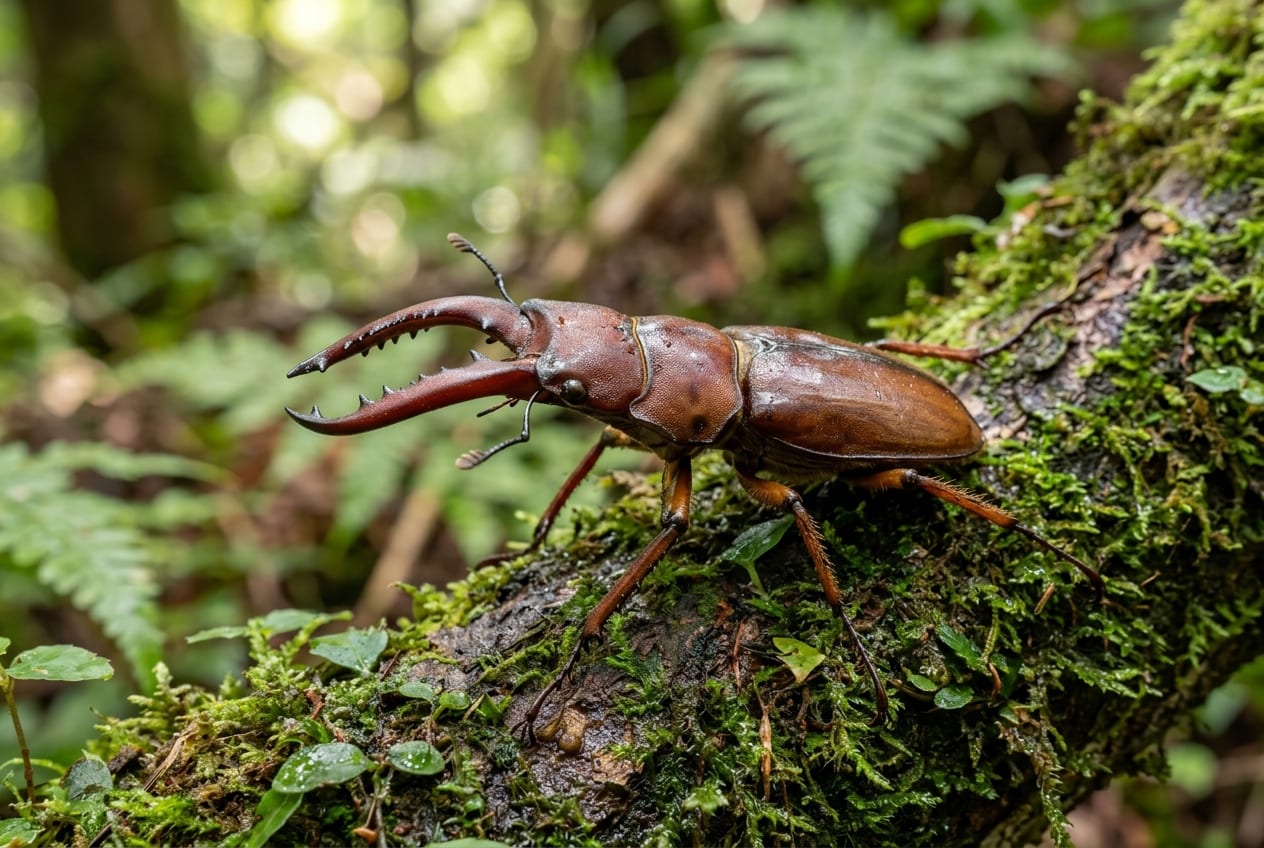
Mishima-Io Saw Stag Beetle
The Mishima-Io Saw Stag Beetle is a rare subspecies of saw stag beetle found only on Iojima Island in Kagoshima Prefecture's Mishima village. Compared to the nominate subspecies found on the mainland, its mandibles are noticeably thicker with a gentler curve, giving it a bold yet rounded silhouette that sets it apart. Individuals tend to develop a more pronounced mandible curve once they exceed roughly 60mm in body length, so no two beetles look quite the same. Most individuals show a reddish-brown coloration, while black-brown specimens are uncommon. Considered an easy species for beginners, it makes a great starting point for anyone new to stag beetle keeping.
View Mishima-Io Saw Stag Beetle encyclopedia →0% commission on your first sales!Register by September 30, 2026 and your first 2 sales are commission-free!
Breeder Wanted!
List on BreederDirect and sell directly to customers nationwide!
6 Transparency Standards You Can Trust
When listing Insects, Breeders disclose the following. We guarantee transparency on growth stage and breeding unit.
- Life Stage Clarity
- Generation Info
- Real Photos
- Breeding Unit
- Country of Origin
- Body Length (mm)
Browse all 296 breeds
Verified breeders wanted for Insects
Breeders are signing up now ahead of launch. Subscribe to be notified when new listings go live.
Getting alerts is free with a member account. When new listings match your saved search, we'll notify you by email and in-app.
Browse other categories
Verified breeders (preview)
Mishima-Io Saw Stag Beetle key facts
- Care level
- Beginner-friendly
- Lifespan
- 2-3 months once active (adults overwinter in the pupal cell after emergence)
- Size
- Males 27.5-69.3mm, females 24.5-35mm
- Temperature
- 18〜24℃
- Diet
- Beetle jelly (tabunoki and Japanese mallotus sap in the wild); larvae on fermented substrate or fungus bottles
- Temperature & Humidity
- As a Japanese species it can be kept at room temperature. For large adults the guideline is about 20C for young larvae, 18-20C in the third instar and 20-24C around pupation. Avoid summer heat.
- Breeding & Egg-laying
- It breeds in the standard saw stag set of a log buried in fermented substrate. In the wild larvae occur in the roots of rotten hardwood and buried logs, especially camellia.
- Cohabitation
- House singly. Males are aggressive and can crush females, so pair only briefly and under supervision.
- Lifespan & Rearing Period
- Adults overwinter in the pupal cell and become active the following year. The wild flight season runs from July to November, late for a saw stag beetle.
- Health & Notes
- It is restricted to Iwojima, so never mix it with saw stags from other localities. Insect collecting is reported to be banned by ordinance in Mishima village, so stock in trade is mainly captive-bred.
About Mishima-Io Saw Stag Beetle
A rare saw stag beetle subspecies found only on Iojima Island, Kagoshima. Known for thick, gently curved mandibles and reddish-brown coloring, it's an easy beetle for beginners to keep.
7 things to know before welcoming a Mishima-Io Saw Stag Beetle
1Found Only on Iojima Island
This subspecies is found only on Iojima Island in Kagoshima Prefecture's Mishima village and doesn't occur naturally anywhere else. It's often confused with the nominate subspecies, but the shape of its mandibles sets it apart.
2Thick, Gently Curved Mandibles
Compared to the nominate subspecies, this beetle has noticeably thicker mandibles with a gentler curve. The curve tends to become more pronounced once body length exceeds roughly 60mm, so you can enjoy subtle differences depending on growth stage.
3Mostly Reddish-Brown Coloring
Most individuals display a reddish-brown body color, while black-brown specimens are uncommon. Since coloring varies between individuals, comparing a few before choosing one adds to the fun.
4Beginner-Friendly to Keep
This beetle is considered relatively easy to keep, making it a good choice for first-time insect keepers. Basic temperature control and misting for humidity are usually enough to keep it stable.
5Short 2-3 Month Active Period
Adults remain active for only about 2 to 3 months after emerging. Since this window is limited, it's worth preparing your setup in advance so you can make the most of the observation and care period.
6Overwinters in the Pupal Cell
After pupation, individuals don't become active right away — they overwinter inside the pupal cell before emerging. Keep in mind that the timing of digging them out can shift when they actually start being active.
7Size Varies by Individual
Males range from 27.5 to 69.3mm and females from 24.5 to 35mm, so size varies quite a bit between individuals. Larger males in particular tend to show a stronger mandible curve, adding another dimension to their appearance.
Frequently asked questions about Mishima-Io Saw Stag Beetle
- Q.Is it suitable for beginners?
- A.Yes, it's considered a beginner-friendly species. As long as you manage basic temperature and humidity, it's easy to keep even without specialized equipment.
- Q.How is it different from a regular saw stag beetle?
- A.Compared to the nominate subspecies, it has thicker mandibles with a weaker curve. Its distribution is also limited to Iojima Island in Kagoshima's Mishima village.
- Q.How long does it live?
- A.Adults are typically active for about 2 to 3 months after emerging. After pupation, they overwinter inside the pupal cell before coming out.
- Q.How much does size differ between males and females?
- A.Males grow larger, ranging from 27.5 to 69.3mm, while females range from 24.5 to 35mm. Larger males also tend to have a more pronounced mandible curve.
- Q.Is this species subject to any regulations?
- A.This species is not subject to CITES.
Useful tools for Mishima-Io Saw Stag Beetle care
Learn more about Mishima-Io Saw Stag Beetle in the encyclopedia
View Mishima-Io Saw Stag Beetle encyclopedia entry →
Care difficulty, lifespan, size and diet — all basics covered.
More in this category
Can't find the one you're looking for?
Post your wishes for free and breeders with matching animals will contact you with introductions.