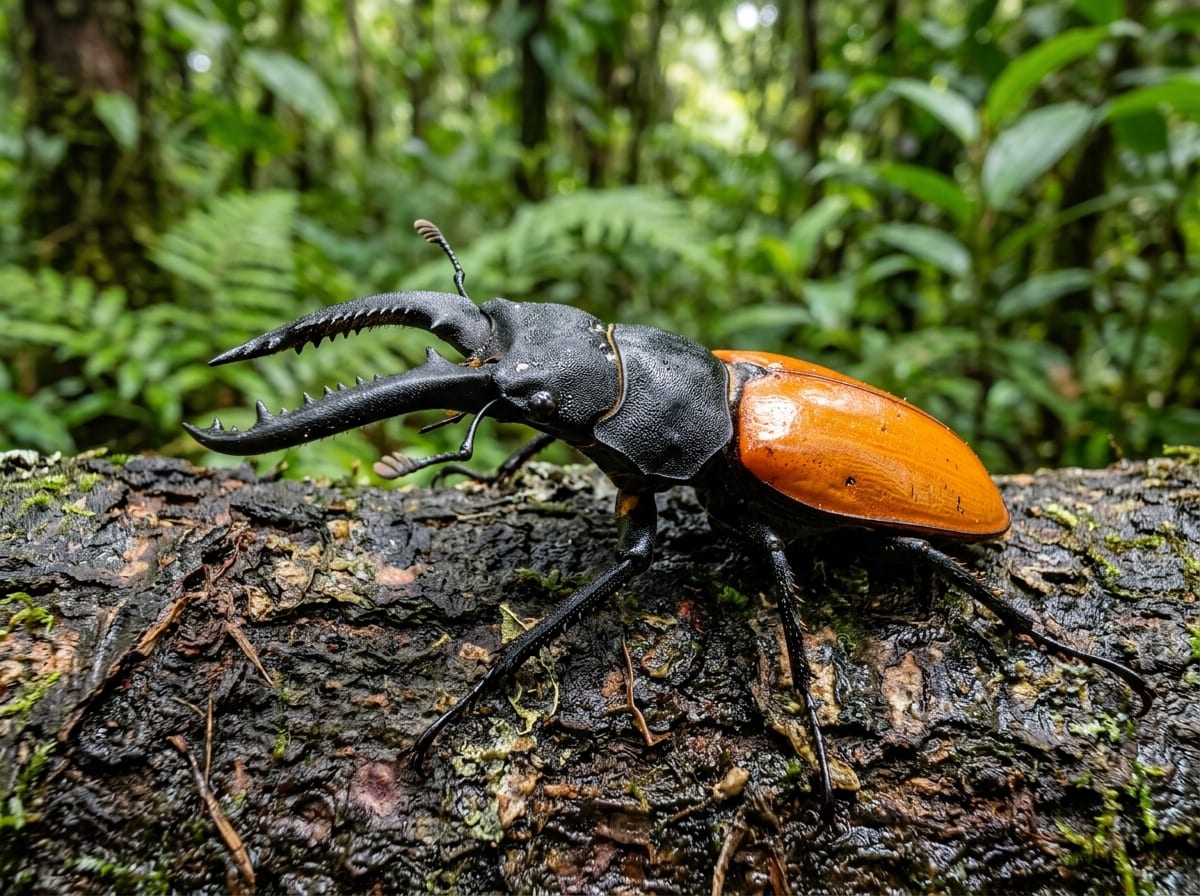
Laferte's saw stag beetle
The Laferte's saw stag beetle hails from New Caledonia and other islands across the South Pacific. Unlike most of its slender-bodied relatives in the saw stag beetle group, it has a noticeably stout, thick-set body, set off by strikingly orange forewings. Its legs give it an unusually strong grip, letting it cling tightly to bark and branches. To avoid fights between males, adults are best kept individually. Because keeping this species well calls for some baseline husbandry knowledge, it's generally considered better suited to keepers with some prior experience than absolute beginners.
View Laferte's saw stag beetle encyclopedia →Breeder Wanted!
List on BreederDirect and sell directly to customers nationwide!
BreederDirect's 6 Transparency Commitments
When listing Insects, Breeders disclose the following. We guarantee transparency on growth stage and breeding unit.
- Life Stage Clarity
- Generation Info
- Real Photos
- Breeding Unit
- Country of Origin
- Body Length (mm)
Browse all 336 breeds
Verified breeders wanted for Insects
Breeders are signing up now ahead of launch. Subscribe to be notified when new listings go live.
Getting alerts is free with a member account. When new listings match your saved search, we'll notify you by email and in-app.
Browse other categories
Verified breeders (preview)
Laferte's saw stag beetle key facts
- Care level
- Intermediate
- Lifespan
- Larval stage 10-14 months (little data on adult lifespan)
- Size
- Captive records 83.4mm (male) and 48.7mm (female); wild record 81.2mm (male)
- Diet
- Adults take beetle jelly; larvae eat fine fermented substrate
- Temperature & Humidity
- There is little numeric temperature data. It is regarded as easy to rear, with large adults emerging readily.
- Breeding & Egg-laying
- Females lay well in substrate, so use a good, fine-grained fermented substrate.
- Lifespan & Rearing Period
- The larval stage is very long; adults emerge after ten months to a year and two months.
- Cohabitation
- In the wild two or three males gather round a female, but in captivity keep adults singly to avoid fights. Its grip is strong, so do not pull it off surfaces by force.
- Health & Notes
- Importing foreign stag and rhinoceros beetles is regulated by the Plant Protection Act and the Invasive Alien Species Act (species-name certificate), with each species needing clearance from the Plant Protection Station, so domestically bred stock is the safe choice. Never release captive beetles.
About Laferte's saw stag beetle
Laferte's saw stag beetle from New Caledonia and the South Pacific stands out with a stout body, vivid orange forewings, and a strong leg grip. An intermediate-level species for keepers.
7 things to know before welcoming a Laferte's saw stag beetle
1Origins in the South Pacific
This species originates from New Caledonia and other islands of the South Pacific. Since it comes from a naturally warm region, it's best to avoid exposing your beetle to extreme cold when managing enclosure temperature.
2A stout, thick-bodied build
While most beetles in this genus have slender bodies, the Laferte's saw stag beetle is noticeably stout and thick-set. Its glossy orange forewings are another signature feature.
3A powerful grip for climbing
Its legs are strong enough to cling firmly to tree bark and branches. Give your enclosure sturdy climbing branches or bark so it has plenty to grip onto.
4A longer larval stage
The larval stage typically lasts anywhere from 10 months to about 1 year and 2 months. Keep substrate conditions and temperature stable, and be prepared for a fairly long wait before the adult emerges.
5Limited data on adult lifespan
Little documented information exists about how long adults live once they mature. Because individual variation can be significant, regular observation is the best way to catch any changes in condition early.
6Size varies between individuals
BE-KUWA records list 83.4mm as the captive-bred record for males and 81.2mm as the wild-caught record. Actual size will vary depending on the individual and rearing conditions.
7Best suited to intermediate keepers
This species is generally rated as suited to intermediate-level keepers, since some background in temperature and humidity control and larval rearing helps things go smoothly. It's a good fit for those who already have some stag beetle keeping experience.
Frequently asked questions about Laferte's saw stag beetle
- Q.Can beginners keep this species?
- A.Since this species is generally rated as intermediate-level, it suits keepers who already have some stag beetle experience. It's a good idea to learn the basics of temperature and humidity control, as well as larval rearing, before taking one on.
- Q.How large does it grow?
- A.BE-KUWA records list 83.4mm as the captive-bred record for males and 81.2mm for wild-caught males. Actual size varies by individual and rearing conditions.
- Q.How long is the larval stage?
- A.The larval period generally runs from about 10 months up to roughly 1 year and 2 months. Be patient while it develops, and keep the substrate and temperature stable throughout.
- Q.How long do the adults live?
- A.There isn't much documented data on adult lifespan for this species. Since individual variation can be considerable, it helps to keep a close eye on your beetle's condition day to day.
- Q.Is this species subject to any legal restrictions?
- A.The Laferte's saw stag beetle is not covered by CITES. It is not designated as a species subject to international trade regulation.
Useful tools for Laferte's saw stag beetle care
Learn more about Laferte's saw stag beetle in the encyclopedia
View Laferte's saw stag beetle encyclopedia entry →
Care difficulty, lifespan, size and diet — all basics covered.
More in this category
Can't find the one you're looking for?
Post your wishes for free and breeders with matching animals will contact you with introductions.