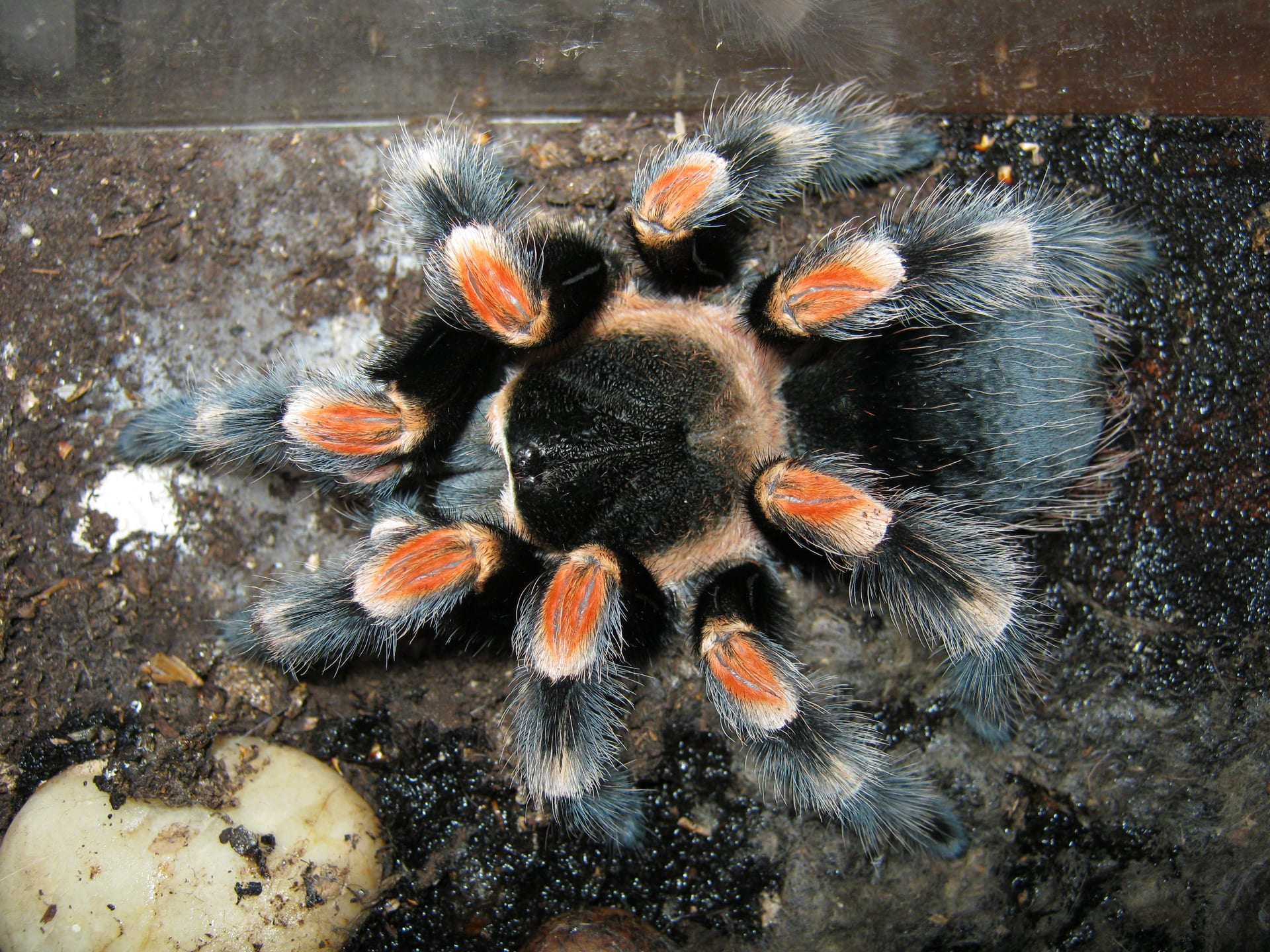
 © HTO / Public domain
Mexican Red-kneed Tarantula (smithi)
The Mexican Red-kneed Tarantula (smithi) is native to the Pacific coast of Guerrero, Mexico. Its blue-black legs carry striking bands running from reddish-orange to pale pink, giving it an ornamental look that has long made it a favorite among keepers. It moves slowly and tends to stay calm, which makes it approachable for first-time tarantula owners. For years it was confused with the closely related B. hamorii, a mix-up still reflected in how the two are sometimes sold under the same name. Hardy and easy to care for, it's a species keepers can expect to share a long companionship with.
View Mexican Red-kneed Tarantula (smithi) encyclopedia →0% commission on your first sales!Register by September 30, 2026 and your first 2 sales are commission-free!
Breeder Wanted!
List on BreederDirect and sell directly to customers nationwide!
5 Transparency Standards You Can Trust
When listing Exotic Invertebrates, Breeders disclose the following. We guarantee transparency on growth stage and breeding unit.
- Real Photos
- Breeding Unit
- Generation Info
- Body Length (mm)
- Country of Origin
Browse all 249 breeds
No listings match your filters
Adjust your filters, or get notified when new listings arrive.
Getting alerts is free with a member account. When new listings match your saved search, we'll notify you by email and in-app.
Browse other categories
Verified breeders (preview)
Are you raising exotic invertebrates?
Register as a breeder and connect with buyers directly.
Apply as a breederMexican Red-kneed Tarantula (smithi) key facts
- Care level
- Beginner-friendly
- Lifespan
- Females take 9-10 years to mature in the wild and can then live about another 10; the longest captive record is 12 years, in Berlin zoos, for the spider then called B. annitha
- Size
- Females 5.2-5.9cm body length, males 4.4-4.9cm; the fourth leg is longest at 6.6-7.0cm
- Diet
- Large insects, and sometimes frogs and mice
- Temperature & Humidity
- It occurs in hilly deciduous tropical forest in Guerrero. Avoid keeping it in hot, humid conditions.
- Enclosure
- It digs burrows under rocks and tree roots: a tunnel about three times its leg span leading to a moulting chamber and a larger resting chamber. Give it deep substrate to dig in.
- Diet & Feeding
- It ambushes prey at the burrow entrance, taking large insects and also frogs and mice. In captivity, feed live insects.
- Temperament & Venom
- Brachypelma species are known as docile tarantulas. When provoked they flick urticating hairs from the abdomen.
- Notes
- When moulting or laying eggs it seals the burrow entrance with silk, soil and leaves; leave it alone at these times. A CITES Appendix II species.
About Mexican Red-kneed Tarantula (smithi)
A tarantula native to Guerrero, Mexico, with striking blue-black legs banded in reddish-orange to pale pink. Calm and beginner-friendly, and known for its notably long lifespan.
7 things to know before welcoming a Mexican Red-kneed Tarantula (smithi)
1Keep the enclosure on the dry side
This species comes from a dry region on Mexico's Pacific coast, so keep the substrate on the drier side in a well-ventilated enclosure. Excess humidity can lead to mold and health problems, so a simple water dish is usually enough.
2Calm, easygoing temperament
It moves slowly and, even when startled, tends to just raise a defensive posture or flick hairs rather than act aggressively. Still, as a wild animal, direct handling should be kept to a minimum.
3Growth takes time
Reaching adult size takes many years — females grow to about 5.2–5.9 cm in body length, males to about 4.4–4.9 cm. Watching a juvenile grow bit by bit with each molt is part of the enjoyment.
4A remarkably long lifespan
Females take about 9–10 years to mature in the wild and can then live roughly another decade, so keeping one means committing to a long-term companion. Consider whether you can provide care over that timeframe before bringing one home.
5Feeding centers on crickets
Feeding mainly consists of live prey like crickets, adjusted in frequency to the animal's growth stage. Appetite can fluctuate, and it's not unusual for a healthy individual to skip food for several weeks around a molt.
6Watch for confusion with a related species
This species has long been confused with the closely related B. hamorii, so trade names and information can sometimes be mixed up. Checking the scientific name and origin at the time of purchase helps avoid confusion.
7Prepare supplies in advance
Having a well-ventilated enclosure, substrate, hide, and water dish ready in advance makes for a smooth start. Even though it's considered beginner-friendly, it's still a living animal, so it's worth reviewing basic care knowledge before bringing one home.
Frequently asked questions about Mexican Red-kneed Tarantula (smithi)
- Q.What's the difference between this and the "Mexican Red Knee" B. hamorii?
- A.The name "Mexican Red-kneed" has long been used loosely for both species due to confusion with B. hamorii. B. smithi is a distinct species endemic to the Pacific coast of Guerrero, Mexico, with its own leg-banding coloration and origin.
- Q.Is this species suitable for beginners?
- A.Yes, it's generally considered a beginner-friendly species. It moves calmly, has a docile temperament, and its enclosure isn't especially difficult to maintain.
- Q.How big does it get as an adult?
- A.As adults, females reach about 5.2–5.9 cm in body length and males about 4.4–4.9 cm. With legs extended, the longest (fourth) leg can measure 6.6–7.0 cm.
- Q.How long does this tarantula live?
- A.In the wild, females take about 9–10 years to mature and can then live roughly another decade, making this a remarkably long-lived species. The longest recorded lifespan in captivity is 12 years.
- Q.Are any permits or registrations required to keep this species?
- A.Mexican Red-kneed Tarantula (smithi) is listed in CITES Appendix II. International trade requires a permit from the exporting country, but as far as CITES is concerned, no registration is needed to buy or sell individuals already legally in Japan.
Learn more about Mexican Red-kneed Tarantula (smithi) in the encyclopedia
View Mexican Red-kneed Tarantula (smithi) encyclopedia entry →
Care difficulty, lifespan, size and diet — all basics covered.
More in this category
Can't find the one you're looking for?
Post your wishes for free and breeders with matching animals will contact you with introductions.