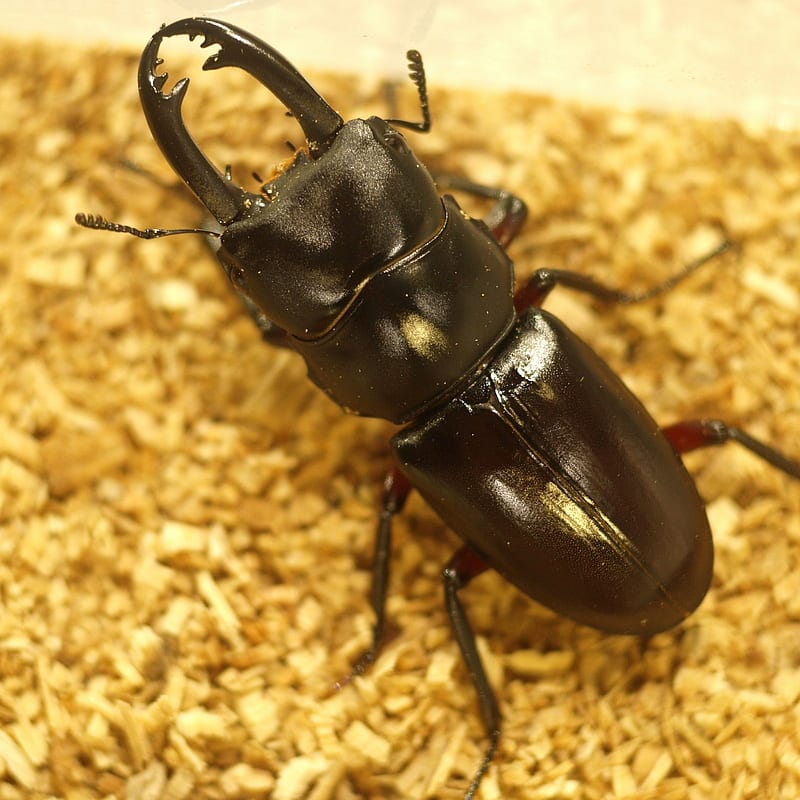
 © OpenCage / CC BY-SA 2.5
Davison's Stag Beetle
The Davison's Stag Beetle is a mid-sized stag beetle native to southern India, prized for its reddish-brown to chestnut elytra (matte in males, strongly glossy in females) and the elegant, glossy, gently curved mandibles of the males. Unlike most Hexarthrius stag beetles, females of this species will readily lay eggs in beetle mat, sometimes producing a large clutch of eggs in one go, a trait that makes it notably easier to breed than its relatives. They are aggressive and should be kept individually, but their ease of breeding and stable availability make them a great entry point for anyone new to this genus.
View Davison's Stag Beetle encyclopedia →Breeder Wanted!
List on BreederDirect and sell directly to customers nationwide!
BreederDirect's 6 Transparency Commitments
When listing Insects, Breeders disclose the following. We guarantee transparency on growth stage and breeding unit.
- Life Stage Clarity
- Generation Info
- Real Photos
- Breeding Unit
- Country of Origin
- Body Length (mm)
Browse all 336 breeds
No listings match your filters
Adjust your filters, or get notified when new listings arrive.
Getting alerts is free with a member account. When new listings match your saved search, we'll notify you by email and in-app.
Browse other categories
Verified breeders (preview)
Davison's Stag Beetle key facts
- Care level
- Beginner-friendly
- Lifespan
- Adults 6 months to 1 year
- Size
- Males 60-83mm, females 35-48mm
- Temperature
- 22-26°C (around 25°C for egg-laying)
- Diet
- Beetle jelly (adults); fermented substrate or kinshi bottles (larvae)
- Temperature & Humidity
- Run pairing and the laying set at about 25C; a set at 22C reportedly failed, so keep laying slightly warm. Larvae are commonly held at 21-22C.
- Breeding & Egg-laying
- One of the few Hexarthrius that lays in substrate: pack laying substrate firmly with logs buried, or even without logs. Prolific, with 14 larvae from a ten-day set and 20 eggs from one set on record.
- Cohabitation
- Aggressive; house singly. For cohabitation pairing tie the male's mandibles and separate after about two days once mating is seen.
- Lifespan & Rearing Period
- No species-specific adult lifespan is published. Rear larvae in 800-1500cc substrate bottles changed every three months; delaying changes causes wandering and shrinkage.
- Health & Notes
- Reported to feed lightly and grow poorly on kinshi, so substrate rearing is safer. If larvae stall on lightly fermented laying substrate, move them to mature substrate.
About Davison's Stag Beetle
A mid-sized stag beetle from southern India with reddish-brown elytra and elegant, glossy, curved mandibles. It lays readily in beetle mat, making it one of the easier Hexarthrius species for beginners.
7 things to know before welcoming a Davison's Stag Beetle
1Elytra sheen differs by sex
The elytra range from chestnut brown to a reddish hue, matte in males and strongly glossy in females. The mandibles are glossy, so comparing the textures of a pair is part of the appeal.
2Handle the male's jaws with care
Males grow long, gracefully curved mandibles that become more prominent as they mature. A pinch from them can hurt, so be mindful of how and where you hold the beetle.
3Big size gap between sexes
Males reach 60–83mm while females stay at 35–48mm, a striking size difference for a single species. Displaying a pair side by side highlights just how different they look.
4Lays well even in beetle mat
Unusually for a Hexarthrius species, females will lay eggs in mat as well as in wood. Under good conditions, a single clutch can produce a large number of eggs, making breeding attempts rewarding.
5Beginner-friendly to keep
Within the genus Hexarthrius it lays in mat and breeds readily, so it is a common entry point. It is aggressive and should be kept individually, and larvae are light eaters, so watch the timing of food changes.
6Avoid direct sun and sudden temperature swings
As with most insects, direct sunlight and sudden temperature swings put unnecessary stress on the beetle. Keep it indoors in a temperature-stable spot, roughly 22–26°C (around 25°C for egg-laying).
7Care centers on insect jelly
Adults are mainly fed store-bought insect jelly, with regular replacement and a clean enclosure as the core of daily care. Before bringing one home, it helps to have jelly, a rearing case, and a climbing branch ready.
Frequently asked questions about Davison's Stag Beetle
- Q.How big does the Davison's Stag Beetle get?
- A.Males typically reach 60–83mm, while females grow to about 35–48mm. The two sexes look strikingly different in scale for the same species.
- Q.Can a beginner keep this species?
- A.Yes — it lays well in mat and breeds readily, and is considered one of the easier Hexarthrius species to keep. It is aggressive, so keep each adult alone, and a first-time keeper can succeed by watching the timing of larval food changes.
- Q.How long do they live?
- A.There's no fixed figure for this species' lifespan, and like beetles generally, it varies by individual and environment. Stable temperatures and attentive daily care help them live as long as possible.
- Q.Can the mandibles pinch you?
- A.Males have mandibles that can deliver a painful pinch if you're careless. Hold the body firmly and keep your fingers away from the jaws when handling.
- Q.Is breeding this species difficult?
- A.Unusually for a Hexarthrius species, females lay well in beetle mat and can sometimes produce a large clutch under the right conditions. That makes this species relatively approachable for breeding within its genus.
Useful tools for Davison's Stag Beetle care
Learn more about Davison's Stag Beetle in the encyclopedia
View Davison's Stag Beetle encyclopedia entry →
Care difficulty, lifespan, size and diet — all basics covered.
More in this category
Can't find the one you're looking for?
Post your wishes for free and breeders with matching animals will contact you with introductions.