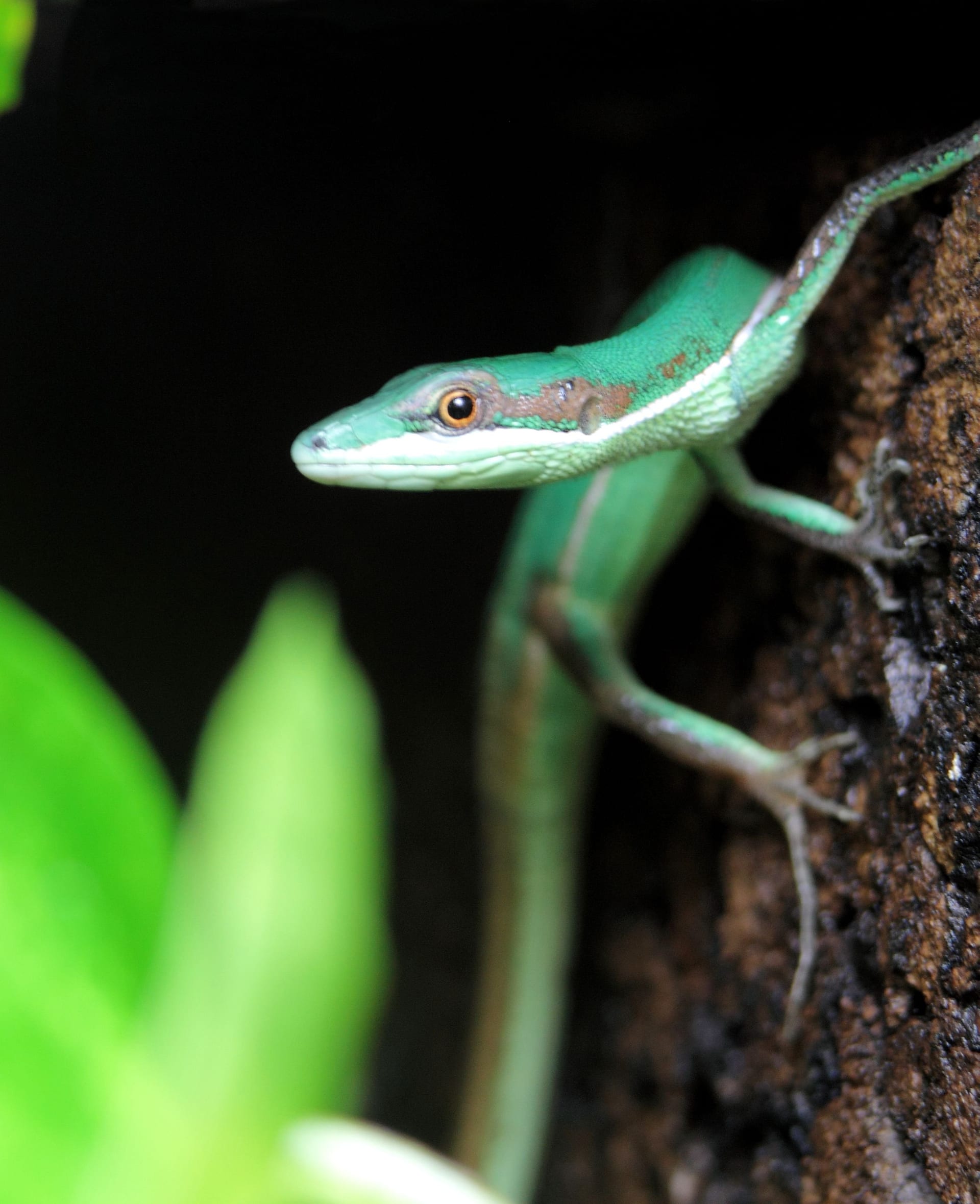
 © Touchardflorian / CC BY-SA 3.0
Green Grass Lizard
The Green Grass Lizard is a lizard species found only in Japan, native to the Amami Islands, the Okinawa Islands, and the southern Tokara Islands. Its vivid green body is marked with white stripes, and its long tail, making up roughly three-quarters of its total length, is put to graceful use as it climbs, wrapping around grasses and branches. It's a quick-moving animal that tends to keep its wild wariness even in captivity, making it a species best appreciated through patient, hands-off observation. Because keeping one well means managing temperature, humidity, and UV lighting with some care, it's generally considered a better fit for keepers with some prior reptile experience. Since this species has adapted closely to Japan's natural seasonal rhythms, shaping the enclosure's conditions around those seasonal shifts is key to keeping it well.
View Green Grass Lizard encyclopedia →0% commission on your first sales!Register by September 30, 2026 and your first 2 sales are commission-free!
Breeder Wanted!
List on BreederDirect and sell directly to customers nationwide!
6 Transparency Promises from Br-Choku
Every Reptiles & Amphibians from verified Breeder breeders includes complete information: morph, genetics, feeding requirements, and temperament details.
- Morph Information
- Actual Photos
- Feeding Information
- Temperament Information
- Genetics Information
- Age (Months)
Browse all 319 breeds
Difficulty Level
Feeding Type
Temperament
Verified breeders wanted for Reptiles & Amphibians
Breeders are signing up now ahead of launch. Subscribe to be notified when new listings go live.
Getting alerts is free with a member account. When new listings match your saved search, we'll notify you by email and in-app.
Browse other categories
Verified breeders (preview)
Are you raising reptiles & amphibians?
Register as a breeder and connect with buyers directly.
Apply as a breederGreen Grass Lizard key facts
- Care level
- Intermediate
- Lifespan
- Few data on lifespan in captivity
- Size
- 20-28 cm total length (tail about three-quarters)
- Diet
- Carnivore (insects, spiders, earthworms)
- Housing
- A diurnal climber that wraps its long tail around grass and twigs; use an enclosure with plants and thin branches, and full-spectrum UVB lighting is recommended for grass lizards.
- Diet & Feeding
- It eats insects, spiders and earthworms; offer small live insects such as crickets dusted with calcium.
- Temperature & Humidity
- A species of the subtropical Amami and Okinawa islands; provide a daytime basking spot and slightly cooler nights.
- Temperament
- Grass lizards may drop their tails if handled roughly, so keep handling to a minimum.
- Health & Cautions
- Females lay several clutches of two eggs between March and August; males bite the female's head or neck when mating.
- Notes
- It is a Japanese endemic listed as Near Threatened by the IUCN. Do not confuse it with the Sakishima and Miyako grass lizards, whose capture and transfer are in principle banned under the Species Conservation Act, and check local ordinances and protected-area rules before any wild collection. Never release a captive animal into the wild. Releasing it on islands outside its native range creates a domestic invasive-species problem.
About Green Grass Lizard
An overview of the Green Grass Lizard, a lizard species native to Japan, covering its appearance and temperament, adult size, care difficulty, and what's known about its lifespan, for anyone considering bringing one home.
7 things to know before welcoming a Green Grass Lizard
1Native to Japan's Subtropical Islands
The Green Grass Lizard is found only in Japan, native to the Amami Islands, the Okinawa Islands, and the southern Tokara Islands, where it lives among lush shrubs and grasses. Furnishing the enclosure with plenty of plants and hiding spots helps recreate that environment and keeps your lizard more settled.
2A Vivid Green Body and a Long Tail
Its standout feature is a vivid green body marked with white stripes running along its sides. The tail makes up about three-quarters of its 20 to 28 cm total length, and watching it wrap that long tail around branches and grass to climb is one of the real pleasures of keeping this species.
3Quick-Moving and Naturally Wary
These lizards are naturally wary and quick on their feet, so it's best to let them get used to their surroundings before attempting to handle them. Their tails can detach as a defense response, so avoid grabbing the tail when handling.
4Best Suited to Experienced Keepers
The Green Grass Lizard is generally rated as suited to keepers with some prior reptile experience rather than complete beginners. Between environmental management and adjusting care through Japan's seasonal shifts, it helps to already be comfortable with reptile husbandry basics before taking one on.
5Managing Humidity and UV Lighting
This species favors warm, humid conditions, so the enclosure should hold steady humidity while still getting enough airflow to avoid staying damp. Installing UVB lighting and creating a clear day-night and seasonal temperature gradient is also important.
6Primarily an Insect Eater
This species leans heavily toward an insectivorous diet, feeding mainly on small insects. It's worth researching appropriate feeder insects and feeding routines in advance to help keep its diet balanced.
7Set Up the Enclosure Before Bringing One Home
Before bringing one home, have hiding spots, climbing branches, and UVB lighting all set up and ready. Since there's still limited data on captive lifespan, plan to watch your lizard closely day to day and build your care routine around what you observe.
Frequently asked questions about Green Grass Lizard
- Q.Is the Green Grass Lizard subject to CITES?
- A.The Green Grass Lizard is not subject to CITES. Not listed under CITES (no entry in Species+). It is not designated under the Species Conservation Act, but its congeners the Sakishima and Miyako grass lizards are National Endangered Species whose capture and transfer are in principle prohibited. The Ministry of the Environment lists the Okinoerabu and Tokunoshima populations as threatened local populations. Check local ordinances and natural-monument area rules before collecting in the wild, and never release captive animals.
- Q.Is it a good choice for reptile-keeping beginners?
- A.The Green Grass Lizard is generally considered suited to keepers with some prior reptile experience rather than absolute beginners. Managing temperature, humidity, and UV lighting, along with adjusting care through Japan's seasonal changes, takes a bit of know-how.
- Q.How big do they get?
- A.Adults typically reach a total length of about 20 to 28 cm, with the tail making up roughly three-quarters of that length. The body itself stays fairly slender.
- Q.How long do they live in captivity?
- A.There isn't yet enough documented data to give a reliable lifespan estimate for captive individuals. Keeping a close eye on your lizard's day-to-day health and condition is the best approach.
- Q.Are they skittish, and do they tame down?
- A.These lizards tend to be wary, quick-moving animals by nature, though individuals vary. It's best to let them settle into their enclosure at their own pace rather than trying to handle them right away.
Useful tools for Green Grass Lizard care
Learn more about Green Grass Lizard in the encyclopedia
View Green Grass Lizard encyclopedia entry →
Care difficulty, lifespan, size and diet — all basics covered.
More in this category
Can't find the one you're looking for?
Post your wishes for free and breeders with matching animals will contact you with introductions.