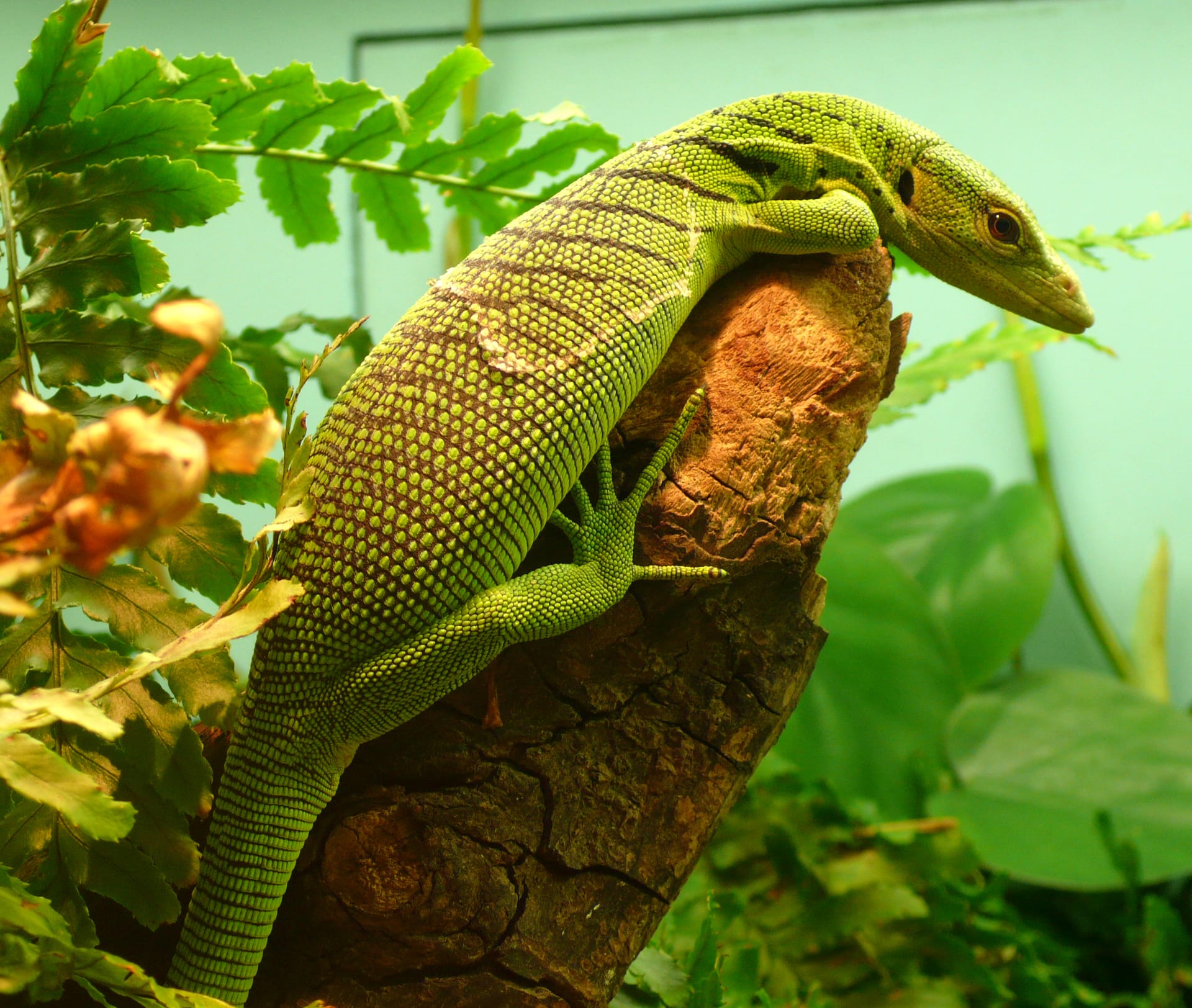
 © TimVickers / Public domain
Emerald Tree Monitor
The Emerald Tree Monitor is a slender, strikingly green arboreal monitor lizard that reaches 75 to 100 cm in total length. It uses a prehensile tail and long, curved claws to move confidently through branches, and is one of the few monitor species known to live in small social groups rather than staying solitary. Because it depends on height, humidity, and a fully three-dimensional enclosure to thrive, this species is generally recommended only for experienced reptile keepers.
View Emerald Tree Monitor encyclopedia →Breeder Wanted!
List on BreederDirect and sell directly to customers nationwide!
BreederDirect's 6 Transparency Commitments
Every Reptiles & Amphibians from verified Breeder breeders includes complete information: morph, genetics, feeding requirements, and temperament details.
- Morph Information
- Actual Photos
- Feeding Information
- Temperament Information
- Genetics Information
- Age (Months)
Browse all 319 breeds
Difficulty Level
Feeding Type
Temperament
Verified breeders wanted for Reptiles & Amphibians
Breeders are signing up now ahead of launch. Subscribe to be notified when new listings go live.
Getting alerts is free with a member account. When new listings match your saved search, we'll notify you by email and in-app.
Browse other categories
Verified breeders (preview)

Are you raising reptiles & amphibians?
Register as a breeder and connect with buyers directly.
Apply as a breederEmerald Tree Monitor key facts
- Care level
- Advanced
- Lifespan
- 15-20 years
- Size
- 75-100cm
- Temperature
- Basking 49-54°C / cool side 27-28°C / ambient 27-28°C at night
- Humidity
- 70% or above
- Diet
- Crickets, dubia roaches and other insects, with rodents as a supplement
- Temperature & Humidity
- Figures published for the tree monitors call for a gradient reaching from a basking site of 49-54C down to cool areas of 27-28C. Supplemental heat is sometimes used at night to hold ambient temperatures at 27-28C. Humidity must not fall below 70 per cent; these lizards dehydrate easily and rehydrate only by drinking.
- Enclosure
- It is strongly arboreal, so climbing surface and height matter more than floor area. An enclosure of roughly 120 cm wide by 180 cm tall by 60 cm deep is cited for a pair, and larger is better. Use a deep leaf-litter layer and branches of varying thickness arranged both vertically and horizontally. Ventilation holes are considered unnecessary, since high humidity must be held. It is social, so small groups of one male with several females are sometimes kept where space allows.
- Diet & Feeding
- In the wild it is an arboreal insectivore taking mainly arthropods, with small vertebrates as well. In captivity base the diet on crickets, dubia and other roaches with rodents as a supplement, dusting feeders with calcium.
- Temperament
- It is one of the few social monitors, living in the wild in small groups centred on a dominant male. It is nonetheless fast and nervous, fleeing when threatened and biting if cornered, so it is not suited to handling.
- Notes
- Varanidae spp. are listed on CITES Appendix II, so import requires an export permit; no Japanese registration certificate is needed for Appendix II. Of the varanids, only the Komodo dragon and the crocodile monitor are specified animals under Japanese law, and this species is not among them. Juveniles dehydrate far more rapidly than adults, so watch humidity and water intake closely.
About Emerald Tree Monitor
The Emerald Tree Monitor is a vivid green arboreal monitor lizard reaching 75-100 cm, known for its prehensile tail and small social groups — a species suited to experienced keepers.
7 things to know before welcoming a Emerald Tree Monitor
1A Tall, Vertical Enclosure
Emerald Tree Monitors grow to 75-100 cm and are highly arboreal, climbing and gripping branches throughout the day. Provide a tall enclosure with plenty of vertical space and several sturdy branches thick enough for them to wrap around.
2High Humidity Care
This species comes from humid tropical forest habitats and needs consistently high humidity, maintained through regular misting or a reliable humidifier. Letting the enclosure dry out can lead to shedding problems and other health issues.
3An Unusually Social Monitor
Unlike most monitor lizards, Emerald Tree Monitors are known to live in small social groups in the wild. Even so, keeping multiple individuals together requires careful observation of compatibility and each animal's condition.
4Best Suited to Experienced Keepers
This species is considered an advanced-level animal to keep, given the number of factors — temperature, humidity, and enclosure layout — that need to be managed well. Researching its care requirements thoroughly before bringing one home is strongly recommended.
5Sharp Claws and a Prehensile Tail
Long claws and a strong prehensile tail help this monitor move confidently among branches. During handling, those claws can scratch, so it's best to let the animal set the pace rather than forcing interaction.
6A Largely Insect-Based Diet
Emerald Tree Monitors tend to rely more heavily on insects than many other monitor species do. It's worth researching appropriate feeder insect types and sizes before you bring one home.
7Do Your Homework Before Bringing One Home
Because this species has several specific care needs around climbing space, humidity, and social behavior, it's worth researching thoroughly from reliable sources beforehand. Set up the enclosure and equipment in advance of your monitor's arrival.
Frequently asked questions about Emerald Tree Monitor
- Q.Is this species suitable for beginners?
- A.The Emerald Tree Monitor is generally considered an advanced-level species. Its humidity requirements and arboreal setup call for specialized knowledge, so it's best suited to keepers who already have reptile-keeping experience.
- Q.How big does it get?
- A.Adults typically reach a total length of about 75 to 100 cm. Despite its slender build, it moves actively through branches, so plan for a spacious, tall enclosure that accommodates its full adult size.
- Q.Does it behave differently from other monitor lizards?
- A.Unlike most monitors, this species is known to live in small social groups in the wild, which is unusual for the group. That said, individual temperament varies, so anyone considering keeping more than one should watch compatibility closely.
- Q.Can I handle it?
- A.Because of its long claws and prehensile tail, forcing handling can stress the animal or result in scratches. It's best to focus mainly on observation and let the individual set the pace for any interaction.
- Q.Is this species subject to CITES regulation?
- A.Emerald Tree Monitor is listed in CITES Appendix II. International trade requires a permit from the exporting country, but as far as CITES is concerned, no registration is needed to buy or sell individuals already legally in Japan.
Useful tools for Emerald Tree Monitor care
Learn more about Emerald Tree Monitor in the encyclopedia
View Emerald Tree Monitor encyclopedia entry →
Care difficulty, lifespan, size and diet — all basics covered.
More in this category
Can't find the one you're looking for?
Post your wishes for free and breeders with matching animals will contact you with introductions.