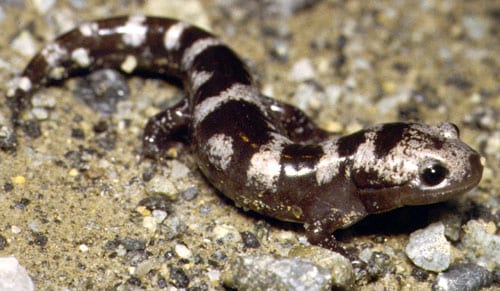
 © Patrick Coin (Patrick Coin) / CC BY-SA 2.5
Marbled Salamander
The marbled salamander is a small mole salamander native to the eastern United States, instantly recognizable for its bold black body marked with bands that run white in males and grayish in females — a trait that makes sexing adults surprisingly easy. In the wild it spends most of its time tucked beneath leaf litter and fallen logs, and that same low-key, sedentary nature carries over into captivity, making it a calm, easy-to-observe animal. Its modest adult size keeps housing needs compact, making it a approachable entry point for anyone new to keeping amphibians.
View Marbled Salamander encyclopedia →0% commission on your first sales!Register by September 30, 2026 and your first 2 sales are commission-free!
Breeder Wanted!
List on BreederDirect and sell directly to customers nationwide!
6 Transparency Promises from Br-Choku
Every Reptiles & Amphibians from verified Breeder breeders includes complete information: morph, genetics, feeding requirements, and temperament details.
- Morph Information
- Actual Photos
- Feeding Information
- Temperament Information
- Genetics Information
- Age (Months)
Browse all 280 breeds
Difficulty Level
Feeding Type
Temperament
Verified breeders wanted for Reptiles & Amphibians
Breeders are signing up now ahead of launch. Subscribe to be notified when new listings go live.
Getting alerts is free with a member account. When new listings match your saved search, we'll notify you by email and in-app.
Browse other categories
Verified breeders (preview)
Are you raising reptiles & amphibians?
Register as a breeder and connect with buyers directly.
Apply as a breederMarbled Salamander key facts
- Care level
- Beginner-friendly
- Lifespan
- 8-12 years
- Size
- About 11cm
- Temperature
- 18〜24℃
- Diet
- Crickets, waxworms and small insects
- Temperature & Humidity
- Hold a steady 18-24 C. Extended exposure above 30 C can be fatal, so keep it in a cool air-conditioned room. Keep the substrate damp but never waterlogged.
- Enclosure
- It burrows poorly, so use a shallow substrate with several slanted hides of bark or stone. It swims badly, so provide a shallow dish rather than a deep pool. Use a tight-fitting lid.
- Diet & Feeding
- Two-week-old crickets and waxworms form the staple. Clean the enclosure the day after feeding and remove uneaten food to prevent fouling.
- Temperament
- Nocturnal and secretive. It can be kept singly or in small groups of similar-sized animals. It moves slowly and shows little aggression.
- Notes
- It has skin poison glands, so wash your hands after handling. When rearing larvae keep the water above pH 6.5, as lower values have been reported to inhibit growth.
About Marbled Salamander
A small salamander native to the eastern US, known for its bold black-and-white banded pattern and beginner-friendly care.
7 things to know before welcoming a Marbled Salamander
1Humidity Is the Key to Care
Since this species lives among moist forest leaf litter, the enclosure needs consistently high humidity. Use a moisture-retentive substrate like sphagnum moss or coconut fiber, and mist regularly to prevent it from drying out.
2Provide Plenty of Hiding Spots
This species naturally hides beneath logs and leaf litter, so placing cork bark, dried leaves, and multiple shelters in the enclosure helps it settle in. Staying tucked away out of sight is normal behavior, not a sign of trouble.
3Band Color Can Indicate Sex
Once adult, the color of the banding can give a rough indication of sex — males tend to show near-white bands, while females show more grayish bands. It's one of the small pleasures of observing this species.
4Prefers Cooler Temperatures
This species tends to prefer cool, damp conditions over heat and humidity. Keep the enclosure out of direct sunlight and hot spots, in a stable, well-ventilated indoor location.
5Calm and Low-Activity by Nature
Rather than being an active, roaming animal, it tends to stay still for long periods. It suits a quiet, observation-focused style of keeping rather than one centered on handling.
6Diet Centers on Live Insects
It prefers small, moving live prey such as crickets and isopods. Choose prey sized appropriately for the animal, and remove uneaten food promptly to keep the enclosure clean.
7Set Up the Enclosure Before Arrival
Prepare an enclosure with adequate humidity and hiding spots in advance, and let the temperature stabilize before the animal arrives to reduce stress. After transport, give it time to settle quietly before checking on it.
Frequently asked questions about Marbled Salamander
- Q.Can beginners keep a marbled salamander?
- A.This species is considered beginner-friendly, and as long as you manage humidity and provide adequate hiding spots, it's approachable even for first-time amphibian keepers. That said, daily observation is still essential for any living animal.
- Q.How large does it grow?
- A.It's a small species that reaches around 11cm (about 4.3 inches) as an adult. That compact adult size is one reason it's a popular choice for space-conscious keepers.
- Q.Can I handle it like a pet you play with?
- A.Given its calm, low-activity nature, this species suits quiet observation more than frequent handling. Its skin is sensitive, so any handling should be kept to a minimum.
- Q.Are there any CITES restrictions on this species?
- A.The marbled salamander is not listed under CITES.
- Q.How can I tell males and females apart?
- A.Once the animal reaches adulthood, the color of its body bands makes sexing easier — males tend to have near-white bands, while females tend to have more grayish ones.
Useful tools for Marbled Salamander care
Learn more about Marbled Salamander in the encyclopedia
View Marbled Salamander encyclopedia entry →
Care difficulty, lifespan, size and diet — all basics covered.
More in this category
Can't find the one you're looking for?
Post your wishes for free and breeders with matching animals will contact you with introductions.