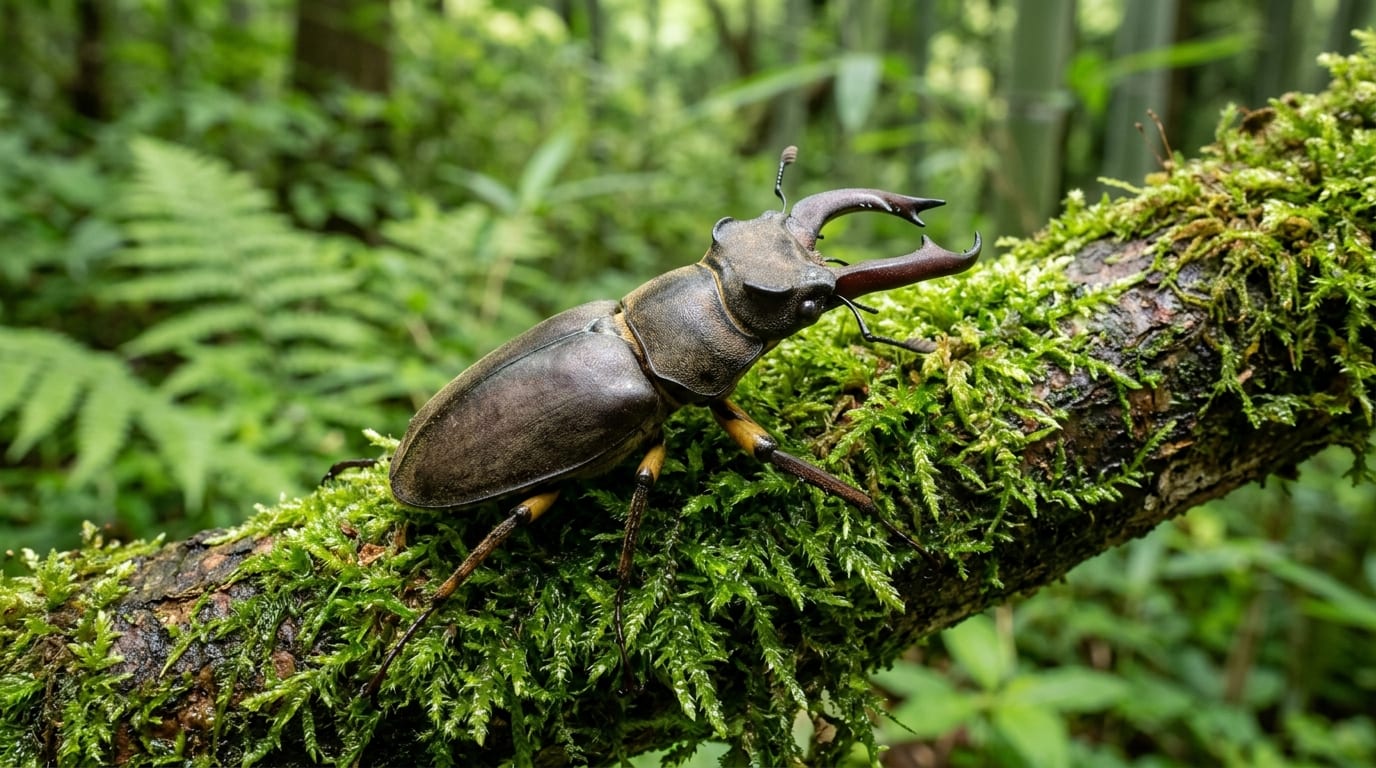
Izu Miyama Stag Beetle
The Izu Miyama stag beetle is a subspecies of Miyama stag beetle found only on Japan's Izu Islands. Its mandibles are short and thick, fully developed into what's known as the "Fuji" form, giving the beetle a strikingly powerful look. The ear-like projections on its head are less pronounced than in the mainland subspecies, and its body has a distinctive shape, with a relatively small upper body balanced by a sturdier lower half. The femurs often show well-developed yellowish-brown markings, adding another detail worth observing. Because keeping this beetle well requires attention to temperature and humidity, it's generally considered a beetle for experienced keepers — but for anyone drawn to island-endemic subspecies, it's a distinctive and rewarding one to raise.
View Izu Miyama Stag Beetle encyclopedia →0% commission on your first sales!Register by September 30, 2026 and your first 2 sales are commission-free!
Breeder Wanted!
List on BreederDirect and sell directly to customers nationwide!
6 Transparency Standards You Can Trust
When listing Insects, Breeders disclose the following. We guarantee transparency on growth stage and breeding unit.
- Life Stage Clarity
- Generation Info
- Real Photos
- Breeding Unit
- Country of Origin
- Body Length (mm)
Browse all 296 breeds
No listings match your filters
Adjust your filters, or get notified when new listings arrive.
Getting alerts is free with a member account. When new listings match your saved search, we'll notify you by email and in-app.
Browse other categories
Verified breeders (preview)
Izu Miyama Stag Beetle key facts
- Care level
- Advanced
- Lifespan
- About two to three months once active (a figure for the species as a whole)
- Size
- Males 33.8-70.0mm, females 25.0-43.9mm (captive maximum 68.7mm)
- Temperature
- 25℃
- Diet
- Adults take tree sap and beetle jelly; larvae eat well-rotted substrate
- Temperature & Humidity
- For the species as a whole, egg-laying is not difficult as long as the temperature is held at or below 25C. Cool rearing is needed to bring out large beetles. Keep the substrate at a moisture that forms a ball when squeezed.
- Breeding & Egg-laying
- In captivity the larval stage runs close to two years and the beetle then needs six months to a year of dormancy management, so rearing takes patience. The BE-KUWA 2025 edition gives a captive record of 68.7mm (Takashi Kumada, registered 2016, expected maximum 77mm) and a wild record of 70.0mm (Akihiko Toba). The smallest captive beetle recorded is 29.9mm.
- Cohabitation
- Adults are kept singly and put together only for pairing. Do not mix them with the nominate subspecies or with beetles from other islands. Since large beetles have been recorded only on Izu Oshima, keep localities strictly separate.
- Lifespan & Rearing Period
- For the species as a whole, adults live about two to three months once active and as a rule do not overwinter as adults. In the field they appear from July to September, peaking in mid to late August on Izu Oshima, early to mid August on Toshima, and late July to early August on Kozushima and Miyakejima.
- Health & Notes
- Collecting insects is prohibited on Kozushima, and numbers on Miyakejima are thought to be low. The populations are separated island by island, so avoid beetles without a stated locality and lines of mixed origin. Rearing calls for cool temperatures and a long dormancy period, which puts it among the harder Japanese stag beetles.
About Izu Miyama Stag Beetle
Discover the Izu Miyama stag beetle, a subspecies found only on Japan's Izu Islands, known for its thick Fuji-form mandibles and richly marked femurs. Best suited to experienced keepers due to its care needs.
7 things to know before welcoming a Izu Miyama Stag Beetle
1Endemic to the Izu Islands
The Izu Miyama stag beetle is a subspecies found only on Japan's Izu Islands. It shows regional traits distinct from the mainland subspecies, making it interesting to compare against other Miyama stag beetle populations.
2Powerful Fuji-form mandibles
Its mandibles are short and thick, fully developed into the so-called "Fuji" form. This shape appears regardless of overall body size, giving every individual a strong, distinctive look.
3Understated head projections
The ear-like projections on either side of the head are less pronounced than in the mainland subspecies. This subtler feature is one of the clues used to identify the Izu form.
4A distinctive body balance
This beetle has a somewhat unusual build, with a relatively small upper body and a larger lower body. Comparing the overall silhouette makes the difference from other Miyama stag beetles easier to spot.
5Size varies between individuals
Adults typically range from about 33.8 to 70.0mm in males and 25.0 to 43.9mm in females, with a recorded captive maximum of 68.7mm. Size varies noticeably between individuals, which makes each one worth observing closely.
6An active period of a few months
Once active as an adult, this beetle typically lives for around two to three months, which is relatively short compared to some other insects. After bringing one home, it's worth checking in on it regularly during this limited period.
7Care suited to experienced keepers
This species is generally considered suited to experienced keepers, since maintaining the right temperature and humidity takes some knowledge and care. If it's your first time keeping one, it's a good idea to research proper husbandry and prepare a case and substrate in advance.
Frequently asked questions about Izu Miyama Stag Beetle
- Q.How is the Izu Miyama stag beetle different from the regular Miyama stag beetle?
- A.The two differ in mandible shape, the size of the head projections, body proportions, and femur coloring. The Izu form is a subspecies endemic to the Izu Islands and has notably less pronounced head projections than the mainland subspecies.
- Q.How large do adults typically grow?
- A.Males typically reach about 33.8 to 70.0mm and females about 25.0 to 43.9mm. The largest recorded captive individual measured 68.7mm.
- Q.How long do adults live?
- A.Adults are generally active for around two to three months. Since this active period is relatively short, it's important to check in on the beetle regularly after bringing it home.
- Q.Is this beetle suitable for beginners?
- A.This species is generally recommended for experienced keepers rather than beginners. Managing temperature and humidity requires some knowledge and experience, so it's best to research proper care before bringing one home.
- Q.Are there any legal restrictions on keeping this beetle?
- A.The Izu Miyama stag beetle is not subject to CITES.
Useful tools for Izu Miyama Stag Beetle care
Learn more about Izu Miyama Stag Beetle in the encyclopedia
View Izu Miyama Stag Beetle encyclopedia entry →
Care difficulty, lifespan, size and diet — all basics covered.
More in this category
Can't find the one you're looking for?
Post your wishes for free and breeders with matching animals will contact you with introductions.