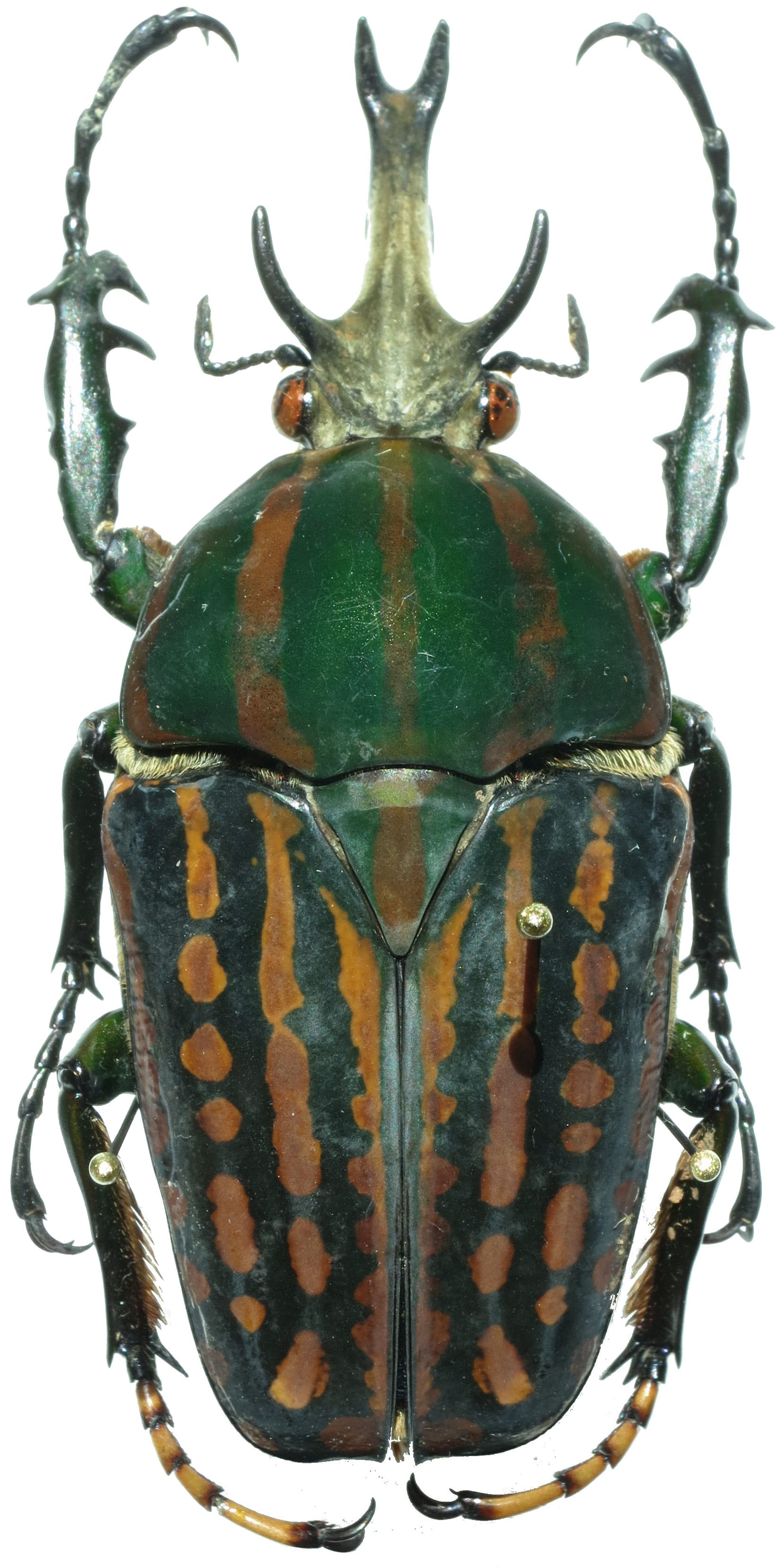
 © Lsadonkey / CC BY-SA 4.0
Savage's Flower Beetle
The Savage's Flower Beetle is a large flower beetle native to the region around the Gulf of Guinea and central Africa. Its glossy green thorax paired with black elytra striped in yellow gives it a striking look, and males carry a forward-pointing horn that adds real presence. Adult size ranges widely from 35 to 75mm, so keepers can end up with genuinely imposing specimens. Considered suited to intermediate keepers, with breeding difficulty rated moderate, it's an approachable next step for anyone with some beetle-keeping experience, and watching it develop from larva to adult is part of the appeal.
View Savage's Flower Beetle encyclopedia →0% commission on your first sales!Register by September 30, 2026 and your first 2 sales are commission-free!
Breeder Wanted!
List on BreederDirect and sell directly to customers nationwide!
6 Transparency Standards You Can Trust
When listing Insects, Breeders disclose the following. We guarantee transparency on growth stage and breeding unit.
- Life Stage Clarity
- Generation Info
- Real Photos
- Breeding Unit
- Country of Origin
- Body Length (mm)
Browse all 296 breeds
No listings match your filters
Adjust your filters, or get notified when new listings arrive.
Getting alerts is free with a member account. When new listings match your saved search, we'll notify you by email and in-app.
Browse other categories
Verified breeders (preview)
Savage's Flower Beetle key facts
- Care level
- Intermediate
- Lifespan
- Adults 4-8 months
- Size
- 35-75 mm
- Diet
- Fruit, tree sap and beetle jelly
- Temperature & Humidity
- Raise the larvae on a humid substrate of rotten wood and leaves, and keep them slightly drier through pupation.
- Breeding & Egg-laying
- It is rated of medium difficulty. Larvae grow on a wood-and-leaf substrate, and silkworm powder, cat food or the larvae of other non-carnivorous species can be added, though these readily bring mites and mould. The snags are that females lay very few eggs and that larvae sometimes die at pupation.
- Cohabitation
- Males fight with their horns, so keep adults singly and put a pair together only for breeding. Larvae can be raised communally, but crowding at pupation leads to failures.
- Lifespan & Rearing Period
- In the congener Mecynorhina torquata, larval periods of twelve months to two years have been reported.
- Health & Notes
- Importing live beetles requires the species identification certificate demanded for live Scarabaeoidea. Sources disagree about its range, so choose stock with a stated locality and do not breed different localities together.
About Savage's Flower Beetle
A large flower beetle native to the Gulf of Guinea and central Africa, with a green thorax, yellow-striped black elytra, and a horned male. Adults reach 35-75mm; suited to intermediate keepers.
7 things to know before welcoming a Savage's Flower Beetle
1Native to Central Africa
This tropical beetle is found from the Gulf of Guinea region into central Africa. Recreating a warm, humid environment close to its native climate is the foundation of healthy care.
2Only males have horns
Males carry a forward-pointing horn that females lack. Since the horn is mainly used in skirmishes between males, avoid housing multiple males together.
3Striking green and black coloring
The glossy green thorax against black, yellow-striped elytra is a major highlight. The metallic sheen shifts appealingly depending on the angle of light.
4Adults feed on insect jelly
Adults readily eat insect jelly and fruit. Mist the enclosure regularly to keep humidity from dropping too low.
5Larvae grow in fermented mat
During the larval stage, they develop in humus-based fermented substrate. Regular mat changes and temperature control help larvae grow into robust adults.
6Breeding difficulty is moderate
Captive breeding is rated as moderately difficult. Raising eggs through to larvae takes some experience and the right setup, so it helps to research the process beforehand.
7Prepare housing beforehand
Have appropriately sized enclosures and substrate ready for both adults and larvae before bringing one home. Since this species suits intermediate keepers, gather the basic tools and knowledge first.
Frequently asked questions about Savage's Flower Beetle
- Q.Is this beetle suitable for beginners?
- A.It's generally considered suited to intermediate keepers rather than complete beginners. Some prior beetle-keeping experience makes it easier to get started, though it can be demanding as a first species.
- Q.How can I tell males from females?
- A.Males have a forward-pointing horn that females lack. The presence or absence of this horn is the easiest way to tell the sexes apart.
- Q.Is breeding difficult?
- A.Breeding difficulty is rated as moderate. Egg-laying and larval rearing take some experience, but successful breeding is achievable with the right setup.
- Q.Can multiple males be kept together?
- A.Males may use their horns in skirmishes with each other, so housing multiple males together isn't recommended. Keeping them singly, or as a pair, is the safer approach.
- Q.Are there any legal restrictions?
- A.The Savage's Flower Beetle is not subject to CITES. It falls outside that international trade framework.
Useful tools for Savage's Flower Beetle care
Learn more about Savage's Flower Beetle in the encyclopedia
View Savage's Flower Beetle encyclopedia entry →
Care difficulty, lifespan, size and diet — all basics covered.
More in this category
Can't find the one you're looking for?
Post your wishes for free and breeders with matching animals will contact you with introductions.