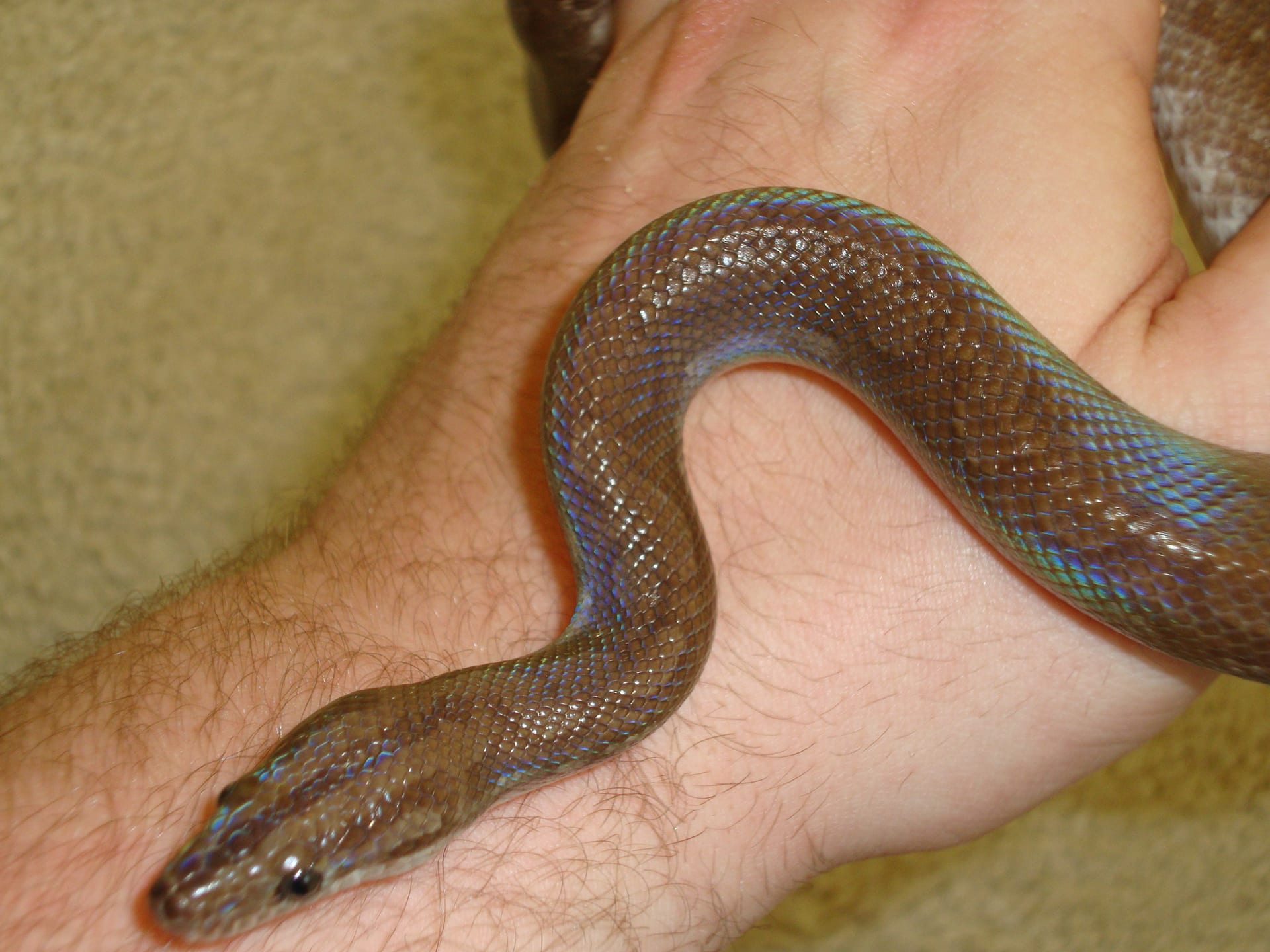
 © Beeb144 / Public domain
Colombian Rainbow Boa
The Colombian Rainbow Boa is the smallest species in the rainbow boa group, native to southern Central America and northern South America. Its rich brown body is lined with black-edged ring markings, and in the light its scales shimmer with an iridescent rainbow sheen — the trait that gives the species its name. Its color even shifts to a brighter, silvery tone after dark, adding another layer of appeal for anyone who enjoys observing it. Manageable in size for a boa, individuals vary in temperament, with some settling into a calm, steady demeanor over time. That said, keeping one well calls for real knowledge of humidity and temperature management, making this a species best suited to keepers with some prior snake-keeping experience.
View Colombian Rainbow Boa encyclopedia →0% commission on your first sales!Register by September 30, 2026 and your first 2 sales are commission-free!
Breeder Wanted!
List on BreederDirect and sell directly to customers nationwide!
6 Transparency Promises from Br-Choku
Every Reptiles & Amphibians from verified Breeder breeders includes complete information: morph, genetics, feeding requirements, and temperament details.
- Morph Information
- Actual Photos
- Feeding Information
- Temperament Information
- Genetics Information
- Age (Months)
Browse all 280 breeds
Difficulty Level
Feeding Type
Temperament
No listings match your filters
Adjust your filters, or get notified when new listings arrive.
Getting alerts is free with a member account. When new listings match your saved search, we'll notify you by email and in-app.
Browse other categories
Verified breeders (preview)
Are you raising reptiles & amphibians?
Register as a breeder and connect with buyers directly.
Apply as a breederColombian Rainbow Boa key facts
- Care level
- Intermediate
- Lifespan
- Over 20 years in captivity
- Size
- 90-180cm
- Temperature
- 21〜29℃
- Humidity
- 50〜70%
- Diet
- Mice and rats, frozen-thawed
- Temperature & Humidity
- It is extremely sensitive to anything above 32 C, so use a thermostat. Build a gradient with a cool side at 21 C, a warm side at 28-29 C and an ambient of 26-27 C. It manages at around 50% humidity, tolerating drier air than its relatives.
- Enclosure
- Semi-arboreal, so give it height as well as floor area: full length by half length for the footprint and at least 90 cm of height. Fix cork bark and branches firmly to the walls or floor, and add hides plus a water container it can soak in.
- Diet & Feeding
- Feed frozen-thawed mice and rats. A meal of roughly 10% of body weight is the guide, and no prey item should be wider than the snake at its thickest. Feed juveniles every one to two weeks and adults less often.
- Temperament
- Nocturnal and most active in the middle of the night. Juveniles climb readily and adults become more terrestrial. Keep it singly, and use feeding tongs to avoid accidental bites.
- Notes
- Dehydration and overheating are the two leading causes of death in rainbow boas. Incomplete sheds, dry wrinkled scales and regurgitation signal dehydration. It is a boid and therefore on CITES Appendix II, and it is not one of Japan's designated dangerous animals.
About Colombian Rainbow Boa
The smallest rainbow boa species, known for scales that shimmer iridescent in the light. Suited to intermediate keepers; grows to 90-180cm and can live 20+ years in captivity.
7 things to know before welcoming a Colombian Rainbow Boa
1Housing sized for the adult
Adults reach 90-180cm, so it's worth planning enclosure size around that eventual length before bringing one home. Start with a smaller setup for a juvenile, but map out where a larger enclosure will go as the snake grows.
2Temperature and humidity gradient
Recreating the humid tropical habitat this species comes from means maintaining both a temperature gradient and consistently higher humidity in the enclosure. Provide a warm basking area alongside a cooler zone, and check the balance between moisture and ventilation regularly.
3Temperament varies by individual
Some individuals settle down and tolerate handling well, while others stay more defensive and reactive. They tend to be especially sensitive to change right after arrival, so it's best to give a new snake time to settle before attempting regular handling.
4Color shift after dark
This species is largely nocturnal, tending to stay still and hidden during the day. After dark, its coloration is known to shift to a brighter, more silvery tone, so most active behavior is best observed at night.
5Feeding size and frequency
Prey size should match the snake's girth, and feeding frequency needs to be adjusted as it grows to avoid overfeeding. Expect to revisit both prey size and feeding intervals periodically as the snake matures.
6Humidity care during shedding
Around shedding time, insufficient humidity is a common source of problems. Using a hide or a humid hide box to support a smooth shed is a simple way to reduce the risk.
7A long-term commitment of 20+ years
It's not unusual for this species to live 20+ years in captivity, so it's worth thinking ahead about whether you can commit to care over that full span. Factor in future moves or lifestyle changes when planning for the long term.
Frequently asked questions about Colombian Rainbow Boa
- Q.Can beginners keep this species?
- A.This species is considered suited to intermediate keepers. Having some prior experience with temperature and humidity management for snakes will help you care for it with confidence.
- Q.How big does an adult get?
- A.Adults typically reach around 90-180cm in length. Since there's individual variation, it's a good idea to plan your enclosure around that potential final size.
- Q.How long does it live?
- A.It's not uncommon for this species to live 20+ years in captivity. When considering one, it's worth thinking about whether you can commit to care over that long a period.
- Q.Is it aggressive or docile?
- A.Temperament varies from individual to individual — some are calm, others more defensive. They tend to be especially sensitive right after arrival, so it's best to go slowly and let a new snake settle in before handling regularly.
- Q.Is it subject to CITES?
- A.Colombian Rainbow Boa is listed in CITES Appendix II. International trade requires a permit from the exporting country, but as far as CITES is concerned, no registration is needed to buy or sell individuals already legally in Japan.
Useful tools for Colombian Rainbow Boa care
Learn more about Colombian Rainbow Boa in the encyclopedia
View Colombian Rainbow Boa encyclopedia entry →
Care difficulty, lifespan, size and diet — all basics covered.
More in this category
Can't find the one you're looking for?
Post your wishes for free and breeders with matching animals will contact you with introductions.