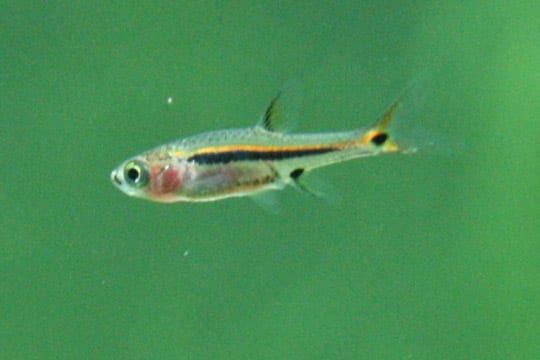
 © Melanochromis / Public domain
Exclamation Point Rasbora
The Exclamation Point Rasbora (Boraras urophthalmoides) is a tiny cyprinid from Southeast Asia, named for the dark stripe running along its body and the round black spot at the base of its tail fin — together they resemble an exclamation mark, which is exactly how the English name came about. In the wild these fish live in peat swamps and marshes with soft, weakly acidic water, and recreating those conditions calls for a bit of experience, which is why the species is generally considered suited to intermediate keepers. They are naturally peaceful shoalers, and a group swimming together brings out the best in their small, delicate bodies. Their calm temperament also makes them easy to combine with other similarly sized, gentle tankmates.
View Exclamation Point Rasbora encyclopedia →0% commission on your first sales!Register by September 30, 2026 and your first 2 sales are commission-free!
Breeder Wanted!
List on BreederDirect and sell directly to customers nationwide!
Our 6 Transparency Commitments
All Tropical Fish listings include water quality, temperament, and tank size information from verified Breeder.
- Origin Disclosed
- Real Photos
- Water Quality Disclosed
- Recommended Tank Size
- Temperament Disclosed
- Breed Line Disclosed
Browse all 301 breeds
Water Type
Care Level
No listings match your filters
Adjust your filters, or get notified when new listings arrive.
Getting alerts is free with a member account. When new listings match your saved search, we'll notify you by email and in-app.
Browse other categories
Verified breeders (preview)
Are you raising tropical fish?
Register as a breeder and connect with buyers directly.
Apply as a breederExclamation Point Rasbora key facts
- Care level
- Intermediate
- Lifespan
- 2-4 years
- Size
- 1.6cm SL (FishBase records up to 4cm TL)
- Temperature
- 20〜28℃
- Diet
- Fine dried foods and live or frozen Artemia nauplii and daphnia
- Tank
- Seriously Fish suggests a 45 x 30cm base. A densely planted tank with driftwood, leaf litter and floating plants to diffuse the light suits it, and filter flow should be gentle, as it comes from sluggish water.
- Water Temperature & Quality
- Seriously Fish gives 20-28C, pH 6.0-7.0 and 1-10 dGH. It depends less on strongly acidic water than its congeners and does well in soft, slightly acidic conditions. In a small tank, change water often.
- Tank Mates
- Peaceful but small and timid, so not a general community fish. Other Boraras, plus Microdevario, Sundadanio, Danionella, Trigonostigma, pygmy Corydoras and Otocinclus, are good choices.
- Diet & Feeding
- Its mouth is very small, so use the finest dried foods. Live or frozen Artemia nauplii and daphnia improve colour and breeding condition. Feed small amounts several times a day.
- Breeding & Spawning
- An egg-scattering continuous spawner with no parental care. Given fish in good condition, a few eggs are laid every day, and in a mature, densely planted tank some fry survive unaided.
- Health & Notes
- Groups of eight to ten or more settle it and bring out colour. Published sizes differ widely between sources, so judge tankmates from the fish in front of you. The IUCN rates it Near Threatened and it is not covered by CITES.
About Exclamation Point Rasbora
A tiny Southeast Asian cyprinid whose black stripe and tail-spot resemble an exclamation mark. Prefers soft, weakly acidic water and is generally rated for intermediate keepers; shoals beautifully.
7 things to know before welcoming a Exclamation Point Rasbora
1Prefers Soft, Acidic Water
In the wild these fish live in the peat swamps and marshes of Southeast Asia, so they thrive in soft, weakly acidic water. Filtering through soil substrate or peat helps keep water chemistry stable.
2A Natural Shoaling Fish
Kept in a group rather than alone, this rasbora shows more of its natural behavior and its tiny body looks far more lively. Shoaling together is also thought to reduce stress.
3The "Exclamation Mark" Pattern
The dark stripe along the body paired with the round black spot at the base of the tail resembles an exclamation mark — the source of both its English and Japanese names. It's also a useful clue for telling it apart from closely related Boraras species.
4Choose Small, Peaceful Tankmates
Because this fish is extremely small, avoid housing it with large or aggressive species and stick to similarly sized, peaceful tankmates. It also tends to do well alongside invertebrates such as shrimp.
5Feed Fine, Small Food
Its mouth is very small, so powdered or finely crushed food is easiest for it to eat without leftovers. Offering small amounts several times a day helps ensure even nutrition.
6Sensitive to Sudden Water Changes
Being so small, this fish is sensitive to sudden shifts in water quality or pH. Take time acclimating new arrivals, and change water in small, frequent amounts rather than large infrequent ones.
7Why It's Rated for Intermediate Keepers
Maintaining stable, soft, weakly acidic water and staying alert to changes in water quality are what place this species in the intermediate category. It helps to understand the basics of water management before bringing one home.
Frequently asked questions about Exclamation Point Rasbora
- Q.Is this fish suitable for beginners?
- A.This species is generally rated for intermediate keepers, so some prior experience with water quality management is recommended. Beginners who can maintain stable, soft, weakly acidic water can still succeed with it.
- Q.Can it be kept with other fish?
- A.Because it's so small, it does best with similarly sized, peaceful tankmates. Avoid pairing it with large or aggressive fish.
- Q.What tank size does it need?
- A.With a standard length of around 1.6 cm, this is an extremely small fish best kept in a group, so choose a tank with enough room for several to shoal comfortably. Maintaining soft, weakly acidic water is equally important.
- Q.Where does its name come from?
- A.The dark stripe along its body combined with the black spot at the base of the tail looks like an exclamation mark, which is how it got the English name "Exclamation Point Rasbora." This distinctive marking is the same feature behind its Japanese name.
- Q.Are there any regulations to be aware of?
- A.This species is not subject to CITES.
Useful tools for Exclamation Point Rasbora care
Learn more about Exclamation Point Rasbora in the encyclopedia
View Exclamation Point Rasbora encyclopedia entry →
Care difficulty, lifespan, size and diet — all basics covered.
More in this category
Can't find the one you're looking for?
Post your wishes for free and breeders with matching animals will contact you with introductions.