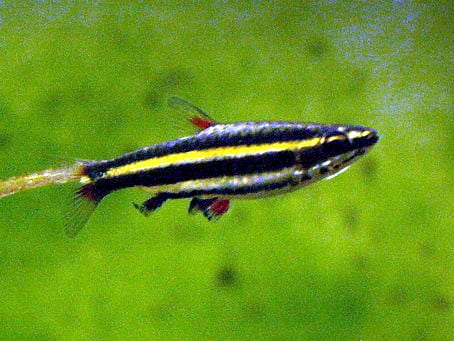
 © Fanch from Paris, France / CC BY 2.0
Dwarf Pencilfish
The dwarf pencilfish is a diminutive tropical fish that tops out around 2.5 to 3.5 cm as an adult. Three bold dark stripes run along its slender body, set off by a touch of red at the base of the tail fin. Its movements are unhurried and peaceable, and it settles in comfortably alongside similarly gentle, similarly sized tankmates. That said, it's sensitive to water conditions and won't thrive in a bright, busy setup — it does best in a mature, soft-water aquarium with steady biological filtration. Because it calls for a bit of aquarium experience, it's best suited to keepers who are already comfortable managing small fish.
View Dwarf Pencilfish encyclopedia →0% commission on your first sales!Register by September 30, 2026 and your first 2 sales are commission-free!
Breeder Wanted!
List on BreederDirect and sell directly to customers nationwide!
Our 6 Transparency Commitments
All Tropical Fish listings include water quality, temperament, and tank size information from verified Breeder.
- Origin Disclosed
- Real Photos
- Water Quality Disclosed
- Recommended Tank Size
- Temperament Disclosed
- Breed Line Disclosed
Browse all 301 breeds
Water Type
Care Level
Verified breeders wanted for Tropical Fish
Breeders are signing up now ahead of launch. Subscribe to be notified when new listings go live.
Getting alerts is free with a member account. When new listings match your saved search, we'll notify you by email and in-app.
Browse other categories
Verified breeders (preview)
Are you raising tropical fish?
Register as a breeder and connect with buyers directly.
Apply as a breederDwarf Pencilfish key facts
- Care level
- Intermediate
- Lifespan
- 3-5 years
- Size
- About 2.5-3.5cm
- Temperature
- 22〜28℃
- Diet
- Fine dried foods, live and frozen brine shrimp, Daphnia
- Tank
- Seriously Fish suggests a base of at least 45 by 30cm, about 41 litres at 30cm depth, and FishBase recommends groups of five or more in a tank of 60cm or longer. Floating plants, driftwood branches and dried leaf litter break up lines of sight, which draws out natural behaviour and reduces skittishness; the decaying leaves also seed microbe colonies.
- Water Temperature & Quality
- Seriously Fish gives 22-28C, pH 4.0-7.0 and 1-10 dGH; FishBase gives pH 5.8-7.5, hardness to 15 dH and 24-26C. Seriously Fish rates it moderate because it needs a mature tank and steady water, so do not add it to a newly set-up aquarium.
- Tank Mates
- In the wild it shares its water with small characids, other lebiasinids and dwarf cichlids. Its mouth is small and it is not assertive, so avoid fish that will out-compete it for food or that are simply too large. It settles when kept as a group.
- Diet & Feeding
- Its mouth is small, so base the diet on finely ground dried food and small live or frozen items such as brine shrimp and Daphnia. It cannot manage large pellets.
- Breeding & Spawning
- Since its habitat is very soft water at pH 4.0 to 6.0, an attempt would mean reproducing that chemistry in dim surroundings.
- Health & Notes
- FishBase lists it as IUCN Least Concern, not on the CITES appendices and harmless to people. Red stripes and yellow tones vary by population, so fish of the same species may not match. It depends on a mature tank and steady water, and swings in water quality tell on it.
About Dwarf Pencilfish
A small tropical fish with three dark stripes and a red mark at the tail base. Dwarf pencilfish grow to about 2.5–3.5 cm and thrive in a mature, soft-water tank suited to intermediate keepers.
7 things to know before welcoming a Dwarf Pencilfish
1Needs a Mature, Soft-Water Tank
Freshly set-up tanks or sudden shifts in water chemistry can throw dwarf pencilfish off balance easily. Before bringing them home, make sure your tank is fully cycled with stable biological filtration — a soft, slightly acidic to neutral environment suits them best.
2Dislikes Bright, Busy Setups
Strong lighting, forceful water flow, or loud tank noise tend to make this fish retreat and hide. Floating plants or driftwood that cast some shade, paired with softer lighting, help bring out its natural color and activity.
3Calm and Prefers Company
Dwarf pencilfish are peaceful by nature and settle in best when kept in a group of their own kind rather than alone. If mixing species, choose similarly sized, equally calm tankmates and avoid larger or more aggressive fish.
4Needs Small, Appropriately Sized Food
Its small mouth means oversized food pellets often go uneaten and foul the water. Offer fine-grained prepared foods or brine shrimp in small portions several times a day to keep it in good condition.
5Watch for Jumping When Startled
Sudden noises or shadows can startle this fish into jumping, so a secure tank lid is worth having. Introduce any changes to the layout or new tankmates gradually to avoid stressing the fish.
6Choose Tankmates Carefully
Despite its calm temperament, its small size makes it vulnerable to faster or larger fish stealing food or causing stress. Pair it with similarly sized, equally gentle swimmers for the best results.
7Acclimate Slowly When Introducing
Because it's sensitive to shifts in water chemistry and temperature, take extra time acclimating a new arrival before release into the tank. It's common for a newly introduced fish to hide for the first few days before settling in.
Frequently asked questions about Dwarf Pencilfish
- Q.Is it a good fish for beginners?
- A.It's considered better suited to intermediate keepers, since it's sensitive to water conditions and can decline quickly in an unstable tank. It's best to gain some experience with small fish before taking one on.
- Q.How big does the dwarf pencilfish get?
- A.Adults typically reach about 2.5 to 3.5 cm, making this one of the smaller tropical fish available. It doesn't grow beyond this size, so plan tankmates accordingly.
- Q.Can it be kept with other fish?
- A.Yes — it's peaceful and does well with similarly sized, calm tankmates. Fast-moving or aggressive fish can stress it out or outcompete it for food.
- Q.How can I tell it apart from similar pencilfish?
- A.Look for the three bold dark stripes along its body and the red marking at the base of the tail fin. These features help distinguish it from other pencilfish species.
- Q.Are there any legal restrictions on this species?
- A.No — this species is not subject to CITES.
Useful tools for Dwarf Pencilfish care
Learn more about Dwarf Pencilfish in the encyclopedia
View Dwarf Pencilfish encyclopedia entry →
Care difficulty, lifespan, size and diet — all basics covered.
More in this category
Can't find the one you're looking for?
Post your wishes for free and breeders with matching animals will contact you with introductions.