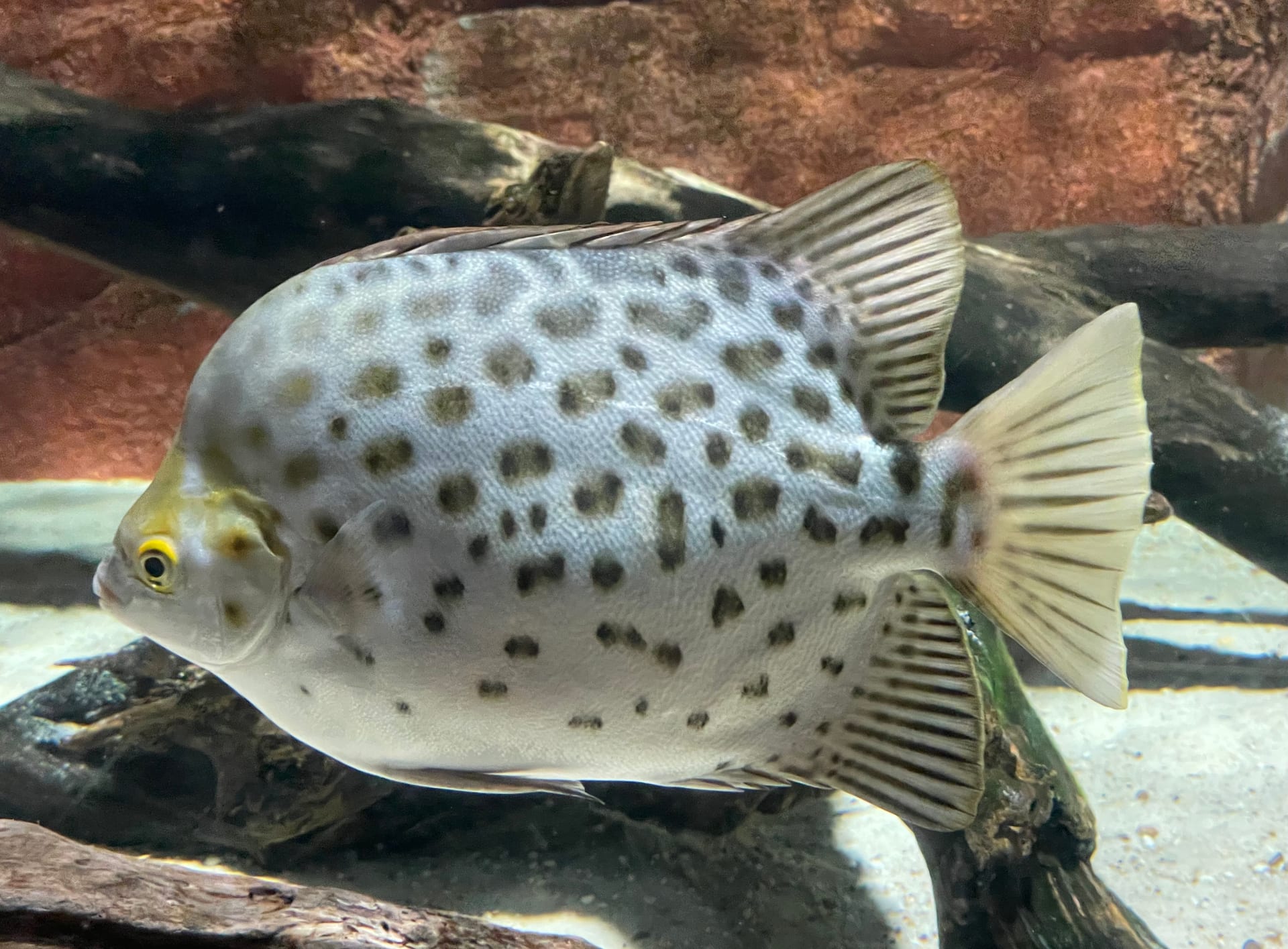
 © Pelagic / CC BY-SA 4.0
Spotted Scat
The Spotted Scat is a brackish-water fish with a squared, laterally compressed body scattered with round dark-brown spots, native to mangroves and estuaries across the Indo-West Pacific. It comes in two color forms, a greenish "green scat" and a reddish "red scat," and the spot patterns vary from fish to fish, making them fun to compare. As an omnivore that favors plant matter, it's a hardy, eager eater that swims actively in groups and brings real presence to an aquarium. That said, the spines in its dorsal fin carry venom, so care is needed to avoid being pricked during tank maintenance or handling. As adults grow into a deep-bodied, sturdy build, they need a correspondingly spacious setup, making this an impressive fish to keep.
View Spotted Scat encyclopedia →0% commission on your first sales!Register by September 30, 2026 and your first 2 sales are commission-free!
Breeder Wanted!
List on BreederDirect and sell directly to customers nationwide!
Our 6 Transparency Commitments
All Tropical Fish listings include water quality, temperament, and tank size information from verified Breeder.
- Origin Disclosed
- Real Photos
- Water Quality Disclosed
- Recommended Tank Size
- Temperament Disclosed
- Breed Line Disclosed
Browse all 301 breeds
Water Type
Care Level
Verified breeders wanted for Tropical Fish
Breeders are signing up now ahead of launch. Subscribe to be notified when new listings go live.
Getting alerts is free with a member account. When new listings match your saved search, we'll notify you by email and in-app.
Browse other categories
Verified breeders (preview)
Are you raising tropical fish?
Register as a breeder and connect with buyers directly.
Apply as a breederSpotted Scat key facts
- Care level
- Intermediate
- Lifespan
- 5-8 years
- Size
- 20-38cm
- Temperature
- 22〜28℃
- Diet
- Prepared foods with vegetable content, marine algae, frozen foods
- Tank
- LiveAquaria gives a 473 litre (125 gallon) minimum. The fish is deep-bodied and grows quickly, so choose a tank with both height and length.
- Water Temperature & Quality
- LiveAquaria gives 22-28C (72-82F), pH 7.5-8.5 and 8-12dKH; FishBase records 20-28C in the wild. It adapts from brackish to marine conditions, but salinity should be kept stable.
- Tank Mates
- LiveAquaria rates it semi-aggressive. Pair it with robust brackish fishes of similar size; its strong appetite means slower feeders lose out.
- Diet & Feeding
- An omnivore with a strong herbivorous component. Base the diet on algae and vegetable-based prepared foods with frozen items alongside. It strips aquatic plants, so it does not suit planted tanks.
- Breeding & Spawning
- FishBase lists it as a commercially farmed species, but home-aquarium spawning is rarely recorded.
- Health & Notes
- The dorsal spines are venomous and both FishBase and LiveAquaria record the species as venomous. Take care not to be stung when netting it or working in the tank.
About Spotted Scat
Spotted Scat: a brackish-water fish with dark spots on a squared body, in green and red color forms. Favors plant matter but note its venomous dorsal spines when handling.
7 things to know before welcoming a Spotted Scat
1Naturally a brackish-water fish
In the wild it lives in mangroves and estuaries, tolerating a wide range of salinity. In the aquarium, offering a mild brackish setup rather than pure freshwater lets it live closer to its natural conditions.
2Dorsal spines carry venom
The spines in its dorsal fin are venomous and can cause a painful sting if touched bare-handed. Take care not to brush against them when netting the fish or working inside the tank.
3Grows into a large adult
Adults reach roughly 20 to 38 cm with a deep, sturdy body. Plan ahead with a spacious tank and strong filtration to match its eventual size.
4Favors plant-based food
It has a natural preference for algae and other plant matter, though it's a hardy eater that adapts well to prepared foods too. A varied, balanced diet helps keep its color and condition healthy.
5Green and red color forms
Two color forms exist, a greenish "green scat" and a reddish "red scat," and the spot patterns differ from fish to fish. Part of the fun is finding a pattern you like.
6Active, shoaling temperament
It tends to do better in small groups than alone and can be housed with similarly active tankmates. Give it room to swim and it will show off its lively, active side.
7Stable water quality matters
Though hardy, it doesn't tolerate sudden water quality swings well, so make water changes gradual and planned. Set up filtration and testing routines before bringing one home.
Frequently asked questions about Spotted Scat
- Q.Can it be kept in freshwater only?
- A.It can survive short-term in freshwater, but as a naturally brackish-water fish it tends to stay healthier with a mild salt content in the water. For long-term keeping, setting up a brackish environment is recommended.
- Q.How large a tank does it need?
- A.Since adults grow to roughly 20 to 38 cm, it's wise to plan for a large tank even while the fish is still young. You can also upgrade the tank size gradually as it grows.
- Q.What happens if the dorsal spines sting me?
- A.The dorsal fin spines are venomous and can cause pain if you're stung. Be careful not to touch them directly when netting the fish or working inside the tank.
- Q.Can it be kept with other fish?
- A.It does well with similarly active tankmates. Since it has a shoaling tendency, keeping several together or with its own kind is also a good option.
- Q.What should I feed it?
- A.Since it favors plant matter, a balanced diet including algae-based prepared foods works well. It's a hardy fish that eats a wide range of foods once accustomed.
Useful tools for Spotted Scat care
Learn more about Spotted Scat in the encyclopedia
View Spotted Scat encyclopedia entry →
Care difficulty, lifespan, size and diet — all basics covered.
More in this category
Can't find the one you're looking for?
Post your wishes for free and breeders with matching animals will contact you with introductions.