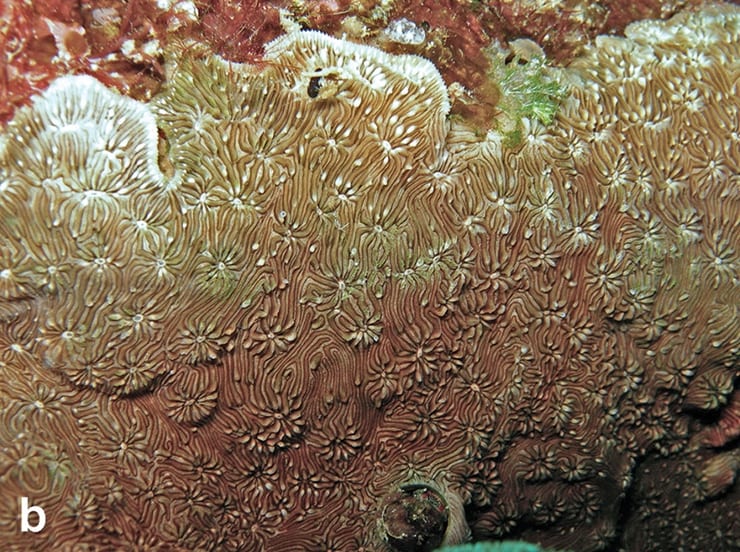
 © Zarinah Waheed, Francesca Benzoni, Sancia E. T. van der Meij, Tullia Isotta Terr / CC BY 4.0
Flat Leaf Coral
Flat Leaf Coral grows either as an encrusting sheet over its base or as a thin plate with corallites on one side only. Round corallites sit sparsely across the surface, each with a columnar columella rising from its center. Colors range widely, including gray, brown, pink, purple, green and yellow, so every colony looks a little different. It resembles Leptoseris explanata but has larger corallites. Care difficulty is rated for advanced keepers, so it suits a stable, well-established tank with room to spread.
View Flat Leaf Coral encyclopedia →0% commission on your first sales!Register by September 30, 2026 and your first 2 sales are commission-free!
Breeder Wanted!
List on BreederDirect and sell directly to customers nationwide!
Br-Choku's 6 Transparency Standards
Our Breeder sellers disclose detailed care specs for all Coral listings. We prioritize Aquacultured/CB specimens, verify WYSIWYG photos, and provide difficulty ratings—avoiding wild-caught.
- Aquacultured
- WYSIWYG Photo
- Difficulty Disclosed
- Frag/Colony
- Care Info Included
- Trade name shown
Browse all 241 breeds
Difficulty
Verified breeders wanted for Coral
Breeders are signing up now ahead of launch. Subscribe to be notified when new listings go live.
Getting alerts is free with a member account. When new listings match your saved search, we'll notify you by email and in-app.
Browse other categories
Verified breeders (preview)
Flat Leaf Coral key facts
- Care level
- Advanced
- Lifespan
- Little data available
- Size
- Wild colonies 70-100 cm (Reeflex)
- Temperature
- 24〜27℃
- Diet
- Photosynthesis (zooxanthellae) plus plankton
- Lighting
- It hosts zooxanthellae and lives on clear-water reef slopes (Reeflex). Acclimate it at moderate light and adjust by watching its colour.
- Flow & Placement
- In the wild it also lives on steep slopes with moving water (Reeflex). It spreads as a crust, so attach it to a flat rock and give moderate flow.
- Water Temperature & Quality
- 24-27°C, salinity 33-35 ppt (SG 1.023-1.025); Reeflex gives 22-27°C.
- Diet & Feeding
- Besides photosynthesis it takes plankton (Reeflex); offer small amounts of fine food.
- Health & Cautions
- Not for beginners (Reeflex). It is easily confused with Leptoseris, so check corallite size and the pillar-like columellae.
About Flat Leaf Coral
Flat Leaf Coral grows as an encrusting sheet or thin plate with sparse round corallites and a wide range of colors. Learn its features and what to know before bringing one home. Best for advanced keepers.
7 things to know before welcoming a Flat Leaf Coral
1Advanced-level care
Its care difficulty is rated for advanced keepers. It is safest to bring one home once you have experience with corals and a tank with stable water quality. Lifespan data is limited, so no clear figure is available.
2Encrusting or plate growth
It either spreads over its base in an encrusting form or grows as a thin plate with corallites on one side only. Place it where its growth will not run into neighboring animals or equipment.
3Round corallites, columella
Round corallites are sparsely spaced, and a columnar columella stands at the center of each one. This structure helps with identification. When browsing photos, look at the size and spacing of the corallites.
4Wide color range
Colors run from gray and brown to pink, purple, green and yellow. Each colony has its own look, so check the listing photos for a color you like. Lighting and photo conditions can change how a color appears, so ask the breeder if anything is unclear.
5Telling look-alikes apart
It looks similar to Leptoseris explanata, but its corallites are larger. Because the two resemble each other, check the species name and corallite size in the photos. If you are unsure, ask the breeder how the coral was identified.
6Adult size to expect
Wild colonies are reported at 70 to 100 cm (Reeflex). A tank colony may not reach that size, but plan on it spreading over time and leave generous room around it.
7Watch closely after arrival
As an advanced-level coral, it needs a slow, careful acclimation to your tank's water quality and temperature. Check on it often for the first few days. Keeping notes on polyp extension, color and tissue condition helps you notice changes early.
Frequently asked questions about Flat Leaf Coral
- Q.Can a beginner keep Flat Leaf Coral?
- A.Its care difficulty is rated for advanced keepers. It is best considered once you have coral-keeping experience and a stable tank. Before buying, it helps to ask the breeder about care and the conditions the coral has been kept in.
- Q.How large does it get?
- A.Wild colonies are reported at 70 to 100 cm (Reeflex). A tank colony may not grow that large, but it spreads as an encrusting sheet or plate, so leave plenty of space around it.
- Q.How does it differ from Leptoseris explanata?
- A.The two look alike, but Flat Leaf Coral has larger corallites. Species can be hard to judge from photos alone, so if you are unsure, ask the breeder how the coral was identified.
- Q.How long does it live?
- A.Lifespan data is limited, so no clear number is available. Plan to keep it for the long term by maintaining stable water quality, giving it room to grow, and observing it regularly.
- Q.What is its CITES status?
- A.Flat Leaf Coral is listed in CITES Appendix II. When you buy, it is a good idea to also check the listing details and any information the breeder provides.
Useful tools for Flat Leaf Coral care
Learn more about Flat Leaf Coral in the encyclopedia
View Flat Leaf Coral encyclopedia entry →
Care difficulty, lifespan, size and diet — all basics covered.
More in this category
Can't find the one you're looking for?
Post your wishes for free and breeders with matching animals will contact you with introductions.