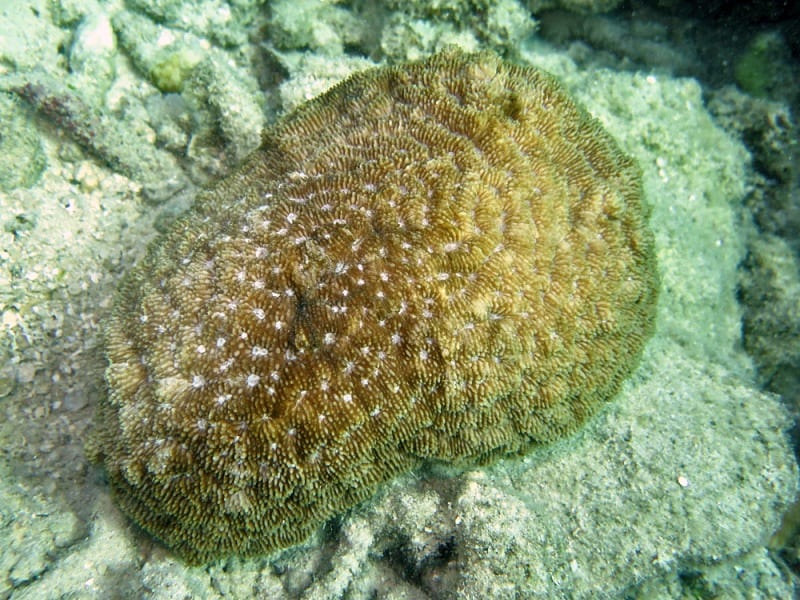
 © Anne Hoggett / CC BY 3.0
Sandalolitha
Sandalolitha, known in Japanese as Helmet Stone Coral, is a large free-living coral in the mushroom coral family (Fungiidae). Unlike corals that anchor themselves to the reef, it lives unattached on the sand or rubble, forming a rounded to oval dome that gives the species its common name. Its surface lacks the axial groove seen in some related corals; instead, countless small corallites sit packed tightly together, creating a distinctive, almost pebbled texture. Coloration ranges from pale to deep brown and can shade into green, and many individuals show corallite centers that fade to white, giving each coral its own subtle pattern. It's a hardy, easy-to-manage species that suits keepers just starting out with corals.
View Sandalolitha encyclopedia →0% commission on your first sales!Register by September 30, 2026 and your first 2 sales are commission-free!
Breeder Wanted!
List on BreederDirect and sell directly to customers nationwide!
Br-Choku's 6 Transparency Standards
Our Breeder sellers disclose detailed care specs for all Coral listings. We prioritize Aquacultured/CB specimens, verify WYSIWYG photos, and provide difficulty ratings—avoiding wild-caught.
- Aquacultured
- WYSIWYG Photo
- Difficulty Disclosed
- Frag/Colony
- Care Info Included
- Trade name shown
Browse all 210 breeds
Difficulty
Verified breeders wanted for Coral
Breeders are signing up now ahead of launch. Subscribe to be notified when new listings go live.
Getting alerts is free with a member account. When new listings match your saved search, we'll notify you by email and in-app.
Browse other categories
Verified breeders (preview)
About Sandalolitha
Sandalolitha is a large free-living dome-shaped coral with tightly packed corallites and no axial groove — a hardy species well suited to coral-keeping beginners.
7 things to know before welcoming a Sandalolitha
1Placement on Substrate
As a free-living species, it isn't attached to rock — simply set it on sand or a stable spot in the tank. Give it enough open space around it to display its full dome shape.
2Corallites Without a Groove
Look closely and you'll see tightly packed, individual corallites with no axial groove running across the surface. This texture is one way to tell it apart from related mushroom corals.
3Color Varies by Individual
Coloration ranges from pale to dark brown and can lean toward green. Corallite centers sometimes fade to white, so no two individuals look quite the same.
4Watch for Debris on the Surface
Being free-living, it doesn't always sit in an ideal position, so sand or detritus can settle on top of it. A gentle current helps keep the surface clear.
5Moderate Light and Flow
Rather than placing it under intense light or direct strong flow, a calmer spot such as near rockwork tends to keep it more stable.
6Leave Room from Other Corals
It grows into a large dome shape, so contact with neighboring corals can trigger stinging responses. Leave generous spacing when placing it.
7Acclimate Slowly
When introducing it to your tank, avoid sudden shifts in temperature or water chemistry. A slow drip acclimation helps it settle in without stress.
Frequently asked questions about Sandalolitha
- Q.Is Sandalolitha suitable for beginners?
- A.Yes, it's considered a hardy, beginner-friendly species. As long as basic water quality is maintained and it's placed appropriately, it's manageable even for first-time coral keepers.
- Q.Does it need to be glued to rock?
- A.No, it's a free-living coral, so no gluing or attachment is needed. It's simply placed on sand or a stable spot in the tank.
- Q.What does "no axial groove" mean?
- A.It means the surface has no groove running across it — instead, individual corallites sit tightly packed side by side. This is one way to distinguish it from related mushroom corals.
- Q.Why does coloration vary between individuals?
- A.Colors range from pale to dark brown and can lean toward green, and corallite centers sometimes fade to white. This is a natural feature of the species, so each coral looks a little different.
- Q.Is it safe to place near other corals?
- A.Since it grows into a large dome, contact with neighboring corals can trigger stinging responses. It's best to leave generous spacing around it.
Useful tools for Sandalolitha care
Learn more about Sandalolitha in the encyclopedia
View Sandalolitha encyclopedia entry →
Care difficulty, lifespan, size and diet — all basics covered.
More in this category
Can't find the one you're looking for?
Post your wishes for free and breeders with matching animals will contact you with introductions.