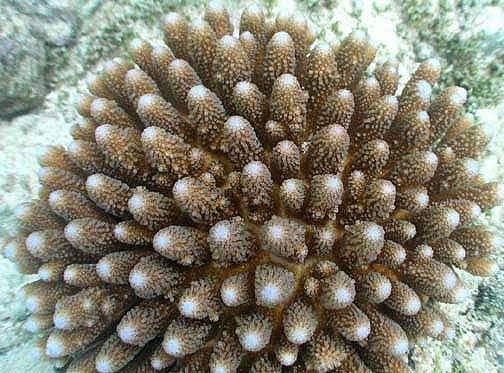
 © NPS photo - Eva DiDonato. Identified by Douglas Fenner / Public domain
Acropora Humilis
Acropora humilis forms an upright, finger-like colony of thick branches that taper toward their tips. Its axial corallites are large and dome-shaped, while the surrounding radial corallites come in two sizes, with the larger ones arranged in neat rows across the branch surface. Coloration ranges from cream, blue, and brown to purple, often with branch tips fading to a paler cream or blue for a striking two-tone effect. Because it demands strong lighting, steady flow, and stable water quality, this species is generally considered suitable for experienced reef keepers rather than beginners.
View Acropora Humilis encyclopedia →0% commission on your first sales!Register by September 30, 2026 and your first 2 sales are commission-free!
Breeder Wanted!
List on BreederDirect and sell directly to customers nationwide!
Br-Choku's 6 Transparency Standards
Our Breeder sellers disclose detailed care specs for all Coral listings. We prioritize Aquacultured/CB specimens, verify WYSIWYG photos, and provide difficulty ratings—avoiding wild-caught.
- Aquacultured
- WYSIWYG Photo
- Difficulty Disclosed
- Frag/Colony
- Care Info Included
- Trade name shown
Browse all 210 breeds
Difficulty
Verified breeders wanted for Coral
Breeders are signing up now ahead of launch. Subscribe to be notified when new listings go live.
Getting alerts is free with a member account. When new listings match your saved search, we'll notify you by email and in-app.
Browse other categories
Verified breeders (preview)
Acropora Humilis key facts
- Care level
- Advanced
- Temperature
- 22〜26℃
- Diet
- Mainly nutrition from symbiotic zooxanthellae, supplemented with powdered or liquid coral foods and phytoplankton.
- Lighting
- Requires strong light. AlgaeBarn cites successful Acropora keeping at PAR 800 or more. Start newly added colonies under reduced light and raise it over several weeks.
- Flow & Placement
- A shallow-water species from upper reef flats and wave-swept slopes that tolerates strong flow. Position it so that water moves between the finger-like branches.
- Water Temperature & Quality
- Water 22-26C, specific gravity 1.023-1.025, KH 8-12, calcium 380-440 ppm, magnesium 1300-1400 ppm. Sudden swings in alkalinity are the most common cause of tissue loss.
- Feeding
- Most of its nutrition comes from photosynthesis by its zooxanthellae. Powdered or liquid coral foods and phytoplankton can be offered as a supplement, but stable light and water chemistry matter more than feeding.
- Notes
- It is exported for the aquarium trade. LiveAquaria rates the care level of Acropora as difficult across the genus, and this species should be kept to that genus-level standard. Listed on CITES Appendix II.
About Acropora Humilis
Acropora humilis is a finger-branching coral with dome-shaped axial corallites and cream-to-blue branch tips, best suited to experienced reef keepers.
7 things to know before welcoming a Acropora Humilis
1Strong Light & Flow Needed
As an advanced-level Acropora, Acropora humilis needs strong lighting and steady water flow to stay healthy. Without enough light and flow, the symbiotic algae can fall out of balance, leading to dull coloration or tissue recession. It's worth confirming your lighting and pump capacity before bringing one home.
2Finger-Like Branching Form
Thick branches taper toward their tips and rise upward like fingers, building into a rounded, bushy colony over time. The axial corallite at each branch tip is large and dome-shaped, surrounded by radial corallites of two different sizes. Watching the branching pattern shift as the colony grows is part of the appeal.
3Acclimate Gradually to Light
Coloration ranges from cream, blue, and brown to purple, often with branch tips fading into a lighter cream or blue. Sudden exposure to intense lighting can damage both color and tissue, so it's best to start with dimmer light right after introduction and increase it gradually.
4Keep Water Parameters Stable
Calcium, alkalinity, and magnesium all feed into skeletal growth, and sudden swings matter more than the exact numbers. This species prefers low-nutrient water, but nutrients that drop too low can also dull its coloration, so regular testing helps you track the balance.
5Give It Room to Grow
The colony grows upward in finger-like branches while also spreading outward, so it needs enough space to avoid contact with neighboring corals. Corals that touch can damage each other, so plan your layout with the colony's eventual size in mind.
6Propagating Through Fragging
Like other Acropora, this species is commonly propagated by cutting off a branch to create a new frag. Keep flow gentle until the cut surface heals, and always take cuttings from a healthy parent colony to improve success.
7Check Condition Before Bringing Home
Before acquiring one, check that the polyps at the branch tips are extended and look for any tissue recession or bleached areas. Acclimate slowly, ideally with a drip method, to avoid shocking it with sudden temperature or water changes, and keep lighting subdued for the first few days.
Frequently asked questions about Acropora Humilis
- Q.Is Acropora humilis suitable for beginners?
- A.This species is generally considered suitable for advanced keepers, requiring strong lighting, stable flow, and confident water quality management. It's best approached after you've built some experience keeping other corals.
- Q.What do its branches and coloration look like?
- A.Thick branches taper toward their tips and rise up like fingers, with large, dome-shaped axial corallites and radial corallites in two sizes. Body color ranges from cream, blue, and brown to purple, often with the branch tips fading to cream or blue.
- Q.Is Acropora humilis covered by CITES?
- A.Acropora Humilis is listed in CITES Appendix II. International trade requires a permit from the exporting country, but as far as CITES is concerned, no registration is needed to buy or sell individuals already legally in Japan.
- Q.How much light and water quality control does it need?
- A.As an advanced-level species, it needs strong lighting and steady water flow. Keeping calcium, alkalinity, and other parameters stable supports healthy skeletal growth.
- Q.Is it okay to place it close to other corals?
- A.Since it grows into a large branching colony, contact with neighboring corals can cause mutual damage. It's best to plan your layout with its eventual size in mind and leave adequate space.
Useful tools for Acropora Humilis care
Learn more about Acropora Humilis in the encyclopedia
View Acropora Humilis encyclopedia entry →
Care difficulty, lifespan, size and diet — all basics covered.
More in this category
Can't find the one you're looking for?
Post your wishes for free and breeders with matching animals will contact you with introductions.