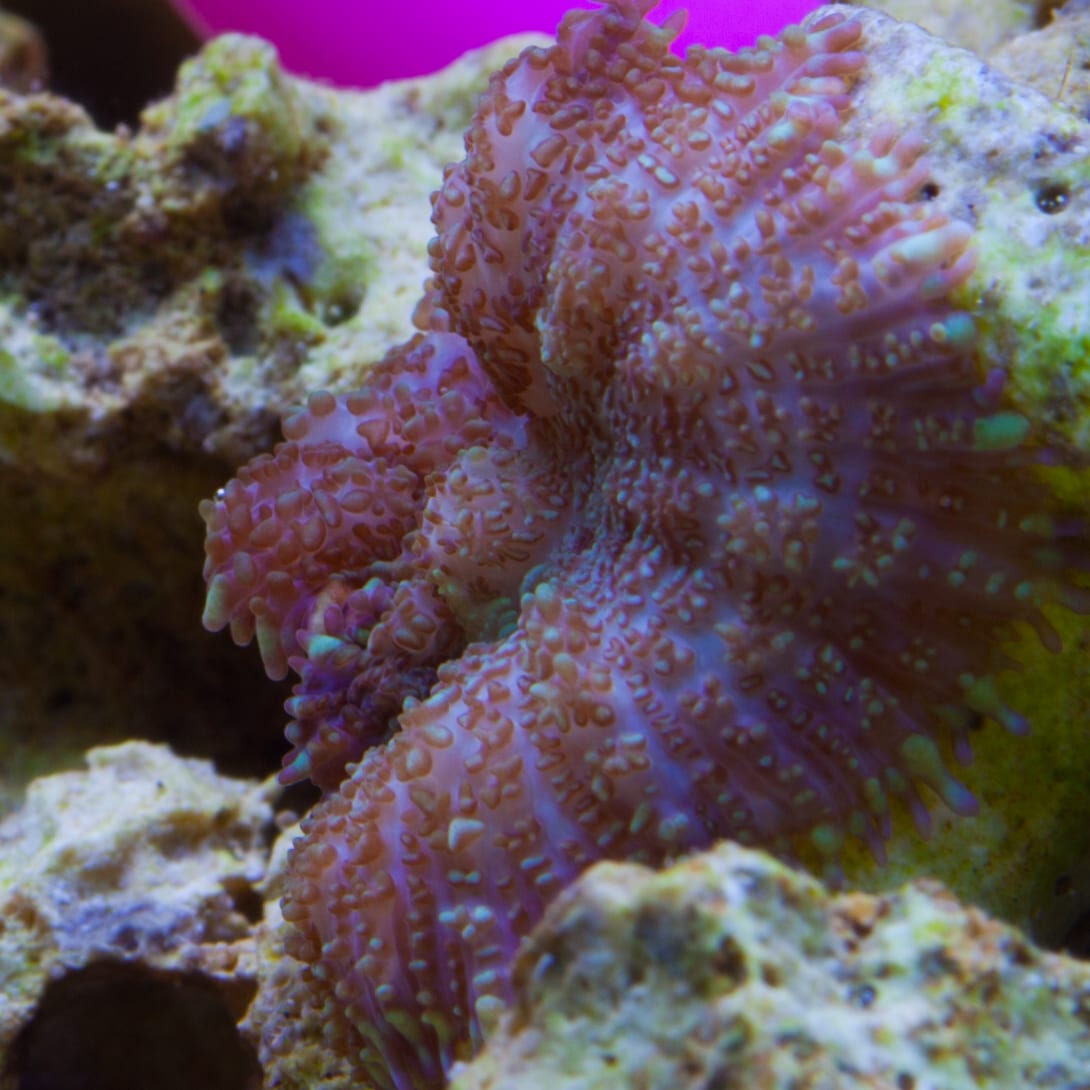
 © Will Thomas / CC BY 2.0
Ricordea Yuma
Ricordea Yuma is a corallimorph known for its large mouth that dominates the oral disc and the rounded, ball-like tentacles that spiral outward from the center. Because it doesn't build a hard skeleton, it has a soft, undulating form quite different from stony corals. It's commonly sold in vivid, fluorescent color morphs that stand out in any reef display. It needs some space from neighboring corals, but with careful attention to water quality and lighting it rewards keepers with slow, visible changes in color and tentacle spread. As an intermediate-level species, it's best suited to keepers who already have some experience managing a reef tank.
View Ricordea Yuma encyclopedia →Breeder Wanted!
List on BreederDirect and sell directly to customers nationwide!
BreederDirect's 6 Transparency Commitments
Our Breeder sellers disclose detailed care specs for all Coral listings. We prioritize Aquacultured/CB specimens, verify WYSIWYG photos, and provide difficulty ratings—avoiding wild-caught.
- Aquacultured
- WYSIWYG Photo
- Difficulty Disclosed
- Frag/Colony
- Care Info Included
- Trade name shown
Browse all 241 breeds
Difficulty
No listings match your filters
Adjust your filters, or get notified when new listings arrive.
Getting alerts is free with a member account. When new listings match your saved search, we'll notify you by email and in-app.
Browse other categories
Verified breeders (preview)
Ricordea Yuma key facts
- Care level
- Intermediate
- Temperature
- 24〜26℃
- Diet
- Nutrition from its zooxanthellae plus echinoderms, crustaceans, small fish and zooplankton.
- Lighting
- LiveAquaria lists Ricordea as needing moderate to high light but warns that metal halide can be too bright. It reacts badly to sudden changes, so acclimate it to new light gradually.
- Flow & Placement
- LiveAquaria gives placement as bottom and flow as low; the disc will not open in strong flow. Note that it is less hardy than most other mushroom corals.
- Water Temperature & Quality
- Water 24-26C, specific gravity 1.023-1.025 (salinity 33-35 ppt), pH 8.1-8.4, KH 8-12. Iodine and trace elements are recommended.
- Feeding
- Beyond what its zooxanthellae provide, offer small foods such as micro-plankton or brine shrimp to each disc. Items that are too large are spat out.
- Notes
- LiveAquaria rates it semi-aggressive and calls for space between it and other corals. Melting syndrome has been reported, so avoid abrupt changes in lighting or water chemistry. Having no skeleton, it is not covered by the CITES coral listings. The genus also contains Ricordea florida from the Caribbean, and the trade name ricordea alone does not distinguish the two. It is a separate species from a different region than this Indo-Pacific one, so check the scientific name down to the species when selecting.
About Ricordea Yuma
Ricordea Yuma is a corallimorph with a large mouth and spiraling, ball-shaped tentacles. It builds no hard skeleton and is often sold in vivid fluorescent colors. Considered an intermediate-level species to keep.
7 things to know before welcoming a Ricordea Yuma
1Lighting & Placement
Ricordea Yuma prefers moderate to fairly strong lighting, though metal halides can be too intense. It is sensitive to changes in light levels, so acclimate it gradually when introducing it. Place it low in the tank, near the bottom, and watch how its color and disc expansion change, adjusting its position if needed.
2Keep Water Flow Gentle
Prolonged exposure to strong flow can cause the oral disc to close up or shrink. A gentle, steady current helps it stay open and display its tentacles naturally. Periodically check and adjust the direction of your pumps.
3No Hard Skeleton
Unlike stony corals, Ricordea Yuma doesn't form a hard skeleton. It multiplies by marginal budding, in which a portion with its own tentacles and mouth grows out from the edge of the oral disc and detaches, so keep that in mind when deciding how to secure it in your layout.
4Give It Some Space
Corallimorphs like this one can affect neighboring corals or livestock through their tentacles or chemical interactions, so it's safer to leave some distance between it and other specimens. Placing them too close together can affect each other's growth and health.
5Feeding Tips
In nature it feeds on the products of photosynthesis from its zooxanthellae and also captures small food such as zooplankton. In the aquarium, offer small foods such as micro-plankton or brine shrimp directly to each oral disc. Food that is too large will be spat out, so choose pieces sized to its mouth.
6Stable Water Quality
As an intermediate-level species, it can struggle with extreme swings in water parameters. Keeping a consistent water change schedule and avoiding sudden changes is key to keeping it healthy long-term.
7Add It to a Mature Tank
It's reassuring to confirm your tank is fully cycled and stable before bringing one home. Treat the period right after placement as a settling-in phase, watching for changes in color and disc expansion as it adjusts to its new environment.
Frequently asked questions about Ricordea Yuma
- Q.Is Ricordea Yuma a true coral?
- A.Taxonomically it belongs to a group called corallimorphs, which differ from stony corals that build a hard skeleton. On marketplaces it's often grouped under the coral category for convenience.
- Q.Is it suitable for beginners?
- A.It's generally considered an intermediate-level species. It's best to gain some experience with basic tank management and water quality maintenance before keeping one.
- Q.Does it need strong lighting?
- A.Moderate to fairly strong lighting is a good guide. However, it is sensitive to changes in light levels and metal halides can be too intense, so acclimate it gradually when introducing it.
- Q.Do I need to feed it?
- A.It gets nutrition from its zooxanthellae but also captures small food, so feeding micro-plankton or brine shrimp to each oral disc is recommended. Food that is too large will be spat out, so choose pieces sized to its mouth.
- Q.Is it okay to place it close to other corals?
- A.Since corallimorphs can affect their surroundings, it's safer to leave some distance between it and other corals or livestock. Placing them too close together can affect each other's growth and health.
Useful tools for Ricordea Yuma care
Learn more about Ricordea Yuma in the encyclopedia
View Ricordea Yuma encyclopedia entry →
Care difficulty, lifespan, size and diet — all basics covered.
More in this category
Can't find the one you're looking for?
Post your wishes for free and breeders with matching animals will contact you with introductions.