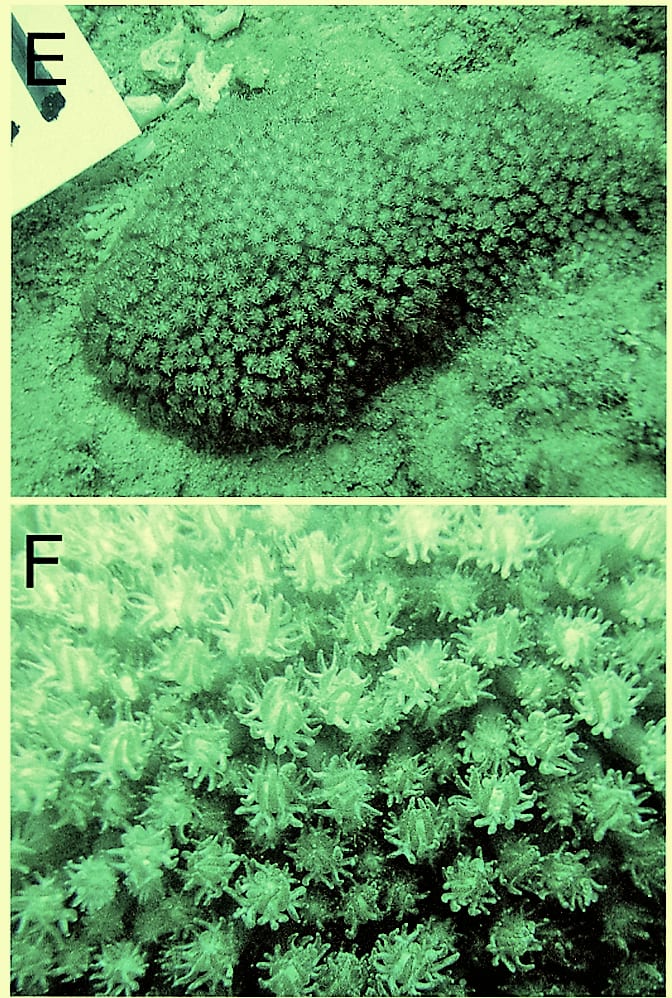
 © Kitano YF, Benzoni F, Arrigoni R, Shirayama Y, Wallace CC, Fukami H (2014) A Phylogeny of the Family Poritidae (Cnidaria, Scleractinia) Based on Molecular and Morphological Analyses. PLoS ONE 9(5): e98406. doi:10.1371/journal.pone.0098406 / CC BY 4.0
Bernardpora
Bernardpora is a small stony coral genus split off from Goniopora in a 2014 molecular phylogenetic study. It forms encrusting to massive colonies with small corallites packed with short polyps, giving mature colonies a densely textured, plush appearance. Records span from Japan to Australia. Considered suitable for intermediate-level keepers, it responds visibly to lighting and flow through polyp extension, and colonies can reach a diameter of roughly a dozen-plus centimeters over time.
View Bernardpora encyclopedia →0% commission on your first sales!Register by September 30, 2026 and your first 2 sales are commission-free!
Breeder Wanted!
List on BreederDirect and sell directly to customers nationwide!
Br-Choku's 6 Transparency Standards
Our Breeder sellers disclose detailed care specs for all Coral listings. We prioritize Aquacultured/CB specimens, verify WYSIWYG photos, and provide difficulty ratings—avoiding wild-caught.
- Aquacultured
- WYSIWYG Photo
- Difficulty Disclosed
- Frag/Colony
- Care Info Included
- Trade name shown
Browse all 210 breeds
Difficulty
No listings match your filters
Adjust your filters, or get notified when new listings arrive.
Getting alerts is free with a member account. When new listings match your saved search, we'll notify you by email and in-app.
Browse other categories
Verified breeders (preview)
About Bernardpora
Bernardpora is a small colonial stony coral split from Goniopora in 2014, known for its densely packed short polyps and small corallites. Suited to intermediate-level reefkeepers.
7 things to know before welcoming a Bernardpora
1A Newly Defined Genus
This stony coral belongs to a genus only separated from Goniopora in 2014 through molecular phylogenetics. Since it closely resembles related species, look for its small corallites and densely packed short polyps to identify it.
2Encrusting to Massive Growth
Colonies grow from an encrusting form into a more massive shape over time, staying relatively small overall. Under stable conditions the colony diameter can reach roughly a dozen-plus centimeters, so leave adequate spacing from neighboring corals from the start.
3Densely Packed Short Polyps
Small corallites packed tightly with short polyps give this coral its signature texture. Polyp extension shifts with lighting and water flow, making it interesting to observe day to day.
4Flow and Lighting Care
Overly strong flow can damage the delicate polyps, so gentle, stable water movement works best. Lighting that's too intense may keep polyps retracted, so adjust intensity gradually while watching the coral's response.
5Spacing from Other Corals
Aggression toward neighbors is generally considered mild, but a growing colony can eventually make contact with corals placed nearby. Plan your layout with its eventual size in mind.
6Confirm Tank Stability First
Like most stony corals, it's sensitive to sudden shifts in water parameters, so make sure your tank is well established before introducing one. Acclimate slowly with a drip method.
7Feeding and Nutrition
Like many stony corals, it likely supplements photosynthesis with feeding on tiny planktonic food sources. If feeding, timing it for when the polyps are extended tends to work well.
Frequently asked questions about Bernardpora
- Q.How difficult is this coral to keep?
- A.It's generally considered suitable for intermediate-level reefkeepers. Some experience managing water quality and flow will help, though a stable tank makes it more approachable.
- Q.How large does this coral grow?
- A.Colonies can reach a diameter of roughly a dozen-plus centimeters. Growth rate varies with conditions, so plan your layout with its eventual size in mind.
- Q.Can it be kept alongside other corals?
- A.Its aggression is generally considered mild, but a larger colony may eventually contact neighboring corals. Giving it some spacing in your layout is recommended.
- Q.Is Bernardpora subject to CITES?
- A.Bernardpora is not subject to CITES.
- Q.How should I manage water quality and flow?
- A.It's sensitive to sudden shifts in water parameters, so introduce it only once your tank is well established. It prefers gentle, stable flow, and both overly strong flow and overly intense lighting can cause the polyps to stay retracted.
Useful tools for Bernardpora care
Learn more about Bernardpora in the encyclopedia
View Bernardpora encyclopedia entry →
Care difficulty, lifespan, size and diet — all basics covered.
More in this category
Can't find the one you're looking for?
Post your wishes for free and breeders with matching animals will contact you with introductions.