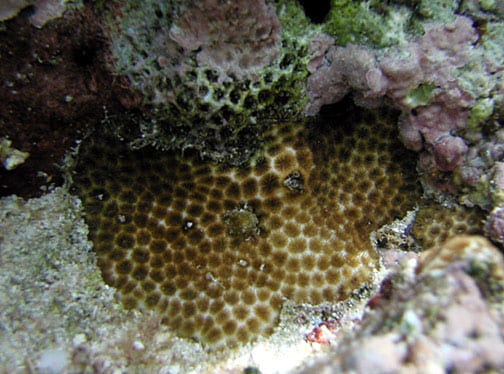
 © Eva DiDonato/NPS / Public domain
Leptastrea
Leptastrea, known in Japanese as "Ruri Sango," is an encrusting stony coral that spreads in a thin sheet across rock and live rock surfaces. Its English name, "crust coral," reflects this low, mat-like growth habit. Many colonies show a color that contrasts with the surrounding tissue at the center of each corallite, and the "orange eye" color variant built around this pattern is a well-known and popular form in the hobby. Considered suitable for intermediate keepers, Leptastrea rewards steady water quality and lighting with slow, gradual colony expansion over time. It's often used to bring color to awkward spots on rockwork — ledges, crevices, and vertical faces — where other corals struggle to establish.
View Leptastrea encyclopedia →0% commission on your first sales!Register by September 30, 2026 and your first 2 sales are commission-free!
Breeder Wanted!
List on BreederDirect and sell directly to customers nationwide!
Br-Choku's 6 Transparency Standards
Our Breeder sellers disclose detailed care specs for all Coral listings. We prioritize Aquacultured/CB specimens, verify WYSIWYG photos, and provide difficulty ratings—avoiding wild-caught.
- Aquacultured
- WYSIWYG Photo
- Difficulty Disclosed
- Frag/Colony
- Care Info Included
- Trade name shown
Browse all 210 breeds
Difficulty
No listings match your filters
Adjust your filters, or get notified when new listings arrive.
Getting alerts is free with a member account. When new listings match your saved search, we'll notify you by email and in-app.
Browse other categories
Verified breeders (preview)
Leptastrea key facts
- Care level
- Intermediate
- Size
- Encrusting colonies to around 10-20 cm across
- Temperature
- 24〜27℃
- Diet
- Mainly nutrition from symbiotic zooxanthellae, supplemented with fine particulate coral foods offered at night.
- Lighting
- LiveAquaria gives moderate lighting for Leptastrea. Too much light washes out the oral-disc colour, so place it from mid-height downwards and adjust while watching the colour.
- Flow & Placement
- Medium flow. Placement from the sand bed to mid-height is fine, but it encrusts outwards and will overgrow neighbours, so mount it on its own rock or where it has room.
- Water Temperature & Quality
- Water 24-26C, specific gravity 1.023-1.025, salinity 33-35 ppt, KH 8-12. It consumes calcium and magnesium, so test and replenish them regularly.
- Feeding
- Most of its nutrition comes from its zooxanthellae. The corallites are small, so feed only small amounts of fine particulate coral food after lights-out.
- Notes
- LiveAquaria classes the genus as aggressive; it digests the tissue of anything it touches, so keep it apart from other corals. As a scleractinian it is on CITES Appendix II and international trade requires permits.
About Leptastrea
Leptastrea is an encrusting stony coral that spreads across rock in a thin sheet. Known for the "orange eye" color variant with contrasting corallite centers, it's an intermediate-level species that slowly expands its colony over time.
7 things to know before welcoming a Leptastrea
1Encrusting Growth Habit
Leptastrea grows as a thin encrusting sheet across rock and live rock rather than forming upright branches. This makes it a natural fit for covering bare spots on your aquascape's base rock or rock sides.
2Intermediate-Level Care
This species is generally recommended for keepers with some coral-keeping experience. A working understanding of water quality, lighting, and flow management helps keep colonies stable.
3The "Orange Eye" Variant
Many colonies show a color at the center of each corallite that contrasts with the surrounding tissue, and the form where this stands out is known as "orange eye." The exact pattern and intensity vary from colony to colony, which is part of the appeal.
4Lighting and Flow Care
Sudden changes in lighting or water flow can cause polyps to retract or become stressed. After introducing a new colony, start with moderate conditions and adjust light and flow gradually while watching how it responds.
5Placement Strategy
Because it can spread across surfaces where other corals struggle to establish, such as rock sides and crevices, Leptastrea works well for filling awkward gaps in a layout. Leave enough space around it, though, since an expanding colony can eventually make contact with neighboring corals.
6Slow Colony Expansion
Reaching a colony diameter of a dozen-plus centimeters takes time with this species. Day-to-day change is minimal, so it's best approached as a coral to enjoy for its gradual, long-term spread.
7Check Tank Stability First
Before bringing one home, confirm that your tank's water parameters — temperature, salinity, pH, nutrients — are already stable. Since this is considered an intermediate-level species, it suits an established reef tank better than one that's just been set up.
Frequently asked questions about Leptastrea
- Q.Is Leptastrea suitable for beginners?
- A.This species is generally considered an intermediate-level coral. It's easiest to keep stable once you're already comfortable managing water quality and lighting.
- Q.What does "orange eye" mean?
- A.It's a common name for colonies where the center of each corallite shows a color that contrasts sharply with the surrounding tissue, a pattern frequently seen in Leptastrea. The exact color and extent vary from colony to colony.
- Q.How large does it grow?
- A.It spreads as an encrusting sheet and can reach a colony diameter of a dozen-plus centimeters. Growth is slow and gradual rather than sudden.
- Q.Is it okay if it touches other corals?
- A.Contact between corals can cause stress in some species, so it's best to leave room around it to account for future growth. Check on the colony's spread periodically.
- Q.Is this species subject to CITES?
- A.Leptastrea is listed in CITES Appendix II. International trade requires a permit from the exporting country, but as far as CITES is concerned, no registration is needed to buy or sell individuals already legally in Japan.
Useful tools for Leptastrea care
Learn more about Leptastrea in the encyclopedia
View Leptastrea encyclopedia entry →
Care difficulty, lifespan, size and diet — all basics covered.
More in this category
Can't find the one you're looking for?
Post your wishes for free and breeders with matching animals will contact you with introductions.