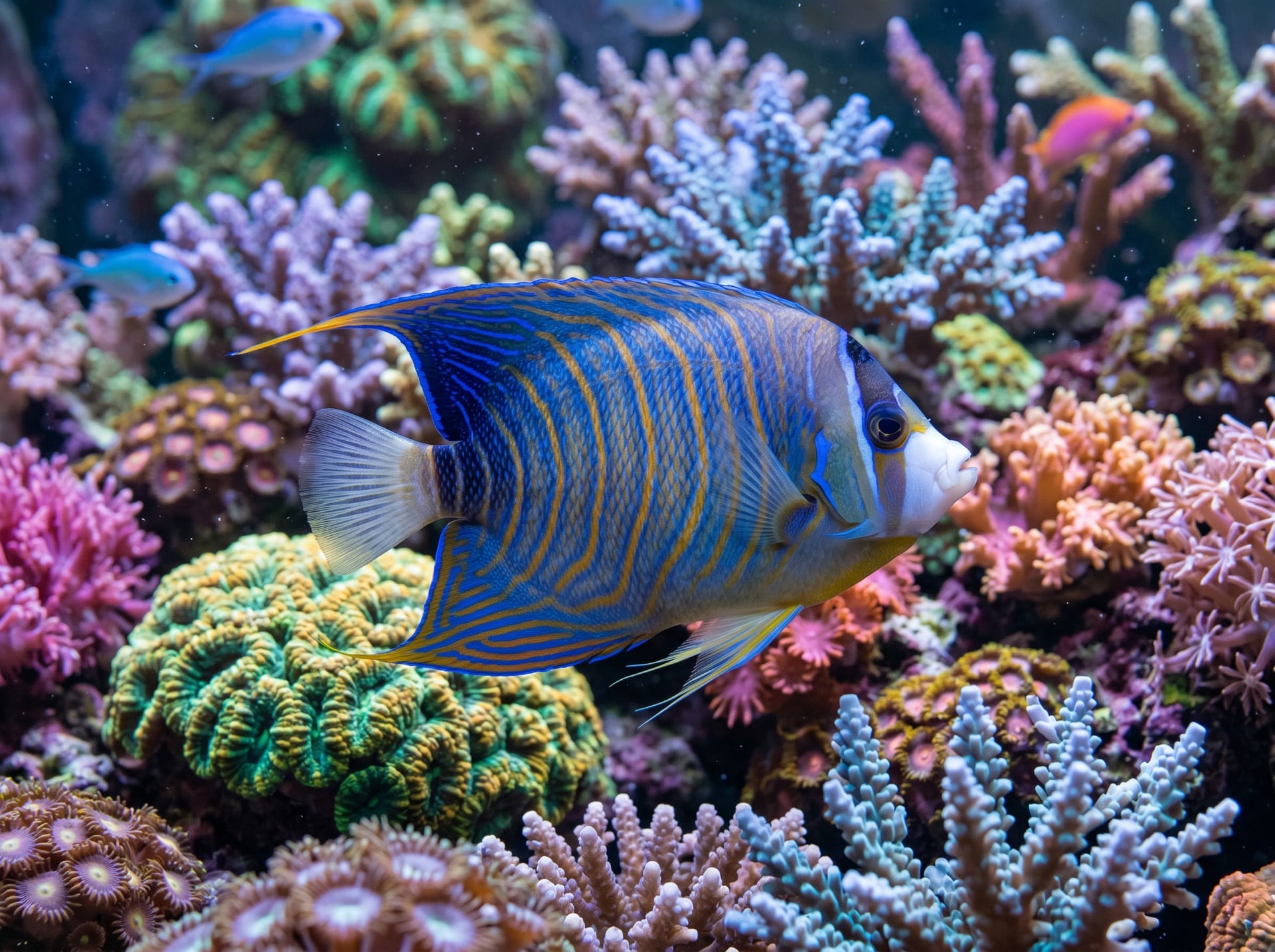
Angelfish
Angelfish (Pomacanthidae) are prized marine fish known for their vivid colors and striking patterns, making them a centerpiece species in reef and fish-only aquariums. Size, temperament, and care requirements vary greatly between species — smaller dwarf angels can suit intermediate keepers, while large angels demand spacious tanks and precise water conditions. Their graceful movement and bold personalities continue to captivate hobbyists worldwide.
0% commission on your first sales!Register by September 30, 2026 and your first 2 sales are commission-free!
Breeder Wanted!
List on BreederDirect and sell directly to customers nationwide!
BreederDirect's 6 Transparency Promises
Every Marine Fish & Coral listing shows Breeder's full disclosure. No wild-caught. Captive-bred priority, tank size guidance, temperament details—transparent aquaculture.
- Captive-bred
- WYSIWYG
- Reef-safe
- Care Info Included
- Origin Disclosed
- Temperament Listed
Browse all 42 breeds
Care Difficulty
Reef-safe
Temperament
No listings match your filters
Adjust your filters, or get notified when new listings arrive.
Getting alerts is free with a member account. When new listings match your saved search, we'll notify you by email and in-app.
Browse other categories
Verified breeders (preview)
Are you raising marine fish & coral?
Register as a breeder and connect with buyers directly.
Apply as a breederAbout Angelfish
Angelfish (Yaкko) is a collective term for marine fish belonging to the family Pomacanthidae, with approximately 90 species distributed across coral reef habitats from the Indian Ocean to the Pacific. The Japanese name "Yaкko" traces back to the Edo period, when these fish were already kept as ornamental species, and is said to derive from the resemblance of their vivid markings to the formal hakama costume of household servants known as "yaкko." The defining anatomical feature is a prominent spine on the preopercle, which distinguishes them from the closely related butterflyfish. Body coloration ranges across stunning geometric patterns of blue, yellow, purple, orange, and white, and many species undergo a dramatic transformation in pattern between juvenile and adult stages. Temperamentally, angelfish are curious and active, though they exhibit strong territorial instincts and occasional skirmishes with conspecifics. Their greatest appeal to hobbyists lies in their extraordinary diversity — from compact pygmy angels to the majestic Emperor Angel — offering choices suited to virtually every skill level and tank setup.
6 things to know before welcoming a Angelfish
1Dwarf vs. Large Angels
Angelfish fall into two broad groups: dwarf angels (e.g., Centropyge spp.) reaching around 10 cm, and large angels (e.g., Pomacanthus spp.) that can grow to 30–40 cm. Dwarf angels can be kept in 60 cm tanks, while large species require 180 cm or larger aquariums. Always confirm the adult size before purchasing.
2Precise Water Quality Is Key
Angelfish are sensitive to water parameter swings. Aim for salinity 1.023–1.025, pH 8.1–8.3, and temperature 24–26°C. Elevated nitrates can cause color fading and increase disease susceptibility, so regular water changes and a protein skimmer are strongly recommended. Stable water chemistry is one of the biggest factors in long-term success.
3Compatibility with Corals
Many angelfish nip at coral polyps and clam mantles, posing a risk in reef tanks. Large species are especially prone to damaging soft corals and LPS. Some dwarf angels like the Flame Angelfish are considered relatively reef-safe, but individual behavior varies, so close observation is always necessary after introduction.
4Strong Territorial Instinct
Angelfish are highly territorial toward the same or closely related species. Keeping multiple individuals together can lead to serious aggression. If mixing species, a large tank with ample hiding spots is essential. Even different species may fight, so introduction order and size matching require careful planning.
5Watch for Marine Ich
Angelfish are notably susceptible to marine ich (Cryptocaryon irritans). A dedicated quarantine period of at least 2–4 weeks in a separate tank is strongly recommended before introducing any new individual to your display tank. Daily observation helps catch early signs of infection and improves treatment outcomes.
6Cost to Buy and Maintain
Angelfish prices vary widely: common dwarf species may cost a few thousand yen, while rare large species can reach hundreds of thousands. Equipment costs — tank, filtration, lighting, protein skimmer — add up quickly, often exceeding tens of thousands of yen even for a modest setup. Planning a realistic long-term budget before starting is essential for sustainable keeping.
Frequently asked questions about Angelfish
- Q.Which angelfish species are best for beginners?
- A.Hardy dwarf species such as the Flame Angel, Coral Beauty, and Lemonpeel Angel are well-suited to beginners. They can be kept in tanks from around 150–200 liters and tend to accept prepared foods more readily than larger species. Proper water quality management is still essential regardless of species.
- Q.Can angelfish be kept in a reef tank with corals?
- A.Large angelfish species pose a significant risk of nipping corals and are generally not recommended for reef tanks. Some dwarf species like the Coral Beauty and Flame Angel are considered relatively low-risk, but individual variation means no species can be guaranteed safe. Regular monitoring after introduction is always necessary.
- Q.Can multiple angelfish be kept in the same tank?
- A.Different genus species can sometimes coexist, but keeping the same or closely related species together often leads to intense territorial conflict. A large tank of 300 liters or more with ample rockwork for cover, combined with simultaneous introduction, greatly improves the chances of a peaceful community.
- Q.How long do angelfish live in captivity?
- A.With proper care, dwarf angelfish typically live 5–10 years, while larger species can exceed 10–15 years in captivity. Stable water parameters, a varied and nutritious diet, and a low-stress environment are the primary factors contributing to a long, healthy life.
- Q.Why are angelfish so prone to marine ich?
- A.Angelfish have relatively thin mucus coatings and are sensitive to stress and water parameter swings, making them more vulnerable to infection by the parasite Cryptocaryon irritans. Quarantining new fish for 2–4 weeks and maintaining stable water conditions are the most effective preventive measures. If infection is detected, isolate the affected fish promptly and begin treatment.
Useful tools for Angelfish care
Angelfish related articles
Bicolor Angelfish (Centropyge bicolor) Care Guide | Tank Mates, Feeding, Reef Safety, and Long-Term Maintenance Tips
Genicanthus (Swallowtail Angelfish) Care Guide | Reef-Safe Angelfish Characteristics, Tank Mates & Sex Reversal
Genicanthus (Swallowtail Angelfish) is a flagship reef-safe angelfish for reef tanks. This guide covers their planktivorous diet that prevents coral-picking, beautiful sexual dimorphism, observing female-to-male sex reversal, compatible tank mates, and quarantine protocols—all explained with practical insights.
Care Guide for Koran Angelfish | Color Change from Juvenile to Adult, Tank Size, Feeding, and Tank Mates
Complete care guide for the Koran Angelfish (Pomacanthus semicirculatus). Covers the dramatic color transformation from juvenile striped patterns to the dignified coloration of adults, explains why tanks of 150 cm or larger are necessary, fish-only (FO) tank mate management, and prevention of white spot disease and lymphocystis.
Dwarf Angelfish (Centropyge) Compatibility Guide | Species Compatibility and Successful Combinations
Mixing guide for Centropyge (Dwarf Angelfish). Compare the temperament and reef-safety of popular species like Coral Beauty, Flame Angelfish, and Lemonpeel, and learn how to successfully set up mixed tanks.
Half-black Angelfish Care Guide | Complete Guide to Dwarf Angel Temperament, Water Parameters, and Reef Safety
A detailed guide to caring for Half-black Angelfish (Centropyge vrolikii). Covers water quality management, feeding, white spot disease prevention, and coral nipping risks in reef tanks for this striking dwarf angelfish with beautiful black and white contrast. Learn key points for long-term success.
Emperor Angelfish (Pomacanthus imperator) Care Guide | Color Transformation from Juvenile to Adult and Long-Term Care Practice
Comprehensive guide to caring for Emperor Angelfish (Pomacanthus imperator) from juvenile to adult. Covers the color transformation process from blue juvenile patterns to golden adult coloration, tank size, feeding, tank mate compatibility, and white spot disease prevention—a practical guide to long-term care of large angelfish species.
More in this category
Can't find the one you're looking for?
Post your wishes for free and breeders with matching animals will contact you with introductions.