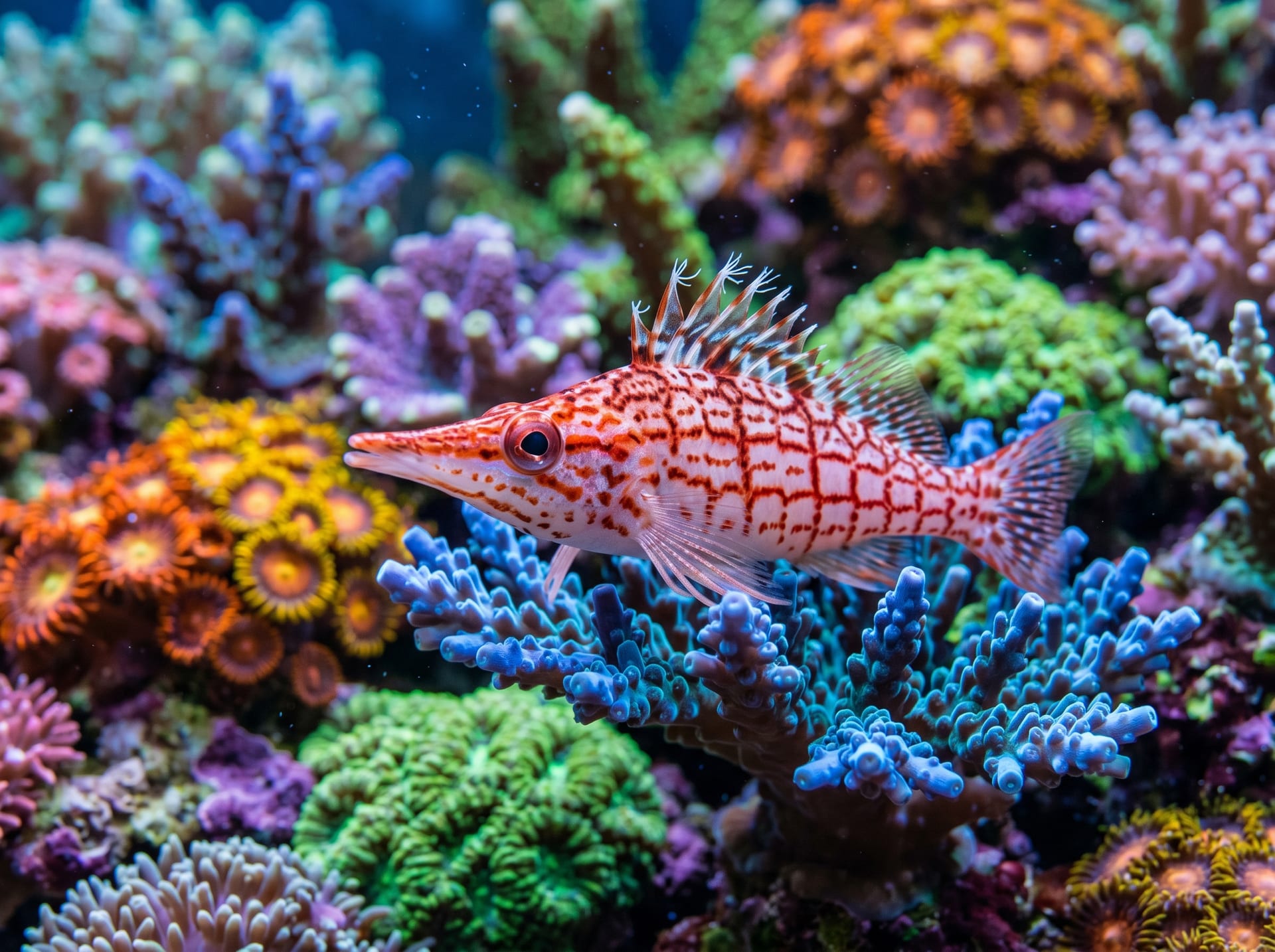
Hawkfish
A cute small marine fish that perches on rocks. Has a habit of sitting still to ambush prey.
View Hawkfish encyclopedia →0% commission on your first sales!Register by September 30, 2026 and your first 2 sales are commission-free!
Breeder Wanted!
List on BreederDirect and sell directly to customers nationwide!
BreederDirect's 6 Transparency Promises
Every Marine Fish & Coral listing shows Breeder's full disclosure. No wild-caught. Captive-bred priority, tank size guidance, temperament details—transparent aquaculture.
- Captive-bred
- WYSIWYG
- Reef-safe
- Care Info Included
- Origin Disclosed
- Temperament Listed
Browse all 42 breeds
Care Difficulty
Reef-safe
Temperament
Verified breeders wanted for Marine Fish & Coral
Breeders are signing up now ahead of launch. Subscribe to be notified when new listings go live.
Getting alerts is free with a member account. When new listings match your saved search, we'll notify you by email and in-app.
Browse other categories
Verified breeders (preview)
Are you raising marine fish & coral?
Register as a breeder and connect with buyers directly.
Apply as a breederHawkfish key facts
- Care level
- Beginner-friendly
- Lifespan
- 5-10 years
- Size
- 5-15cm
- Diet
- Frozen food, Artificial feed
- Housing
- Provide perching spots on rock/coral
- Feeding
- Carnivorous, eats frozen food well
- Compatibility
- May eat small shrimp, use caution
- Notes
- Usually stays in one spot rather than swimming
About Hawkfish
Hawkfish belong to the family Cirrhitidae within the order Perciformes, and are widely distributed across coral and rocky reefs throughout the Indo-Pacific region. They have long been beloved by public aquariums and marine hobbyists alike for their charming faces and distinctive behaviors. Their most recognizable trait is the ability to "perch" on rocks and coral using thickened pectoral fin rays — a behavior rarely seen in fish and endlessly fascinating to observe. Body coloration varies by species, ranging from red and brown to white, often adorned with intricate patterns and fine scales. Hawkfish tend to be bold and curious, becoming quite comfortable with their owners over time, though they do maintain strong territorial instincts. Their low-energy lifestyle and ease of feeding make them an excellent choice for those new to the marine aquarium hobby.
7 things to know before welcoming a Hawkfish
1Tank Size Matters
Hawkfish spend most of their time perching rather than swimming, but they are territorial and do best in tanks of at least 60 cm. Provide multiple live rocks or caves so they can claim a comfortable perch and retreat when needed.
2Caution with Corals
Hawkfish rarely eat corals directly, but they may damage soft coral tissue by perching on them. They are generally compatible with hard coral reef tanks, but use caution when keeping them with delicate soft corals.
3Small Tankmates at Risk
Hawkfish are carnivores and will eat any shrimp or small fish that fits in their mouth. Avoid keeping them with cleaner shrimp or small fish, or carefully size-match tankmates to reduce predation risk.
4Territorial Aggression
Hawkfish can be territorial toward similarly shaped fish, chasing them away from preferred perches. If keeping multiple hawkfish, a bonded male-female pair or a very large tank is recommended. Combining them with other aggressive species requires extra care.
5Adapts to Prepared Foods
In the wild they prey on crustaceans and small fish, but in captivity hawkfish adapt fairly readily to frozen brine shrimp, copepods, and even dry/pellet foods. Choosing an already-eating specimen from the store will make acclimation much smoother.
6Stable Water Quality
As with all marine fish, stable water parameters are essential: zero ammonia and nitrite, low nitrates, and a salinity of 1.023–1.025. Regular partial water changes (roughly weekly) and consistent filter maintenance form the foundation of long-term health.
7Understand Startup Costs
Hawkfish themselves are relatively affordable, typically ranging from around ¥1,500 to ¥6,000 depending on species. However, marine aquarium equipment — including a proper tank, protein skimmer, live rock, and refractometer — means startup costs commonly run into the tens of thousands of yen.
Frequently asked questions about Hawkfish
- Q.Can hawkfish be kept in a reef tank?
- A.Hawkfish do not eat coral, so they are generally compatible with reef tanks. However, they will prey on small crustaceans such as cleaner shrimp, so use caution if you keep ornamental shrimp alongside them.
- Q.Can multiple hawkfish be kept together?
- A.Keeping multiple hawkfish of the same species together often leads to territorial conflicts, so one per tank is generally recommended. Pairs can sometimes be maintained, but a sufficiently large tank with plenty of hiding spots is essential.
- Q.Are hawkfish prone to jumping out of tanks?
- A.Hawkfish can venture near the water surface and have been known to jump out when startled. It is strongly recommended to always use a tight-fitting lid or a jump guard net on the tank.
- Q.Can hawkfish survive on prepared foods alone?
- A.Individuals that have been trained to accept prepared foods can thrive on high-quality pellets or flakes alone. However, offering variety such as frozen krill or brine shrimp periodically helps ensure balanced nutrition.
- Q.How long do hawkfish live, and how can I help them thrive?
- A.With proper care, hawkfish commonly live 5 to 10 years. The keys to longevity are stable water quality, a balanced and varied diet, and a low-stress environment that includes hiding spots and avoids overcrowding.
Useful tools for Hawkfish care
Learn more about Hawkfish in the encyclopedia
View Hawkfish encyclopedia entry →
Care difficulty, lifespan, size and diet — all basics covered.
Hawkfish related articles
Anthias Species Care Comparison Guide | Characteristics of Indonesian & Philippine Strains and Tank Management
Detailed breakdown of popular Anthias species (Purple Queen, Kashiwae, and Hawkfish varieties) by type. This guide covers water quality requirements, feeding challenges, harem maintenance, and sequential hermaphroditism—the core aspects of Anthias husbandry for Indonesian and Philippine specimens.
Hawkfish (Cirrhitidae) Care Guide | Species, Tank Mates, Diet, and Tank Setup
A comprehensive guide to raising hawkfish (Cirrhitidae) species such as flame hawkfish and long-nose hawkfish. Introduces characteristics by species, suitable tank mates, how to feed, and tank layout, presented for beginners.
More in this category
Can't find the one you're looking for?
Post your wishes for free and breeders with matching animals will contact you with introductions.