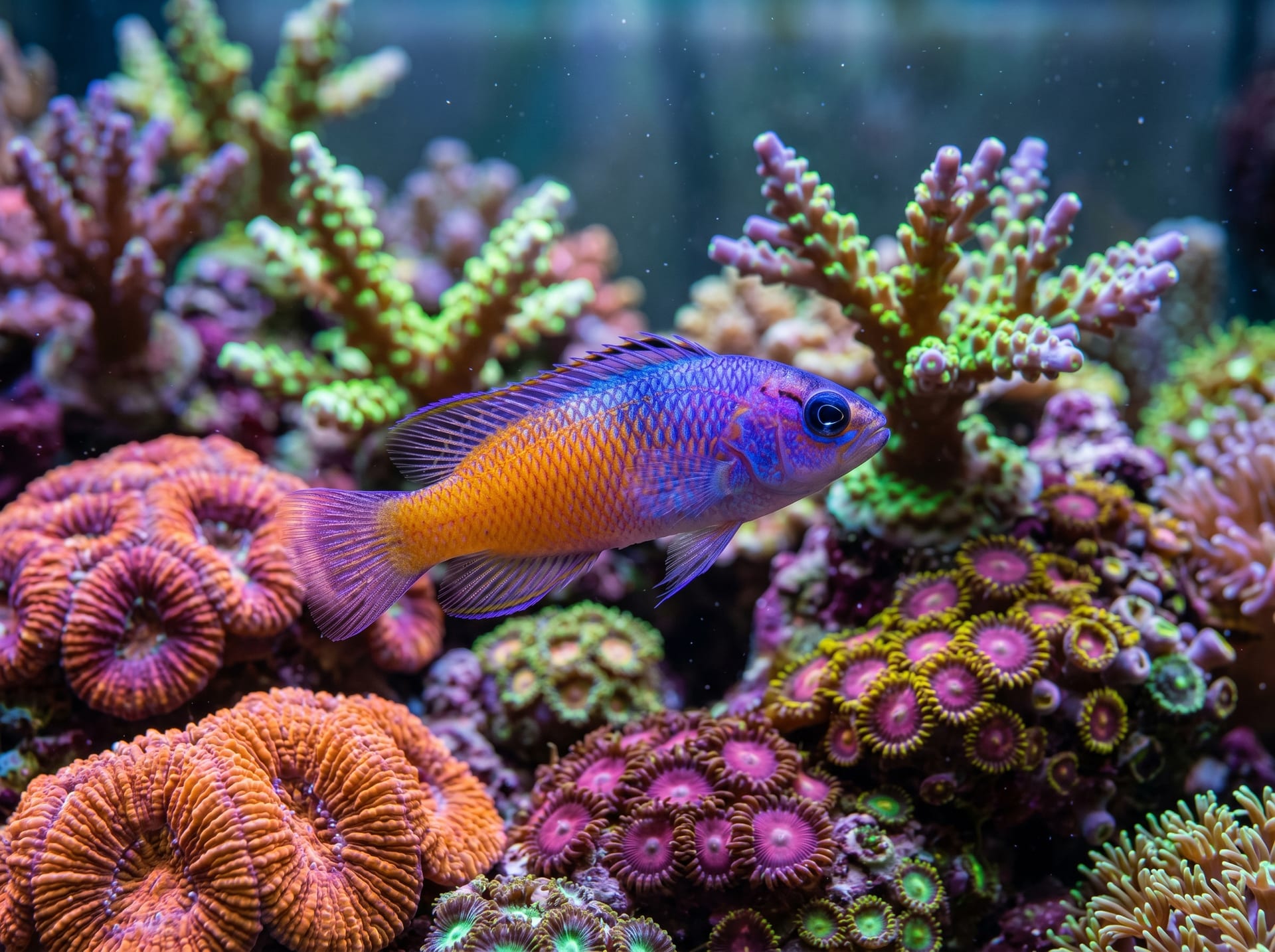
Dottyback
Small colorful marine fish. Royal Dottyback is popular. Feisty but small size limits damage potential.
View Dottyback encyclopedia →0% commission on your first sales!Register by September 30, 2026 and your first 2 sales are commission-free!
Breeder Wanted!
List on BreederDirect and sell directly to customers nationwide!
BreederDirect's 6 Transparency Promises
Every Marine Fish & Coral listing shows Breeder's full disclosure. No wild-caught. Captive-bred priority, tank size guidance, temperament details—transparent aquaculture.
- Captive-bred
- WYSIWYG
- Reef-safe
- Care Info Included
- Origin Disclosed
- Temperament Listed
Browse all 42 breeds
Care Difficulty
Reef-safe
Temperament
Verified breeders wanted for Marine Fish & Coral
Breeders are signing up now ahead of launch. Subscribe to be notified when new listings go live.
Getting alerts is free with a member account. When new listings match your saved search, we'll notify you by email and in-app.
Browse other categories
Verified breeders (preview)
Are you raising marine fish & coral?
Register as a breeder and connect with buyers directly.
Apply as a breederDottyback key facts
- Care level
- Beginner-friendly
- Lifespan
- 3-6 years
- Size
- 5-8cm
- Diet
- Pellets, frozen food
- Temperament
- Feisty — may bully small fish
- Notes
- Reef-safe. May eat small shrimp
- Container & Tank
- Small at 5–8cm, it can be kept in a tank of about 60L. Provide several hiding spots to spread out territories.
- Tank Mates & Compatibility
- It can be aggressive toward fish smaller than itself. Adding it last and choosing tankmates carefully keeps problems to a minimum.
- Diet & Feeding
- Hardy and quick to adapt to prepared food, it eats pellets and frozen food readily. Weaning is almost never a struggle.
About Dottyback
Dottybacks are a group of small marine fish widely distributed across the coral reefs of the Indian Ocean and Western Pacific. Despite their common Japanese name "Nise-Suzume" (false damselfish), they belong to the family Pseudochromidae rather than Pomacentridae, making them a distinct group. Adults typically reach 5–8 cm, yet they command attention in any aquarium through their vivid coloration—ranging from purple and yellow to red and pink depending on species. The Royal Dottyback (Pictichromis paccagnellae) remains the most iconic, celebrated for its bold purple-and-yellow two-tone pattern that has made it a staple in the hobby for decades. While their territorial and feisty temperament is well-documented, their small size keeps any aggression from causing serious harm to larger tankmates, striking a practical balance between personality and manageability. They accept prepared pellets and frozen foods readily, adapt well to captive life, and are considered hardy by marine fish standards. With proper care, dottybacks live approximately 3–6 years, offering hobbyists of all experience levels a rewarding long-term companion.
6 things to know before welcoming a Dottyback
1Tank Size Requirements
Despite their small size, Dottybacks have strong territorial instincts, so a tank of at least 60 cm is recommended. Confined spaces tend to increase aggression toward tankmates. Providing multiple live rocks and hiding spots helps distribute territorial boundaries.
2Bold, Territorial Personality
Dottybacks are bold enough to challenge fish much larger than themselves. Keeping two of the same or closely related species in one tank usually leads to conflict, so one per tank is the general rule. If mixing with other species, choose peaceful fish that are notably larger to minimize aggression.
3Water Quality Basics
As with most marine fish, maintaining stable conditions — specific gravity 1.020–1.025, temperature 24–26°C, and pH 8.1–8.4 — is essential for their health. Sudden water parameter changes can trigger stress and disease, so perform small, regular water changes rather than large infrequent ones. A protein skimmer also helps keep water quality stable.
4Easy to Feed
Dottybacks readily accept prepared foods such as pellets and flakes, as well as frozen brine shrimp and mysis shrimp, making them easy to feed. Offer food twice daily in amounts they can consume within 2–3 minutes. Remove any uneaten food promptly to prevent water quality issues.
5Need for Hiding Spots
In the wild, Dottybacks hide among crevices and caves in reef structures, so providing multiple hiding spots — such as live rock overhangs or PVC tubes — is important in the aquarium. Adequate shelter reduces stress and often enhances their coloration. Newly introduced fish may hide for several days until they adjust to their new surroundings.
6Estimated Keeping Costs
Purchase prices vary by species: common Dottybacks typically cost around 1,000–3,000 yen, while popular varieties like the Royal Dottyback range from 3,000–8,000 yen. Initial setup costs for a marine-compatible tank, filtration system, and hydrometer often total 30,000–100,000 yen. Monthly running costs — food, electricity, and artificial sea salt — generally amount to a few thousand yen.
Frequently asked questions about Dottyback
- Q.Can beginners keep Dottybacks?
- A.Yes, Dottybacks are among the hardier and more feeding-friendly marine fish, making them a reasonable choice for beginners. That said, a solid grasp of basic marine aquarium management—water quality, salinity control, and cycling—is essential before getting started.
- Q.Can I keep multiple Dottybacks together?
- A.Keeping multiple Dottybacks together is generally challenging due to strong territorial aggression between individuals of the same species. If you want to try, use a larger tank (60L or more), provide abundant hiding spots, and introduce all fish simultaneously to reduce the chance of one establishing dominance first.
- Q.Can they live with clownfish?
- A.Clownfish are generally compatible with Dottybacks due to the size difference, which limits the risk of serious harm. However, individual temperament and tank size still play a role, so monitor behavior closely for the first few weeks after introduction and be prepared to separate them if persistent aggression occurs.
- Q.What should I feed them?
- A.A high-quality marine pellet or flake food works well as a staple diet, supplemented with frozen foods like brine shrimp or copepods. Feed twice daily in amounts the fish can consume within 2–3 minutes to avoid water quality issues from excess food.
- Q.Are they reef-safe?
- A.Dottybacks are generally considered reef-safe as they do not nip at corals. However, they may prey on very small crustaceans, including tiny ornamental shrimp, so be cautious about which invertebrates you pair them with in a reef system.
Useful tools for Dottyback care
Learn more about Dottyback in the encyclopedia
View Dottyback encyclopedia entry →
Care difficulty, lifespan, size and diet — all basics covered.
Dottyback related articles
Royal Gramma and Burgess's Dottyback: Keeping and Tank Compatibility Guide | The Charm and Precautions of Beautiful Small Marine Fish
A comprehensive comparison of Royal Gramma and Burgess's Dottyback characteristics, husbandry environment, and tank compatibility. From differences in aggression to feeding and breeding challenges, this guide covers how to safely keep these beautiful small marine fish from the Caribbean and Indo-Pacific.
Royal Gramma & Dottyback Care Guide | Characteristics, Tank Mates & Tank Setup for Small Saltwater Fish
Complete guide to caring for royal grammas, oriole dottybacks, and dottyback species. Learn about the varieties of these small, vibrantly colored saltwater fish, tank mate compatibility, and proper tank setup.
Orchid Dottyback Complete Breeding Guide | Tank Setup, Feeding, Tankmates, Reproduction
A comprehensive guide to caring for the Orchid Dottyback (Pseudochromis fridmani). Covering aquarium size, water quality management, feeding, tankmate compatibility, and breeding—everything you need to know to keep this beautiful purple marine fish healthy and thriving for years.
Dottyback Aggression Management Guide | Mixed-Tank Techniques for Dottybacks
Explains methods for managing aggressive dottybacks in mixed-tank environments. Covers species selection, introduction order, and aquascaping strategies.
More in this category
Can't find the one you're looking for?
Post your wishes for free and breeders with matching animals will contact you with introductions.