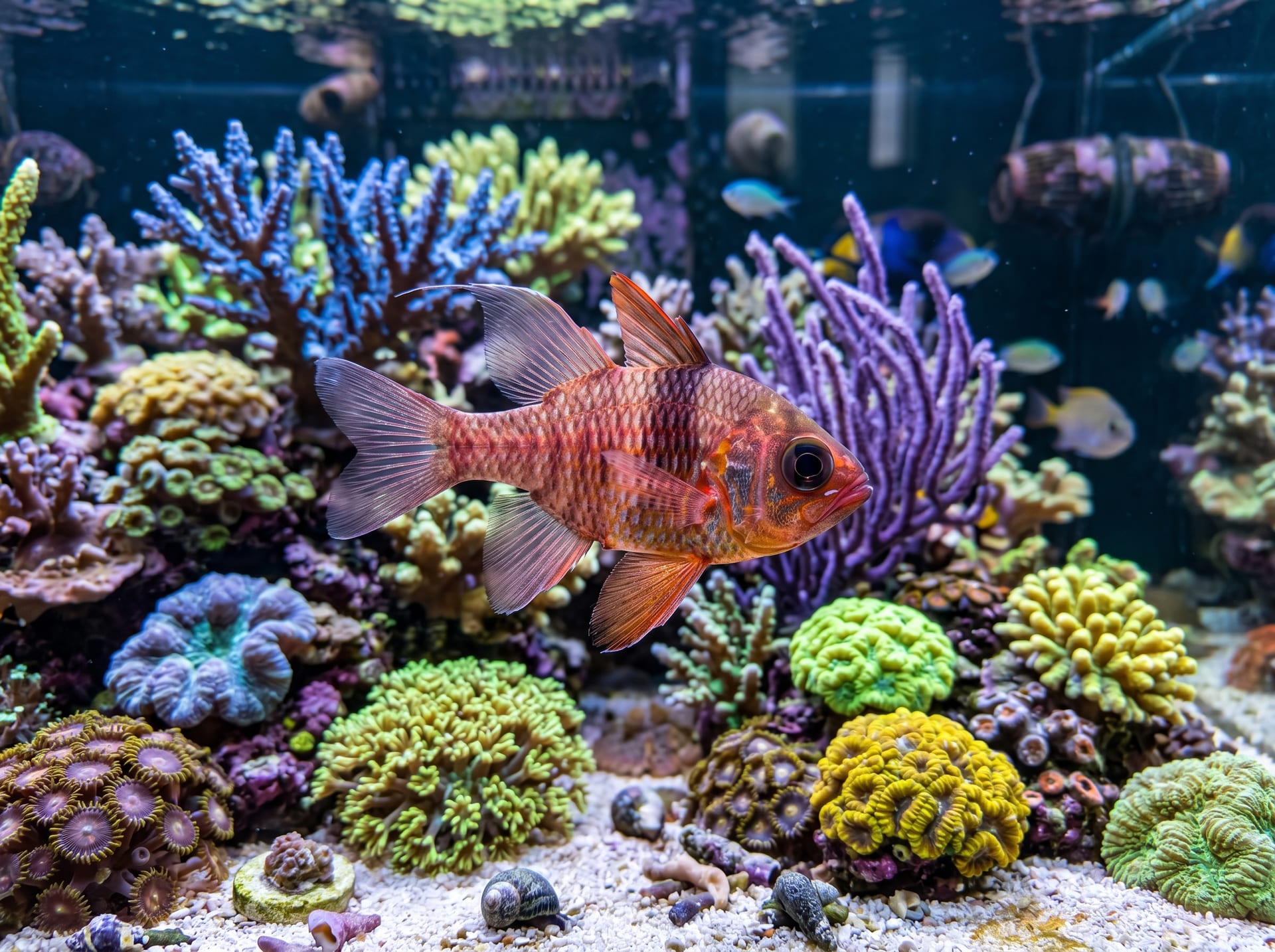
Cardinalfish
Cardinalfish are small reef fish typically reaching 5–10 cm, known for their calm temperament and preference for sheltered spots among coral. They are popular among hobbyists for their fascinating mouthbrooding behavior, where the male incubates eggs orally — a process often observable in home aquariums. Their hardiness and adaptability to aquarium conditions make them a solid choice for beginners in marine fishkeeping.
View Cardinalfish encyclopedia →0% commission on your first sales!Register by September 30, 2026 and your first 2 sales are commission-free!
Breeder Wanted!
List on BreederDirect and sell directly to customers nationwide!
BreederDirect's 6 Transparency Promises
Every Marine Fish & Coral listing shows Breeder's full disclosure. No wild-caught. Captive-bred priority, tank size guidance, temperament details—transparent aquaculture.
- Captive-bred
- WYSIWYG
- Reef-safe
- Care Info Included
- Origin Disclosed
- Temperament Listed
Browse all 42 breeds
Care Difficulty
Reef-safe
Temperament
Verified breeders wanted for Marine Fish & Coral
Breeders are signing up now ahead of launch. Subscribe to be notified when new listings go live.
Getting alerts is free with a member account. When new listings match your saved search, we'll notify you by email and in-app.
Browse other categories
Verified breeders (preview)
Are you raising marine fish & coral?
Register as a breeder and connect with buyers directly.
Apply as a breederCardinalfish key facts
- Care level
- Beginner-friendly
- Lifespan
- 3-5 years
- Size
- 6-8cm
- Temperature
- 24〜26℃
- Diet
- Frozen food, Pellets
- Water Temperature & Quality
- Keep the water at 24–26°C and specific gravity at 1.023–1.025. Avoid sudden changes.
- Tank Mates & Compatibility
- Peaceful toward other species, but they tend to nip each other. Keep a pair, or a group only in a sufficiently large tank.
- Breeding & Egg-laying
- Males mouthbrood the eggs and fry. You can watch everything from spawning to fry release in the tank, and a pair can be bred.
- Housing
- They swim slowly and like to hover among urchin spines or near anemones. Giving them something to shelter beside helps them settle.
- Diet & Feeding
- They eat frozen and prepared foods readily and are easy to wean. Adults are only 6–8cm, so small-sized food suits them.
- Health & Cautions
- Wild populations are declining, so choosing captive-bred fish matters. Lifespan is about 3–5 years.
About Cardinalfish
Cardinalfish belong to the family Apogonidae, a diverse group of over 200 species distributed primarily across coral reefs in the Indian and Pacific Oceans, with many species found in Japanese coastal waters. Their spindle-shaped, slightly compressed bodies often display striking red, orange, or striped patterns that give them a distinctive presence in any aquarium. Their notably large eyes are an adaptation to life in the dim recesses of coral reefs, and some species display stronger nocturnal tendencies. Their greatest appeal among hobbyists is mouthbrooding—the male's remarkable habit of incubating eggs inside his mouth—making them one of the few marine fish where this behavior can be reliably observed in captivity. Peaceful and hardy, Cardinalfish integrate well into community reef tanks and are enjoyed by beginners and seasoned marine keepers alike.
7 things to know before welcoming a Cardinalfish
1Tank Size Guidelines
A single cardinalfish can be kept in a 45 cm tank (around 40 L), but a 60 cm or larger setup is recommended when housing multiple fish or mixing species. Providing plenty of live rock or coral rubble for hiding spots helps reduce stress significantly.
2Mouthbrooding Behavior
Male cardinalfish are mouthbrooders — they hold fertilized eggs in their mouths until hatching, rarely eating during this period and often appearing slimmer. During brooding, minimize disturbances and maintain a calm environment to reduce the chance of the male spitting out the eggs prematurely.
3Compatibility with Tank Mates
Cardinalfish are peaceful and generally compatible with clownfish, small gobies, and tangs. However, conspecifics can show territorial behavior, so provide multiple hiding spots or introduce them as a pair. Avoid housing them with large predatory fish that may view them as prey.
4Water Quality and Temperature
Aim for a water temperature of 24–27°C, specific gravity of 1.023–1.025, and pH of 8.1–8.4. Cardinalfish are sensitive to sudden water parameter shifts, so limit water changes to around 10–15% at a time. Regular water quality testing helps catch nitrate buildup before it becomes a problem.
5Feeding and Diet Tips
Cardinalfish readily accept frozen brine shrimp, copepods, and small mysid shrimp. They can be trained onto pellets or flake foods — feed small amounts twice daily. Wild-caught individuals often transition more smoothly when started on live or frozen foods before gradually introducing prepared diets.
6Nocturnal Activity Patterns
Cardinalfish are predominantly nocturnal, often hiding among live rock or in cave-like structures during the day and becoming more active after lights out. Sudden lighting changes can startle them, so using a gradual sunrise/sunset timer setting is ideal for minimizing stress.
7Quarantine and Acclimation
Quarantining new cardinalfish in a separate tank for 2–4 weeks is strongly recommended before introducing them to your display tank. Use a slow drip acclimation method and watch closely for signs of ich or velvet disease. Careful acclimation is especially important for marine fish, as they react more quickly to water parameter changes than freshwater species.
Frequently asked questions about Cardinalfish
- Q.Can Cardinalfish be kept with corals?
- A.Cardinalfish are generally reef-safe and do not nip at corals, making them a good fit for reef aquariums. However, if a fish repeatedly rests on very small soft corals, monitor for any potential damage and rearrange decor if needed.
- Q.How can I tell if my Cardinalfish are breeding?
- A.A noticeably bulging jaw on the male after spawning is the clearest sign of mouthbrooding. During this period, the male will eat little and remain relatively still. After approximately 7–10 days, the fry can be seen emerging from his mouth.
- Q.Is it better to keep one or multiple Cardinalfish?
- A.Cardinalfish can be kept singly or in groups. Keeping a small group allows you to enjoy their natural schooling behavior. When housing multiple fish, ensure sufficient hiding spots and choose a tank size that prevents overcrowding.
- Q.Why do my Cardinalfish become more active at night?
- A.Cardinalfish are naturally inclined toward nocturnal activity, foraging primarily at night in the wild. Staying hidden among rocks during the day and becoming more active after lights-out is completely normal behavior for this species.
- Q.How should I acclimate Cardinalfish to a new tank?
- A.The drip acclimation method is recommended. Over at least one hour, slowly introduce water from your tank into the transport bag to equalize water chemistry and temperature. After acclimation, transfer the fish without adding the bag water to your tank.
Useful tools for Cardinalfish care
Learn more about Cardinalfish in the encyclopedia
View Cardinalfish encyclopedia entry →
Care difficulty, lifespan, size and diet — all basics covered.
Cardinalfish related articles
See more Cardinalfish articles →More in this category
Can't find the one you're looking for?
Post your wishes for free and breeders with matching animals will contact you with introductions.