Bangaii Cardinalfish—The Perfect Companion for Saltwater Fish Breeding Beginners
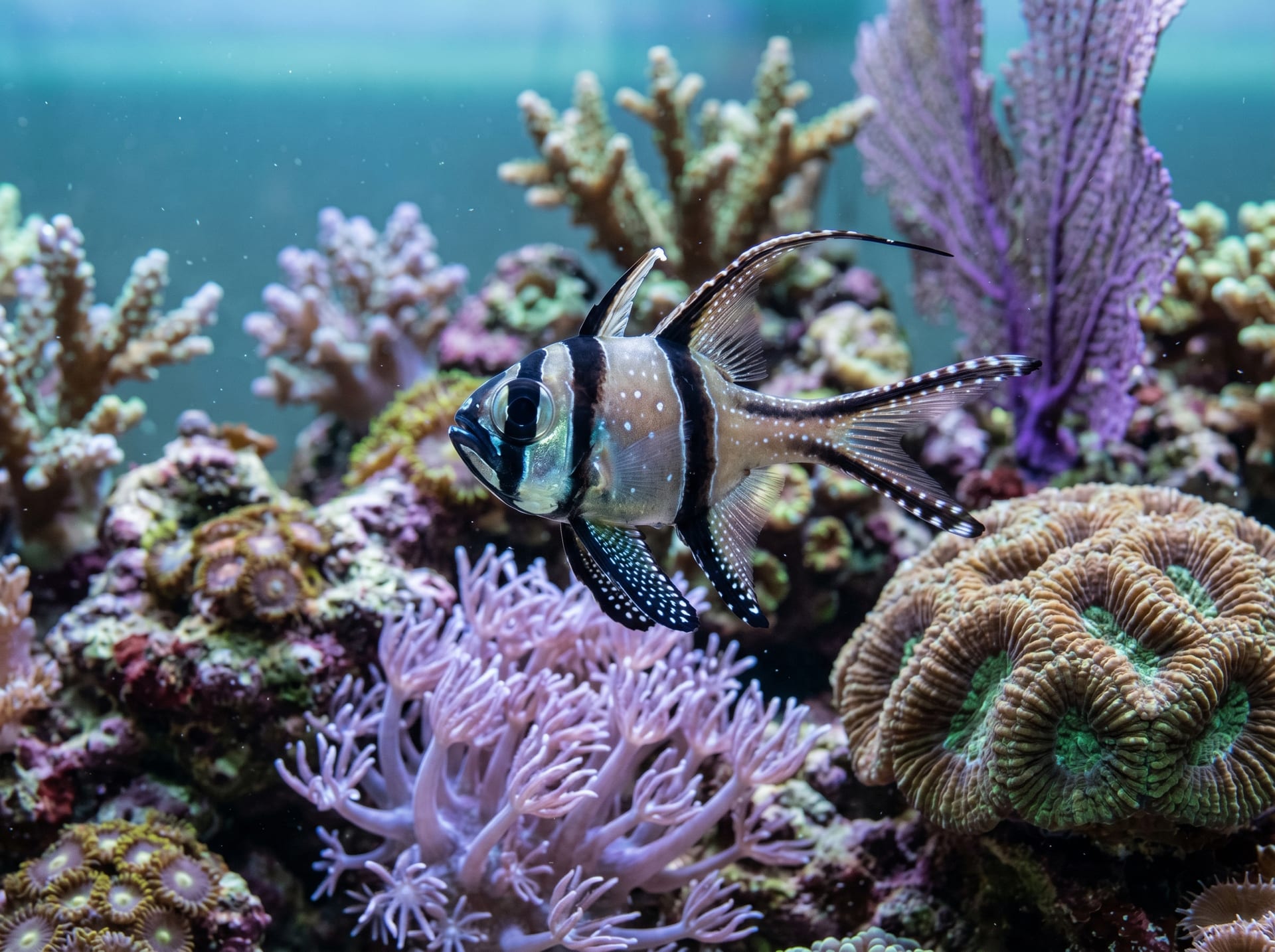
Bangaii Cardinalfish (scientific name: Pterapogon kauderni) is a saltwater fish of the Apogonidae family native to the Banggai Islands in Indonesia. With its silvery-white body, black stripes, and distinctive silhouette featuring elongated dorsal fin filaments, it is an extremely popular ornamental fish species.
However, the greatest appeal of this fish lies in the fact that it has the highest success rate for home breeding among virtually all saltwater fish breeding attempts. Unlike many fish species with planktonic larval stages, the male practices mouthbrooding (buccal incubation), protecting eggs and fry inside his mouth. As a result, the fry emerge from the parent's mouth already developed to a certain size. This unique behavior enables successful breeding without the need for large-scale live food cultures or advanced larval rearing techniques.
In the wild, the species is listed as Vulnerable (IUCN: VU) due to overharvesting and limited habitat range. The proliferation of captive-bred (CB) specimens contributes to the conservation of this species. For breeders, the significance of engaging in reproduction extends beyond the enjoyment of keeping ornamental fish—it also contributes to biodiversity conservation.
Distinguishing Males and Females
Bangaii Cardinalfish show minimal sexual dimorphism (external sex differences). However, the following points can serve as guidelines.
Characteristics of Males During Breeding:
- Jaw area appears noticeably swollen during mouthbrooding
- Males perform "gumming" behavior—rapidly opening and closing the jaw toward females—before and after spawning
- Females tend to have slightly stockier body shapes (though this is not absolute)
In practice, the most reliable method is to place multiple individuals in the same tank and allow them to pair naturally. Introducing 5–6 juveniles will result in natural pair formation within a few weeks, with the pair separating from the rest of the group and acting independently.
Signs of Confirmed Pairing
- The two fish consistently swim near each other and chase away other individuals
- Frequent gumming behavior is observed between the pair
- The remaining fish becomes restless and constantly moves after the other disappears (indicating mouthbrooding)
Once a pair is confirmed, either transfer the other individuals to a separate tank or move the pair to a dedicated breeding tank (30–60 liters).
Breeding Tank Setup—Creating the Environment for Success
Tank Size and Equipment
| Item | Recommended Value |
|---|
| Tank Size | 30–60 liters (dedicated breeding tank) or 60+ liters (community tank) |
| Water Temperature | 26–28°C |
| Specific Gravity | 1.023–1.025 |
| pH | 8.1–8.3 |
| NO₃ | 10 ppm or less |
| Lighting | Standard saltwater fish lighting (not too intense) |
A sponge filter is ideal for filtration, as it avoids the risk of fry being sucked into external or hang-on filters. Choose a small, gentle protein skimmer to prevent excessive water agitation.
Shelters and Live Rock
In the wild, Bangaii Cardinalfish gather around anemones and long-spined sea urchins as shelter. In captivity, provide wide-mouthed clay pipes, hollow coral skeletons, or live rock with appropriately sized cavities as substitutes, allowing the pair to spawn confidently. Multiple shelters reduce territorial conflicts.
From Spawning to Mouthbrooding—The Core Breeding Process
Confirming Spawning
When conditions are right, the pair spawns regularly (approximately every 3–5 weeks). While observing the actual spawning moment is difficult, mouthbrooding can be confirmed by the noticeably swollen jaw of the male the next day.
Typical clutch sizes range from 20–50 eggs, varying by individual and condition. While each spawning yields relatively few eggs, the short breeding cycle allows for 8–10 spawnings per year.
Duration of Mouthbrooding
The male incubates the fertilized eggs inside his mouth for approximately 20–25 days at water temperatures of 26–28°C. During this period, the male eats very little (though he may consume small amounts of microorganisms and plankton that enter his mouth). Force-feeding is strictly prohibited, as minimizing the male's stress is critical.
Precautions During Mouthbrooding:
- Place the male in a calm, solitary environment (separating him into a small container is also effective)
- Separating him from other fish and even his mate ensures best results
- Avoid sudden water quality changes, bright light, and vibrations
- Keep feeding minimal and never force open the mouth
Timing for Fry Collection
Monitor the male's mouth movements and swelling during mouthbrooding. Around day 20, when the male becomes restless and frequently opens and closes his mouth, fry release is imminent.
If Waiting for Natural Fry Release:
If release occurs in the same tank as the parents, fry risk being eaten by the parents or other inhabitants. In small breeding tanks (≤40 liters) with only the pair, moving the parents to a separate tank after natural release is effective.
If Manually Extracting Fry:
Transfer the male to a small container (such as a plastic box or small bucket filled with seawater) and wait for the fry to naturally exit his mouth. Never pry open the mouth with tubes or hands, as this risks injuring the fry. Placing the male in dim light may encourage him to release the fry.
Fry Rearing—The Greatest Difference from Clownfish Breeding
Rearing Bangaii Cardinalfish fry is significantly easier than breeding clownfish because the fry emerge already at a certain size (8–10 mm) and are capable of consuming small crustaceans and finely crushed flake food immediately after release. There is no need to raise massive quantities of planktonic larvae.
Fry Tank Setup
| Item | Setup |
|---|
| Tank Size | 10–20 liters (dedicated fry tank) |
| Filtration | Sponge filter only |
| Water Temperature | 27–28°C |
| Lighting | Dim (to reduce stress) |
| Water Changes | 10–20% daily (water quality maintenance is priority) |
Initial Fry Feeding
After release (Days 0–3):
- Thawed frozen copepods or live Artemia (brine shrimp) nauplii
- Copepods are the most digestible and yield the highest initial survival rates
After 1 week of age:
- Frozen mysid shrimp (finely crushed)
- High-quality fine granule artificial feed (such as commercial SPS food)
- Frozen Artemia
After 1 month:
- Flake food, frozen food, and granules similar to adult diet
- Feed small amounts 2–3 times daily, divided into multiple portions
Important: Water quality deterioration is the leading cause of mortality. Remove uneaten food regularly and perform daily water changes without fail.
Growth and Independence
With proper feeding and water quality management, fry reach 2–3 cm by 2–3 months of age and can be moved to the adult tank or sold. However, territorial conflicts may arise when introducing new individuals, so provide ample shelter.
Managing the Breeding Cycle—For Sustained Reproduction
Once a pair successfully breeds, they will continue to breed repeatedly throughout the year with proper nutrition and water quality maintenance. To help the male recover strength for the next breeding cycle, consciously feed high-protein foods (frozen mysids, Artemia, and quality prepared foods) after mouthbrooding ends.
Overcrowding and water quality deterioration are the primary factors that halt breeding. When managing multiple pairs as a breeder, it is ideal to maintain separate tanks for each pair.
Conclusion—Bangaii Cardinal Breeding Has High Affinity with Breeder Direct Sales
Captive-bred (CB) Bangaii Cardinalfish specimens show superior environmental adaptability compared to wild-caught individuals and are far more receptive to artificial foods. When breeders successfully produce offspring and sell CB specimens directly through platforms like "BreederDirect" (BreederDirect), it provides purchasers with confidence and accessibility while reducing collection pressure on wild populations.
Keep detailed breeding records (spawning dates, release dates, fry counts, and feeding regimens) to inform future pairing and fry-rearing improvements. We encourage you to take this as your first step into saltwater fish breeding.