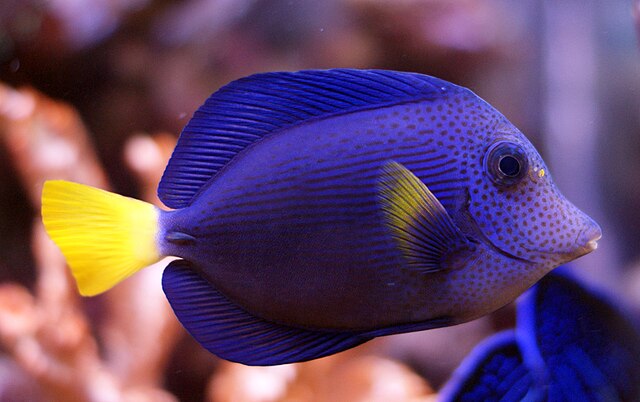
 © Alexander Vasenin / CC BY-SA 3.0
Purple Tang
The Purple Tang is a striking surgeonfish found only in the Red Sea, prized for its deep violet body and contrasting yellow tail. It has a bold, territorial personality, so it tends to do best as the sole tang in a spacious tank rather than alongside close relatives. It grazes readily on marine algae and adapts well to prepared foods, though it can be prone to ich and is somewhat sensitive to water quality swings, making it a fish best suited to keepers with prior saltwater experience. With its vivid color and confident presence, it easily becomes the centerpiece of a reef or fish-only display.
View Purple Tang encyclopedia →0% commission on your first sales!Register by September 30, 2026 and your first 2 sales are commission-free!
Breeder Wanted!
List on BreederDirect and sell directly to customers nationwide!
BreederDirect's 6 Transparency Promises
Every Marine Fish listing shows Breeder's full disclosure. No wild-caught. Captive-bred priority, tank size guidance, temperament details—transparent aquaculture.
- Captive-bred
- WYSIWYG
- Reef-safe
- Care Info Included
- Origin Disclosed
- Temperament Listed
Browse all 175 breeds
Care Difficulty
Reef-safe
Temperament
Verified breeders wanted for Marine Fish
Breeders are signing up now ahead of launch. Subscribe to be notified when new listings go live.
Getting alerts is free with a member account. When new listings match your saved search, we'll notify you by email and in-app.
Browse other categories
Verified breeders (preview)
Are you raising marine fish?
Register as a breeder and connect with buyers directly.
Apply as a breederAbout Purple Tang
The Purple Tang is a striking Red Sea surgeonfish known for its deep violet color and territorial nature. An advanced-level saltwater fish — see care basics and key facts.
7 things to know before welcoming a Purple Tang
1Provide a Spacious Tank
Adults reach 15–25 cm, so they need plenty of open swimming space as they mature. A cramped setup can cause stress, and plenty of live rock for hiding spots helps them feel secure.
2Avoid Housing With Similar Tangs
Purple Tangs are highly territorial and often clash with their own kind or similarly shaped tangs. If combining with other fish, ensure ample space and layout, and introduce new tankmates gradually while watching for aggression.
3Watch for White Spot Disease
Tangs as a group are known to be susceptible to ich (white spot disease), which can be triggered by shipping stress or water quality changes. After introduction, observe the fish closely for any changes on the skin or fins.
4Maintain Stable Water Quality
They are sensitive to sudden shifts in water parameters, so regular water changes and consistent monitoring are essential. Take extra time and care when acclimating a new specimen to its tank.
5Offer an Algae-Based Diet
In the wild they feed primarily on marine algae, so a diet centered on seaweed-based foods is the foundation in captivity. They typically adapt to prepared foods over time, so offering a varied menu works well.
6Be Careful of the Caudal Spine
Like other tangs, it has a sharp spine near the base of the tail that can cause injury during netting or tank maintenance. Handle the fish calmly and avoid chasing it around the tank.
7Plan for Long-Term Care
With a lifespan of around 10–15 years, this is a long-term companion. Before bringing one home, think ahead about tank size and whether you can sustain its care for years to come.
Frequently asked questions about Purple Tang
- Q.Is the Purple Tang suitable for beginners?
- A.The Purple Tang is generally considered a fish for experienced keepers. Its sensitivity to water quality and territorial behavior make it best suited to those with prior saltwater aquarium experience.
- Q.Can it be kept with other fish?
- A.Because it is bold and territorial, keeping it with its own kind or similarly shaped tangs often leads to conflict. Careful attention to tank size and introduction order is needed for any tankmates.
- Q.What should I feed it?
- A.In nature it feeds mainly on marine algae, so seaweed-based foods should form the core of its diet in captivity. It typically adapts to prepared foods as well, so a mixed feeding approach works well.
- Q.How large does it grow?
- A.Adults typically reach 15–25 cm in length. It's important to plan for a tank with enough swimming space to accommodate this eventual size.
- Q.Is the Purple Tang listed under CITES?
- A.The Purple Tang is not listed under CITES, so it is not subject to regulation under that convention for trade or keeping.
Useful tools for Purple Tang care
Learn more about Purple Tang in the encyclopedia
View Purple Tang encyclopedia entry →
Care difficulty, lifespan, size and diet — all basics covered.
More in this category
Can't find the one you're looking for?
Post your wishes for free and breeders with matching animals will contact you with introductions.