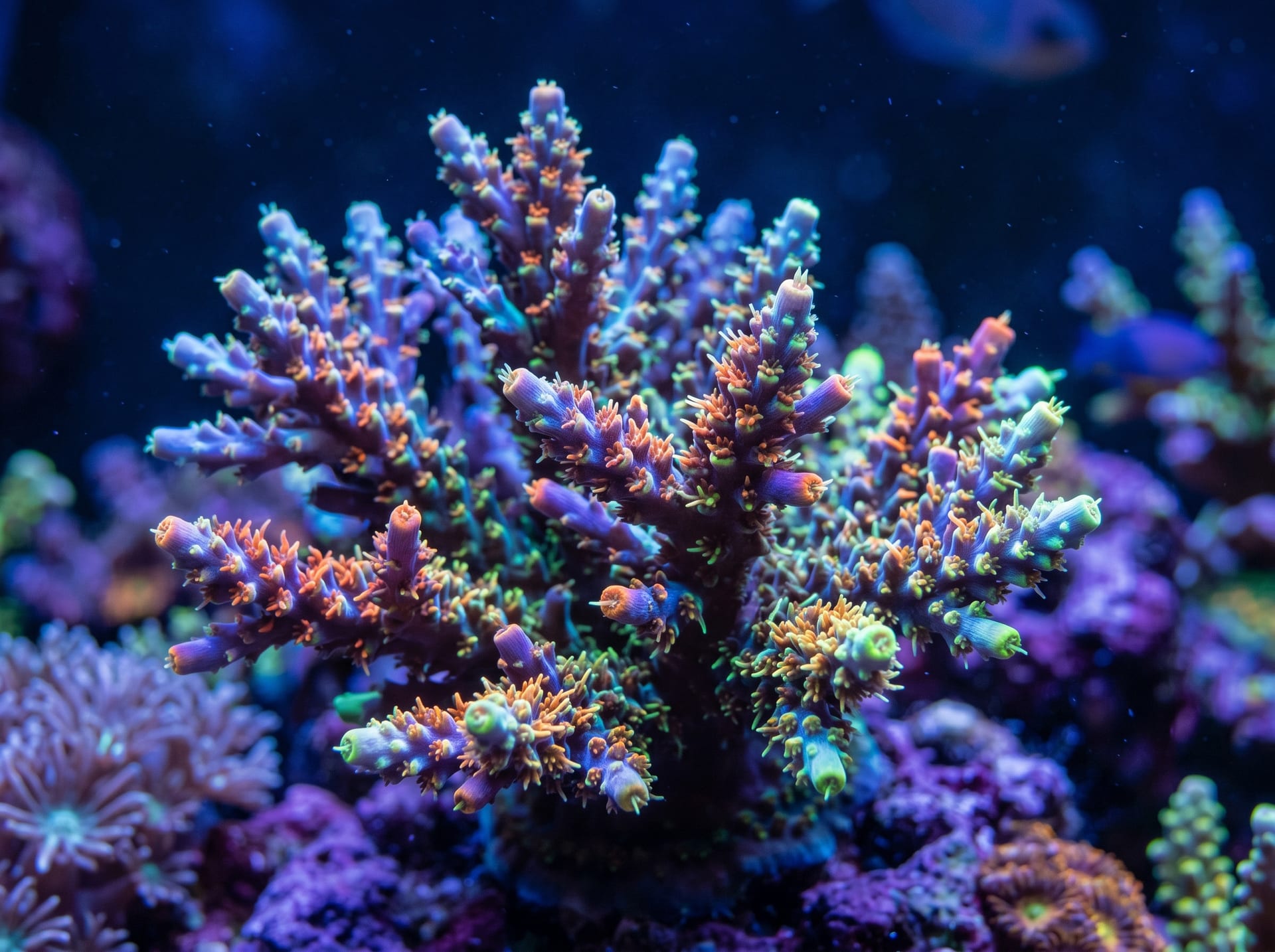
Acropora
Acropora is an iconic SPS coral known for its branching and table-like forms, bringing striking visual impact to any reef tank with vivid hues of blue, green, and pink. Given stable water parameters and intense lighting, its extended polyps create a breathtaking display that rewards dedicated hobbyists. It is a benchmark coral for advanced reef keepers and grows more rewarding as your skills develop.
0% commission on your first sales!Register by September 30, 2026 and your first 2 sales are commission-free!
Breeder Wanted!
List on BreederDirect and sell directly to customers nationwide!
BreederDirect's 6 Transparency Promises
Every Marine Fish & Coral listing shows Breeder's full disclosure. No wild-caught. Captive-bred priority, tank size guidance, temperament details—transparent aquaculture.
- Captive-bred
- WYSIWYG
- Reef-safe
- Care Info Included
- Origin Disclosed
- Temperament Listed
Browse all 42 breeds
Care Difficulty
Reef-safe
Temperament
No listings match your filters
Adjust your filters, or get notified when new listings arrive.
Getting alerts is free with a member account. When new listings match your saved search, we'll notify you by email and in-app.
Browse other categories
Verified breeders (preview)
Are you raising marine fish & coral?
Register as a breeder and connect with buyers directly.
Apply as a breederAbout Acropora
Acropora, commonly known as stony or staghorn coral, is one of the most species-rich coral genera, found across tropical reefs throughout the Indo-Pacific and beyond. Its remarkably diverse growth forms—branching, table, and corymbose—are the product of millions of years of evolution, making it a cornerstone reef-builder with a critical ecological role. Visually, Acropora is recognized by its pointed axial polyps at branch tips and smaller radial polyps lining the sides, which flare open in shades of blue, purple, green, and pink when conditions are right. In the aquarium, it demands exceptionally stable water chemistry and intense lighting, placing it firmly in the advanced category. Yet this challenge is precisely what makes it so rewarding: watching a small frag grow into a sprawling colony over months is one of the most satisfying experiences in the reef-keeping hobby.
7 things to know before welcoming a Acropora
1Intense Lighting Required
Acropora hosts high-density zooxanthellae and demands strong illumination. Aim for PAR levels of 150–300 or more using quality LED or T5 fixtures. Insufficient light causes bleaching and tissue loss over time.
2Precision Water Chemistry
Maintaining stable calcium (420–450 ppm), alkalinity (8–9 dKH), and magnesium (1280–1350 ppm) is essential. Test and adjust these parameters one to two times per week. Even minor swings can cause polyp retraction and rapid tissue necrosis.
3High Flow Is Essential
Acropora thrives in strong, random flow that prevents detritus buildup and keeps tissue healthy. Use multiple circulation pumps to eliminate dead spots and ensure uniform flow across the colony. Insufficient flow encourages mucus accumulation and increases the risk of brown jelly disease.
4Keep Nutrients Ultra-Low
Target nitrate below 5 ppm and phosphate below 0.05 ppm. Excess nutrients cause zooxanthellae overgrowth, dulling color and slowing growth. Run a protein skimmer and perform regular water changes to sustain these ultra-low levels.
5Stable Temperature Matters
Keep temperature between 24–26°C with daily fluctuations under 1°C. Use a chiller or cooling fan in summer and a reliable heater in winter. Sudden temperature spikes are a leading cause of bleaching and should be carefully managed.
6High Initial and Running Costs
Setting up a proper Acropora system requires investment in high-output lighting, a protein skimmer, and a calcium reactor or two-part dosing system, potentially costing several hundred thousand yen. Factor in ongoing costs for test kits, additives, and RO membrane replacement each month.
7Buying Frags vs. Colonies
Acropora is commonly sold as frags (small cut pieces), making entry more affordable. Beginners should start with frags to learn their system's stability before investing in large colonies. Aquacultured specimens from reputable domestic breeders often adapt more readily than wild-caught pieces.
Frequently asked questions about Acropora
- Q.Can beginners keep Acropora successfully?
- A.Acropora is considered one of the most demanding corals and is generally recommended for experienced reef keepers. It is advisable to first develop solid water chemistry skills with soft corals or LPS before attempting Acropora.
- Q.Can Acropora recover from bleaching?
- A.Partial bleaching can sometimes reverse when stable conditions are restored quickly. However, if rapid or slow tissue necrosis (RTN/STN) has set in, recovery is unlikely, making early detection and prompt correction of the underlying cause critical.
- Q.Is Acropora compatible with other corals?
- A.Acropora generally coexists well with other SPS corals when given adequate spacing. However, it should be kept well away from aggressive LPS corals with long sweeper tentacles, which can cause tissue damage on contact.
- Q.How fast does Acropora grow?
- A.Growth rates vary by species and conditions, but in well-maintained tanks some varieties can grow 1–3 cm per month. Table forms spread horizontally while branching types extend in multiple directions, so plan placement with the tank's long-term layout in mind.
- Q.Is a calcium reactor necessary for Acropora?
- A.A calcium reactor is not strictly required, but for maintaining multiple colonies it or a two-part dosing system is strongly recommended. Relying solely on water changes often cannot replenish calcium and alkalinity fast enough to meet the demands of actively growing Acropora.
Useful tools for Acropora care
Acropora related articles
Complete Guide to Enhancing Hard (SPS) Coral Colors | Achieving Vibrant Hues Through Lighting, Feeding, and Water Quality Parameters
A detailed guide to illumination, nutritional supplementation, and water quality management for bringing out the vibrant colors of hard (SPS) corals, especially Acropora. Covers the mechanisms of pigment expression, the role of nutritional components, and a step-by-step color enhancement process with practical guidance.
Complete Guide to Water Flow Design for Acropora (SPS) Tanks: Wave Pump Selection, Placement & Flow Rate Optimization
A comprehensive guide to water flow design essential for long-term maintenance of Acropora (SPS). From wave pump selection and placement strategies to eliminating dead spots and optimal flow rates (20–50× per hour), this practical guide covers all aspects of SPS tank water circulation management, including flow controller settings.
Advanced Acropora Color Enhancement Guide | Achieving an SPS Tank Through Light, Water Flow, and Nutrient Optimization
An advanced guide to bringing out vibrant coloration in Acropora. Explains the mechanisms of zooxanthellae and chromoproteins, optimal PAR values, spectrum, and light cycle settings, turbulent flow configuration, the ideal range for nitrate and phosphate, and management of calcium reactors.
Pocillopora and Stylophora Beginner's Guide | Mastering Water Quality, Lighting, and Water Flow for Your First Branching SPS Corals
Pocillopora and Stylophora are beginner-friendly branching SPS corals that are said to be easier to manage than Acropora. This comprehensive guide covers everything beginners need to know about keeping these corals—from essential water quality parameters and lighting PAR values to water flow design, fragging tips, and common pitfalls.
Acropora (SPS) Color Enhancement and Advanced Care Guide | Lighting, Water Flow, Water Parameters, and Frag Creation
A comprehensive guide to bringing out the beautiful colors of SPS corals, including Acropora, through proper management of light, water flow, and water quality parameters. Covers the balance of calcium, alkalinity, and magnesium, maintaining a low-nutrient environment, step-by-step frag creation procedures, and troubleshooting color loss and bleaching—an essential practical guide for advanced reef aquarium hobbyists.
Table Acropora Care Guide | Light, Flow, and Placement Tips for Plating Corals
A guide to caring for Acropora species that grow in a table or plate shape spreading horizontally. Learn practical tips on light intensity, water flow, placement strategies, spacing with other corals, and trimming techniques for mature colonies.
More in this category
Can't find the one you're looking for?
Post your wishes for free and breeders with matching animals will contact you with introductions.