Acropora (SPS) Color Enhancement and Advanced Care Guide | Lighting, Water Flow, Water Parameters, and Frag Creation
A comprehensive guide to bringing out the beautiful colors of SPS corals, including Acropora, through proper management of light, water flow, and water quality parameters. Covers the balance of calcium, alkalinity, and magnesium, maintaining a low-nutrient environment, step-by-step frag creation procedures, and troubleshooting color loss and bleaching—an essential practical guide for advanced reef aquarium hobbyists.
Key Takeaways
A comprehensive guide to bringing out the beautiful colors of SPS corals, including Acropora, through proper management of light, water flow, and water quality parameters. Covers the balance of calcium, alkalinity, and magnesium, maintaining a low-nutrient environment, step-by-step frag creation procedures, and troubleshooting color loss and bleaching—an essential practical guide for advanced reef aquarium hobbyists.
Related Species
Allure of Acropora and SPS Corals
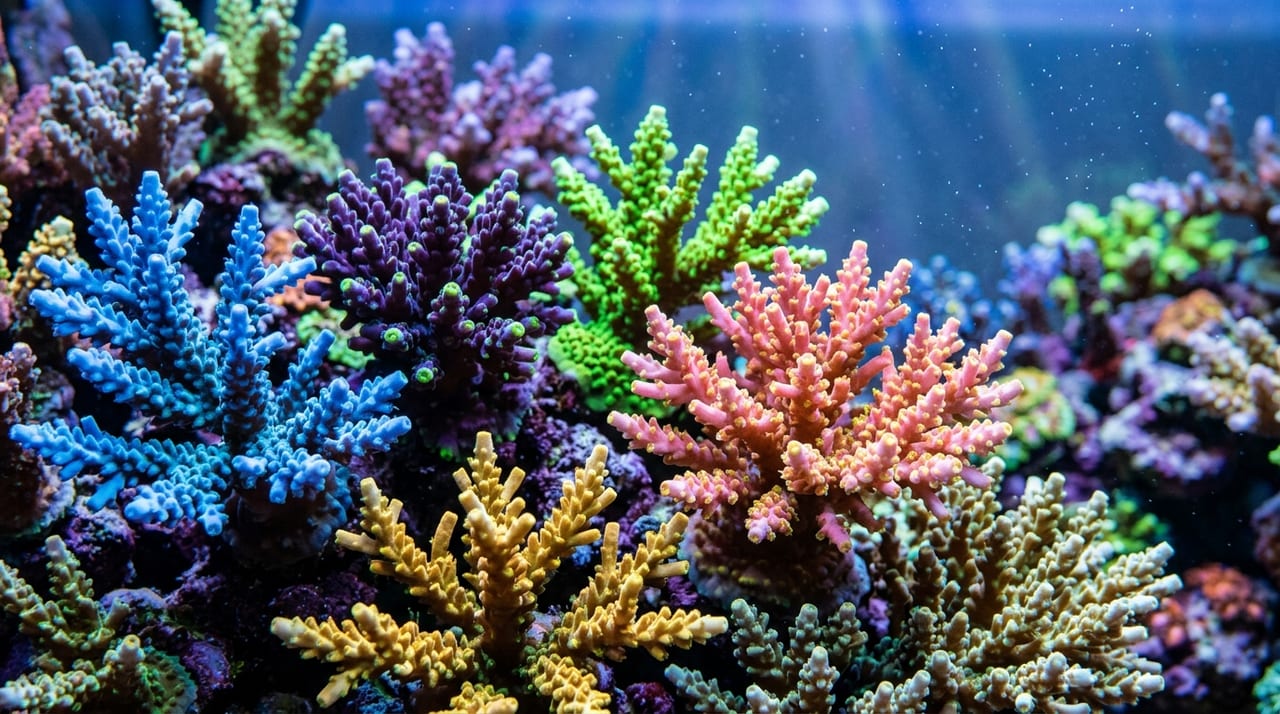
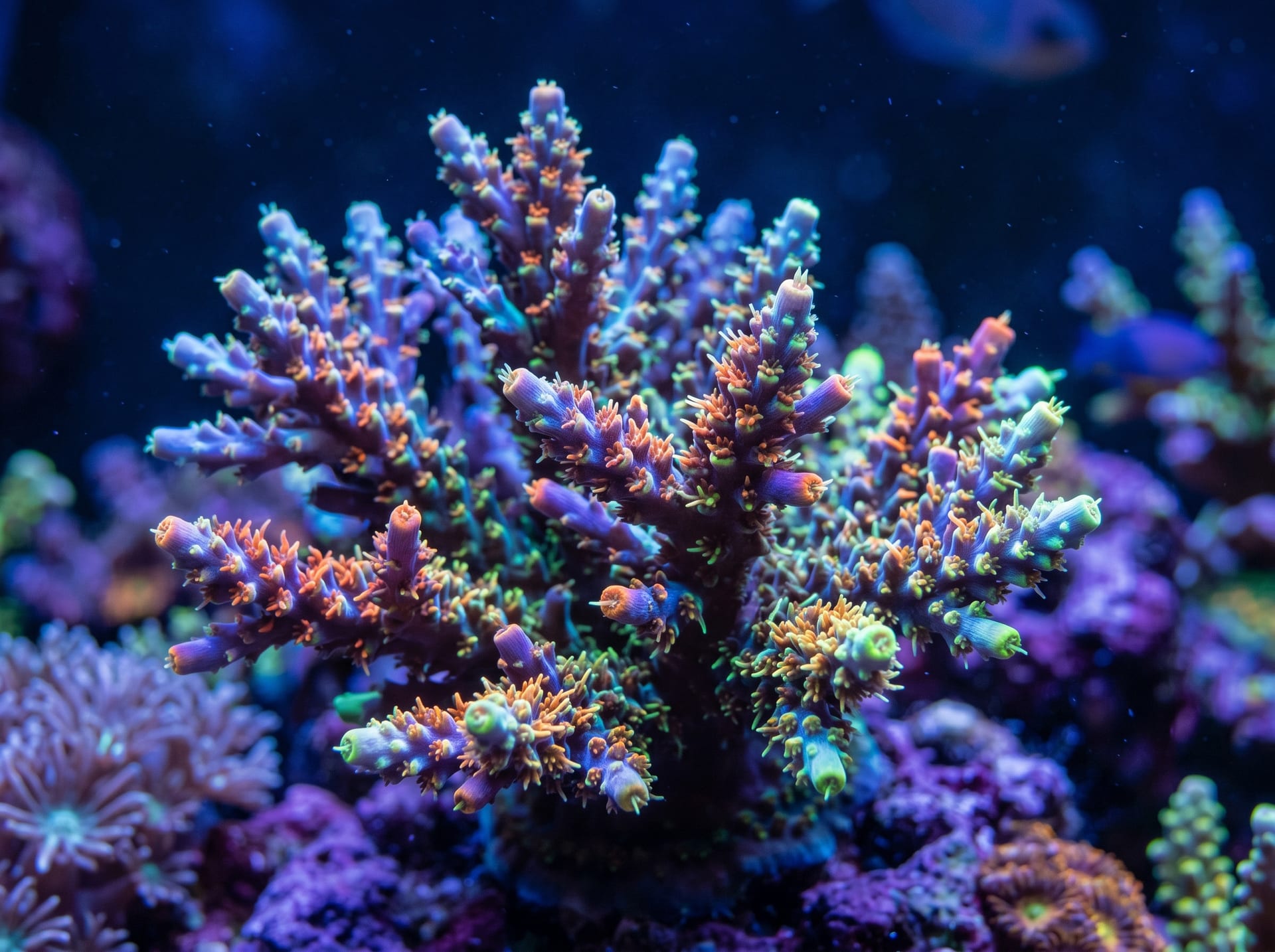
SPS (Small Polyp Stony coral) corals, represented by Acropora, are at the pinnacle of reef aquariums. With vibrant colors ranging from blue, green, purple, pink, and yellow, and forming colonies that branch and extend throughout the tank, they evoke an image of an "underwater forest."
However, maintaining and enhancing the beautiful coloration of Acropora requires precise control of lighting, water flow, water quality, and nutrient balance. This article explains practical techniques for boosting Acropora coloration and stable husbandry.
Factors Determining Acropora Coloration
Acropora color is primarily determined by the concentration of fluorescent proteins (chromoproteins and GFP-type) and symbiotic algae (zooxanthellae/Symbiodinium).
Light and Coloration
| Light Intensity | Zooxanthellae Status | Effect on Coloration |
|---|---|---|
| Strong light (PAR 300–600) | Density decreases | Fluorescent colors (blue, green, pink) stand out |
| Medium light (PAR 150–300) | Moderate | Balanced, natural coloration |
| Weak light (PAR < 100) | Overcrowded (brown) | Dull, brownish coloration |
Key Point: Bringing out beautiful Acropora coloration requires "moderate stress." By increasing light intensity, zooxanthellae density decreases, allowing the coral's own chromoproteins to dominate, resulting in vivid colors. However, if light is too strong, bleaching occurs.
Recommended Lighting Specifications
LED Systems: High-output 3-channel LEDs such as Radion G6, AI Hydra 64HD, or Mitras Lightbar (adjusting the ratio of blue : white : UV is critical)
Light Spectrum:
- 420–450nm (UV to violet): Essential for exciting fluorescent proteins
- 470–490nm (blue): Primary wavelength for photosynthesis
- White (6500K): Creates contrast and depth
Duration: 9–12 hours daily (acclimate gradually using a ramp-up schedule)
Water Flow Management
In nature, Acropora thrive in strong water flow. Proper water flow is essential for polyp extension, feeding, and waste removal.
Recommended Flow Rate: 20–50× tank volume per hour
Flow Pattern: Rather than a single, strong unidirectional current, random or pulsating flow is ideal (using devices such as RW (Rossmont Mover), MP (EcoTech Marine Vortech), Tunze Nanostreams, etc.).
| Flow Problem | Symptoms |
|---|---|
| Insufficient flow | Polyps don't extend, waste accumulation, increased RTN (rapid tissue necrosis) risk |
| Excessive flow (direct blast) | Polyp retraction, tissue damage |
| Fixed flow direction | Downwind tissue damage |
Water Parameter Management
The most critical aspect of Acropora husbandry is maintaining stable three bone-building elements (Ca, Alk, Mg).
Skeleton-Building Parameters
| Parameter | Recommended Range | Measurement Frequency |
|---|---|---|
| Calcium (Ca) | 420–450 mg/L | Once to twice weekly |
| Alkalinity (Alk) | 8–10 dKH | Twice to thrice weekly |
| Magnesium (Mg) | 1300–1400 mg/L | Once weekly |
Alkalinity (Alk) is Most Critical: Rapid Alk fluctuations (±1 dKH/day or more) trigger "Alk crash," causing bleaching and tissue death in Acropora. Automated dosing (kalkwasser, two-part method, or calcium carbonate reactors) is ideal for maintaining stability.
Trace Elements
| Trace Element | Role | Signs of Deficiency |
|---|---|---|
| Iodine (I₂) | Fluorescent protein synthesis | Dull coloration |
| Strontium (Sr) | Skeleton formation support | Slowed growth |
| Potassium (K) | Polyp extension | Reduced polyp extension |
Trace elements should be supplemented using dedicated additives (Fauna Marin, Red Sea Coral Colors, etc.). However, supplementing without testing is dangerous.
Organic Matter and Nutrient Management
Acropora prefer a lower-nutrient environment compared to LPS or soft corals.
| Parameter | Recommended Range (for Acropora) |
|---|---|
| Nitrate (NO₃) | 0–5 mg/L |
| Phosphate (PO₄) | 0.00–0.03 mg/L |
High-nutrient environments cause zooxanthellae overgrowth, dulling coloration and slowing growth. Control organic matter using protein skimmers, granular activated carbon (GAC), carbon dosing (biopellets or vodka), etc.
Frag (Fragment) Creation and Propagation
The basic method for propagating Acropora is fragging (artificial fragmentation).
Frag Creation Steps
Required Materials: Coral pruners (or diamond saw), frag plugs, coral-safe adhesive (cyanoacrylate gel), gloves
Procedure
- Cut a 5–7 cm branch from the parent colony at a diagonal angle with a clean cutter
- Secure firmly to a frag plug with adhesive
- Place in a frag tank or an area with gentle water flow
- For 3–5 days, avoid direct intense light (acclimation period)
- New skeleton formation begins within 1–2 weeks
Frag Growth Rate: With good water quality and light, growth averages 1–2 cm per month.
Advanced Color Enhancement Techniques
High Light + Low Nutrients: Intentionally "starve" zooxanthellae to bring out chromoproteins (Ulns method)
Amino Acid Supplementation: Amino acid additives such as Fauna Marin Ultra Min S or Red Sea AB+ are reportedly effective for both color enhancement and growth promotion (empirically based)
Temperature Stability: Maintain 25–26°C within ±0.3°C. Sudden temperature changes can trigger polyp retraction and bleaching.
Troubleshooting Color Loss and Bleaching
| Symptom | Possible Cause | Solution |
|---|---|---|
| Tip bleaching (RTN/STN) | Insufficient flow, rapid water quality change, parasites | Immediately isolate frag, check water parameters |
| Overall browning | Insufficient light, high nutrients | Increase lighting, enhance skimming |
| Polyps not extending | Stress, predators | Check water flow and livestock |
| Growth halt | Low Alk/Ca | Test and supplement |
Although Acropora is called the "pinnacle of reef aquarium keeping," with proper parameter management and regular observation, you can cultivate beautiful colonies for years. Start with hardy species (A. nasuta, A. millepora, etc.) and gradually progress to more challenging species as your experience grows.