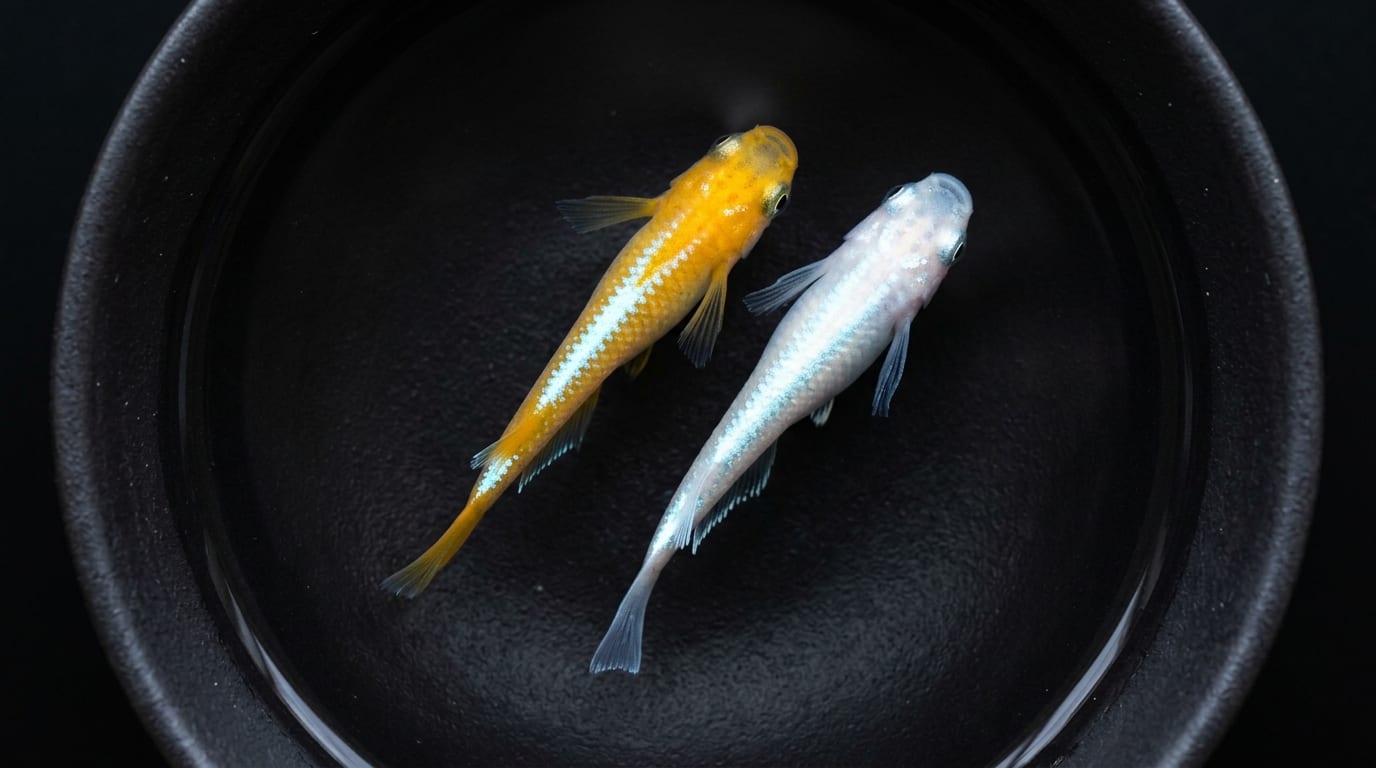
Akari Medaka
Akari is an improved medaka variety that combines yellow and white body coloring with a shimmering outer glow inherited from the Mikuni lineage. It was the first strain in the Mikuni line to develop yellow chromatophores, which is why it is sometimes called Ki-Mikuni. Because its fixation rate is relatively low, fry from the same spawn can vary quite a bit in how strongly the glow and color come through, so each fish tends to have its own distinct look. Adults stay compact, reaching a standard body length of about 4 cm at most, and their calm temperament makes them easy to keep alongside other medaka. Since keeping them well calls for a working knowledge of water quality and temperature management, Akari suits keepers who already have some medaka-keeping experience.
View Akari Medaka encyclopedia →0% commission on your first sales!Register by September 30, 2026 and your first 2 sales are commission-free!
Breeder Wanted!
List on BreederDirect and sell directly to customers nationwide!
9 Transparency Commitments from Br-Choku
Each Medaka listing includes the following from Breeder. Full transparency on color variations (Yokihi/Miyuki/Lame) and lineage guaranteed.
- Variety Name
- Lineage
- Actual Photos
- Color Classification
- Body Type
- Scale Type
- Size
- Origin
- Age/Generation
Browse all 116 breeds
Color
Scale Type
Verified breeders wanted for Medaka
Breeders are signing up now ahead of launch. Subscribe to be notified when new listings go live.
Getting alerts is free with a member account. When new listings match your saved search, we'll notify you by email and in-app.
Browse other categories
Verified breeders (preview)

Akari Medaka key facts
- Care level
- Intermediate
- Lifespan
- 2-3 years
- Size
- Up to about 4cm SL
- Temperature
- 18〜28℃
- Diet
- Prepared medaka food, green water
- Lighting
- External luminescence appears on the back, so the variety is best viewed from above, and a dark container sharpens the contrast between the yellow and the sheen. The Medaka Web Encyclopedia recommends outdoor keeping and notes that summer sun raises water temperature sharply, suggesting shade such as a reed screen over half the container.
- Diet & Nutrition
- Commercial prepared medaka food is the staple, given in an amount finished within a few minutes. Leftovers decay and foul the water, so adjust the quantity. Green water rich in phytoplankton suits fry rearing.
- Water Temperature & Quality
- Slightly acidic to slightly alkaline water is considered ideal, and the water drifts toward acidic as keeping continues. Around one water change per week is the guideline, and because sudden shifts in temperature or pH cause stress, acclimatise new fish by floating the bag. FishBase records the wild water chemistry of this species as pH 7.0-8.0 and hardness 9-19 dH.
- Tank Mates & Compatibility
- A peaceful schooling fish, normally kept as a group of the same variety. One litre of water per fish is the guideline against overcrowding; overstocking causes poor growth, reduced breeding, oxygen shortage and water fouling.
- Breeding
- The fixation rate is low and many expressions appear, so keep selecting parents close to the standard. Outdoors the spawning season runs from about April to October, once water reaches 18C or above with 12-13 hours of daylight. For year-round indoor breeding, 25-28C water and over 13 hours of lighting are the guideline. Eggs hatch at a cumulative 250 degree-days, about 10 days at 25C.
- Health & Notes
- The fixation rate is low and a single spawning yields black, grey, tricolour and non-luminescent fish, so holding a target expression takes repeated selection. The standard set out by the breeder is a yellow-bodied fish carrying external luminescence; fish showing black or black-rim traits fall outside it. Outdoors the fish become inactive and overwinter near the bottom as water cools, resuming activity in spring once daytime water exceeds 10C. A 0.3-0.5% salt bath is used for ailing fish, with water raised to no more than about 28C.
About Akari Medaka
Akari is an improved medaka with yellow-and-white coloring and a shimmering Mikuni-derived outer glow. Each fish shows its own mix of color and glow intensity, and adults stay compact at up to about 4 cm, a variety best suited to intermediate keepers.
7 things to know before welcoming a Akari Medaka
1Individual Variation
Akari has a relatively low fixation rate, so fry from the same spawn can differ noticeably in how much outer glow or yellow coloring they show. Go into it expecting to appreciate each fish's own unique look rather than a uniform standard.
2Outer Glow from Mikuni
The glowing stripe along the back comes from the fish's Mikuni lineage. The length and intensity of this glow varies between individuals and can even change somewhat as the fish matures.
3Best for Intermediate Keepers
Akari suits keepers who are already comfortable with basic water quality and temperature management. Getting the basics right, such as proper acclimation and a regular water-change routine, helps them settle in well.
4Compact Adult Size
Adults reach a standard body length of about 4 cm at most, so you don't need a large tank to get started. Just make sure the enclosure size matches the number of fish to avoid overcrowding.
5Calm Temperament
Akari rarely shows aggression toward other medaka, making it easy to keep in mixed groups. Several fish can comfortably share the same container, and watching them swim together is part of the appeal.
6Managing Temperature & Light
Outdoor setups need attention to seasonal water temperature swings, while indoor tanks require enough light exposure. Both the outer glow and body color are influenced by adequate daylight or lighting duration.
7Preparing Before Arrival
Set up the tank or outdoor container, filtration, and food supply before your fish arrive so the transition goes smoothly. Acclimate them carefully to the new water once they arrive to minimize stress.
Frequently asked questions about Akari Medaka
- Q.How difficult is it to keep Akari medaka?
- A.Akari is considered suitable for intermediate keepers. A basic understanding of water quality and temperature management helps you get started with confidence, so some prior medaka-keeping experience is useful.
- Q.How big does Akari medaka grow?
- A.Adults reach a standard body length of up to about 4 cm. Since they stay fairly compact, it's easy to plan a setup even with limited space.
- Q.Why do some individuals lack the outer glow?
- A.Akari has a relatively low fixation rate, so fry from the same parents can vary in whether or how strongly the outer glow appears. This is a normal characteristic of the variety, not a sign of a problem.
- Q.Can Akari be kept with other medaka?
- A.Yes, Akari has a calm temperament that makes it easy to keep alongside other medaka. Just watch your water quality and stocking density to avoid overcrowding.
- Q.Is Akari the same as Ki-Mikuni?
- A.Yes, Akari was the first strain in the Mikuni line to develop yellow chromatophores, which is why it is also known as Ki-Mikuni. The two names refer to the same variety.
Useful tools for Akari Medaka care
Learn more about Akari Medaka in the encyclopedia
View Akari Medaka encyclopedia entry →
Care difficulty, lifespan, size and diet — all basics covered.
More in this category
Can't find the one you're looking for?
Post your wishes for free and breeders with matching animals will contact you with introductions.