Source: Wikimedia Commons
Japanese pygmy angelfish
IntermediateCentropyge interrupta
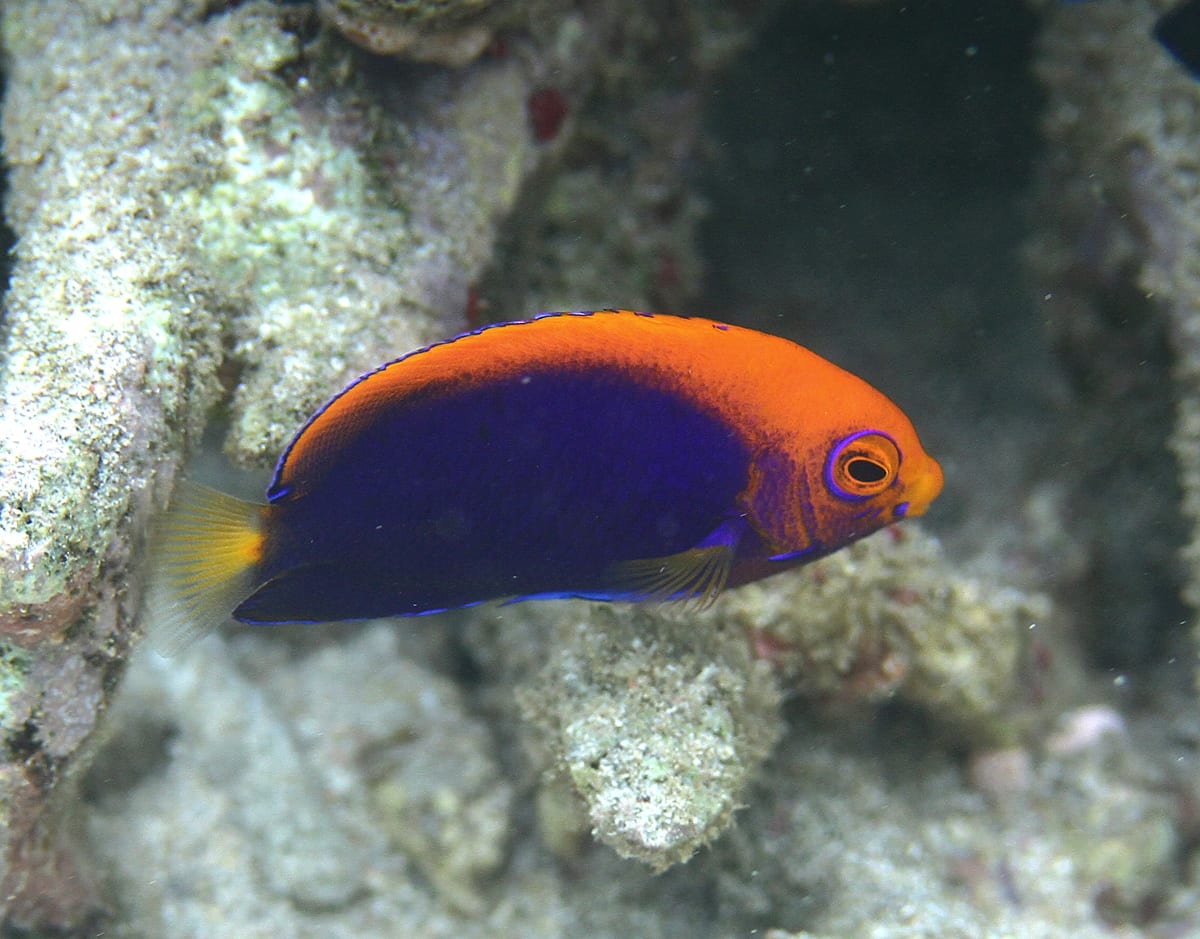
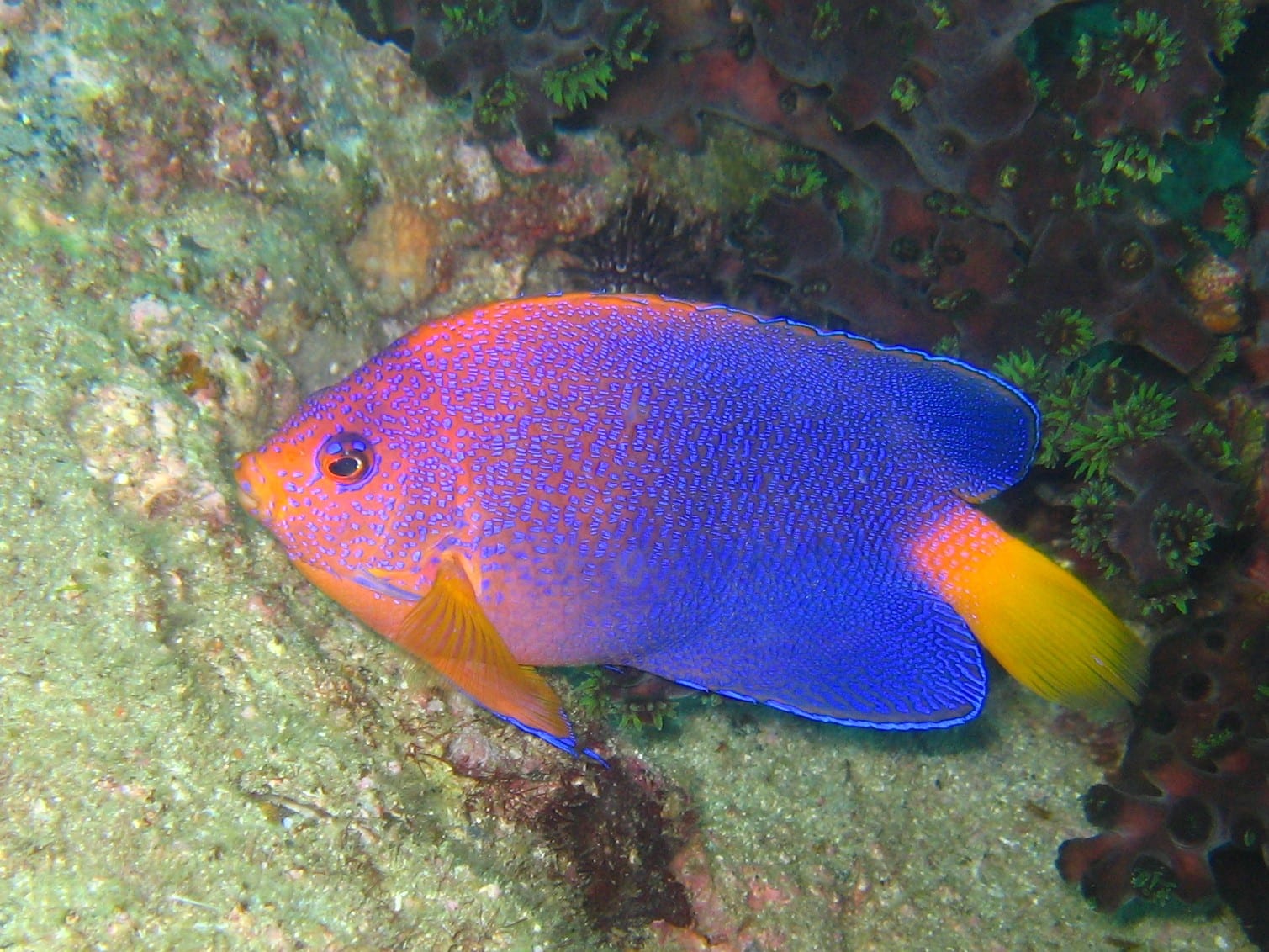
A dwarf angelfish with an orange body scattered with blue-purple spots and a bright yellow tail. A temperate species from rocky reefs around Japan, it grows unusually large for its genus, to about 15 cm.
Difficulty
Intermediate
Temperature
19〜24℃
Size
Up to 15 cm TL
Diet
Omnivore (algae, small invertebrates, sponges)
About
The Japanese pygmy angelfish (Centropyge interrupta) ranges along the Pacific coast of southern and central Japan and in the northwestern Hawaiian Islands (Midway and Kure) (FishBase), and is common around the Izu and Ogasawara islands. FishBase classes it as temperate: it lives in pairs on algae-covered rocky and coral reefs at 12-60 m. At up to 15 cm TL it is large for a Centropyge. The body is orange with blue-purple spots that become larger and more purple towards the tail, and the tail is bright yellow. The older spelling Centropyge interruptus is still widely used. Captive-bred fish are increasingly available, and it is worth asking what temperature a fish has been kept at before buying. It grazes rock surfaces, so an established tank with plenty of live rock suits it. It is scarce in the Japanese trade, and domestically bred fish are also sold.
Source: Wikipedia (CC BY-SA 4.0)
Size of the Japanese pygmy angelfish
The Japanese pygmy angelfish grows to Up to 15 cm TL.
Temperature & humidity for the Japanese pygmy angelfish
The ideal temperature for the Japanese pygmy angelfish is 19〜24℃.
Wild-caught fish do best cooler than a typical tropical tank; Saltcorner suggests 19-24°C.
Basic Info
Origin
Pacific coast of southern and central Japan, the Izu and Ogasawara islands, and the northwestern Hawaiian Islands
Size
Up to 15 cm TL
Temperature
Care Specifications
- Water Temp.
- 19–24℃
- Specific Gravity
- 1.02
- Min. Tank
- 190 L
Semi-aggressiveWith caution
Sources: FishBase (Centropyge interrupta) / Saltcorner Fish Library (Bob Goemans)
References & Sources
Edited & verified by: BreederDirect editorial team
The taxonomic, regulatory, and husbandry data on this page are compiled and verified against the authoritative primary sources below.
Taxonomy & Authority
Regulations & Conservation Status
Not CITES-listedIUCN LC · Least Concern
Not listed in the CITES Appendices (checked on Species+). Not designated as an Invasive Alien Species under Japanese law. It also occurs along the coasts of Japan (southern Japan, the Ryukyu Islands, etc.); collecting in Japan is subject to each prefecture's fisheries adjustment regulations. Never release aquarium animals into the sea.
Sources: Species+ (CITES) / Ministry of the Environment: List of Designated Invasive Alien Species / FishBase
Regulations may change. Always verify the latest information with the relevant authorities.
Japanese pygmy angelfish Listings
Loading latest listingsFind listings for this species