Source: Wikimedia Commons
Blueband goby
IntermediateValenciennea strigata
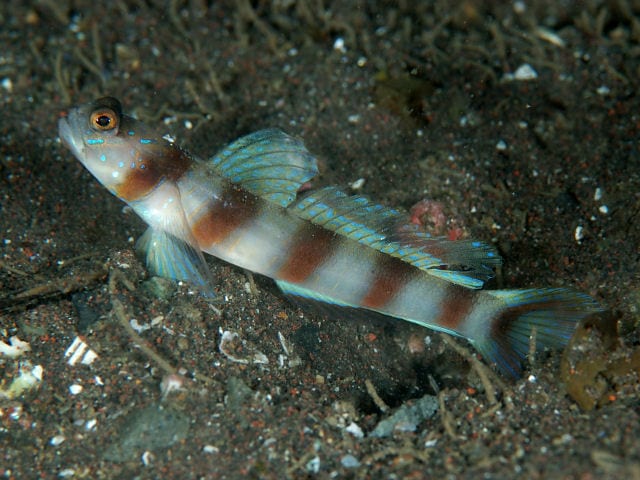
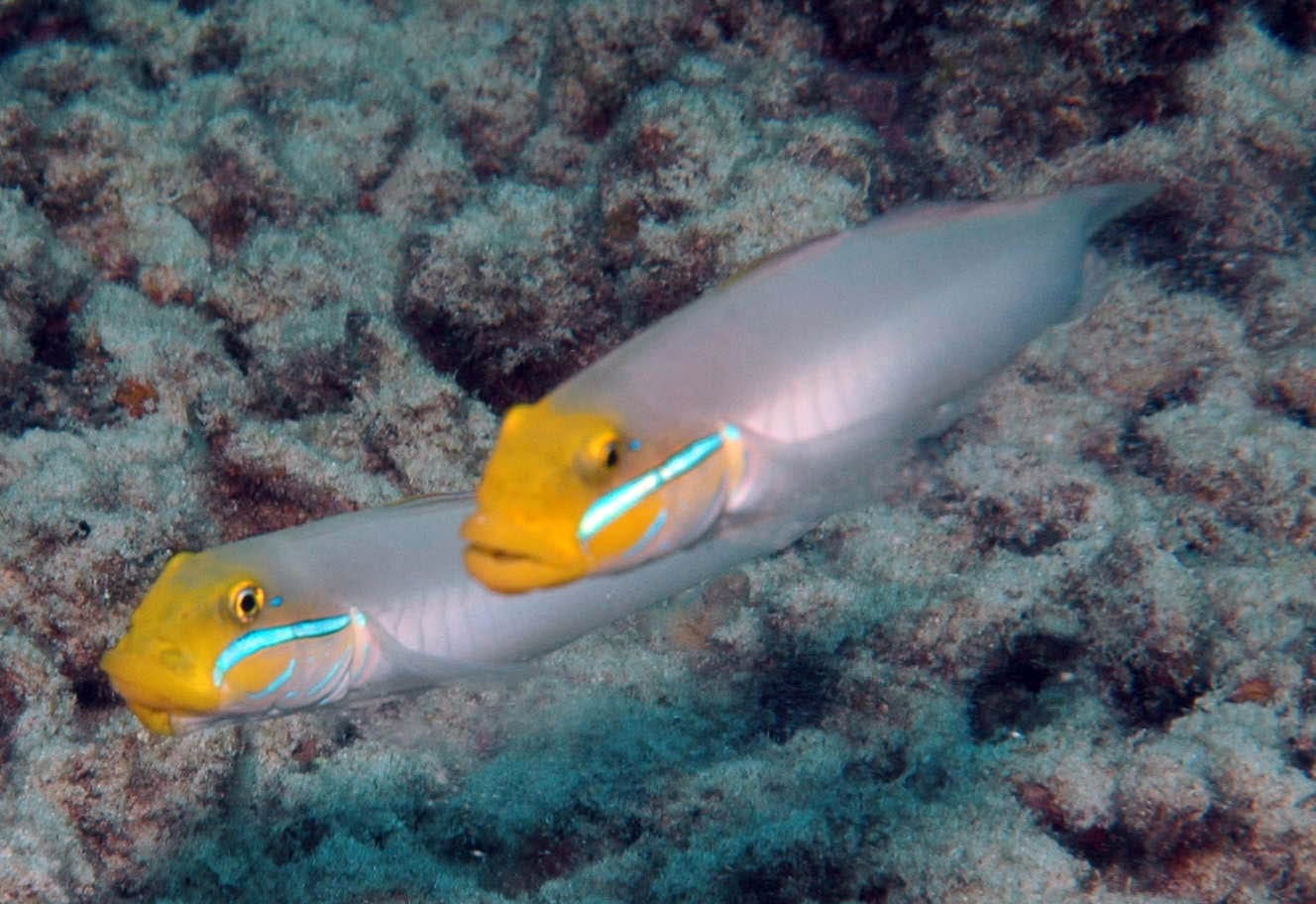
A pale grey goby with a yellow head and a curved blue line from below the eye to the gill cover. It sifts mouthfuls of sand through its gills to pick out small animals.
Difficulty
Intermediate
Temperature
22〜27℃
Lifespan
Little data available
Size
Up to 18 cm TL (FishBase)
Diet
Carnivore (small animals sifted from sand)
About
The blueband or golden-head sleeper goby (Valenciennea strigata) ranges across the Indo-Pacific from East Africa to the Tuamotus, north to the Ryukyu Islands and south to Sydney and Lord Howe Island (FishBase), reaching 18 cm TL. It is pale grey with a yellow head and a curved blue line from below the eye to the gill cover, and in fish over about 4.5 cm the dorsal spines extend into filaments. It lives over sand and rubble in clear outer lagoons and seaward reefs, usually in pairs hovering near their burrow. It takes mouthfuls of sand and expels them through the gills, sifting out small benthic animals and fish eggs - which makes it popular for stirring the aquarium sand bed. It is a different species from its relative V. puellaris. Provide a wide bed of fine sand (1-2 mm) and rocks it can burrow under (Saltcorner). The sand alone rarely supplies enough food, and Saltcorner recommends feeding four times a day; some fish waste away despite good feeding, so choose a healthy specimen. It jumps, so a lid is needed. It does not harm corals.
Source: Wikipedia (CC BY-SA 4.0)
Size of the Blueband goby
The Blueband goby grows to Up to 18 cm TL (FishBase).
Temperature & humidity for the Blueband goby
The ideal temperature for the Blueband goby is 22〜27℃.
Basic Info
Origin
Indo-Pacific (East Africa to the Tuamotus, north to the Ryukyu Islands, south to Sydney)
Lifespan
Little data available
Size
Care Specifications
- Water Temp.
- 22–27℃
- Specific Gravity
- 1.02–1.026
- Min. Tank
- 110 L
PeacefulReef safe
Sources: FishBase (Valenciennea strigata) / Saltcorner Fish Library (Bob Goemans)
References & Sources
Edited & verified by: BreederDirect editorial team
The taxonomic, regulatory, and husbandry data on this page are compiled and verified against the authoritative primary sources below.
Taxonomy & Authority
Accepted name: Valenciennea strigata (Broussonet, 1782)
Synonyms: Eleotriodes strigatus (Broussonet, 1782), Gobiomorus taiboa Lacepède, 1800, Gobius strigatus Broussonet, 1782, Valencienea strigata (Broussonet, 1782), Valencienna strigata (Broussonet, 1782), Valenciennea strigata arcusbranchiae Fowler, 1946, Valenciennea strigatus (Broussonet, 1782)
Authority databases: WoRMS · GBIF · GBIF · WoRMS · FishBase
Nomenclature follows global taxonomic authority databases.
Regulations & Conservation Status
Not CITES-listedIUCN LC · Least Concern
Not listed in the CITES Appendices (checked on Species+). Not designated as an Invasive Alien Species under Japanese law. It also occurs along the coasts of Japan (southern Japan, the Ryukyu Islands, etc.); collecting in Japan is subject to each prefecture's fisheries adjustment regulations. Never release aquarium animals into the sea.
Sources: Species+ (CITES) / Ministry of the Environment: List of Designated Invasive Alien Species / FishBase
Regulations may change. Always verify the latest information with the relevant authorities.
Blueband goby Listings
Loading latest listingsFind listings for this species